“Recycle Cans, Transform the World with RSI 3104: From Beverage Cans to Aluminum Ingots – The Endless Power of Recycling, Core of the Aluminum Loop and Global Circular Economy” SO OK TRADING: 23 SEP 2026
Aluminum: RSI Ingot 3104 Production from UBC and the Global Circular Economy Outlook
SO OK TRADING : September 23, 2026
The beverage can industry is one of the clearest examples of the Circular Economy, utilizing the Aluminum Loop system. Used Beverage Cans (UBC) are returned to the remelting process to produce RSI Ingot 3104, which can then be rolled into sheets and continuously manufactured into new cans without end. This process not only reduces the consumption of natural resources but also lowers carbon emissions and creates added value across the industrial supply chain.
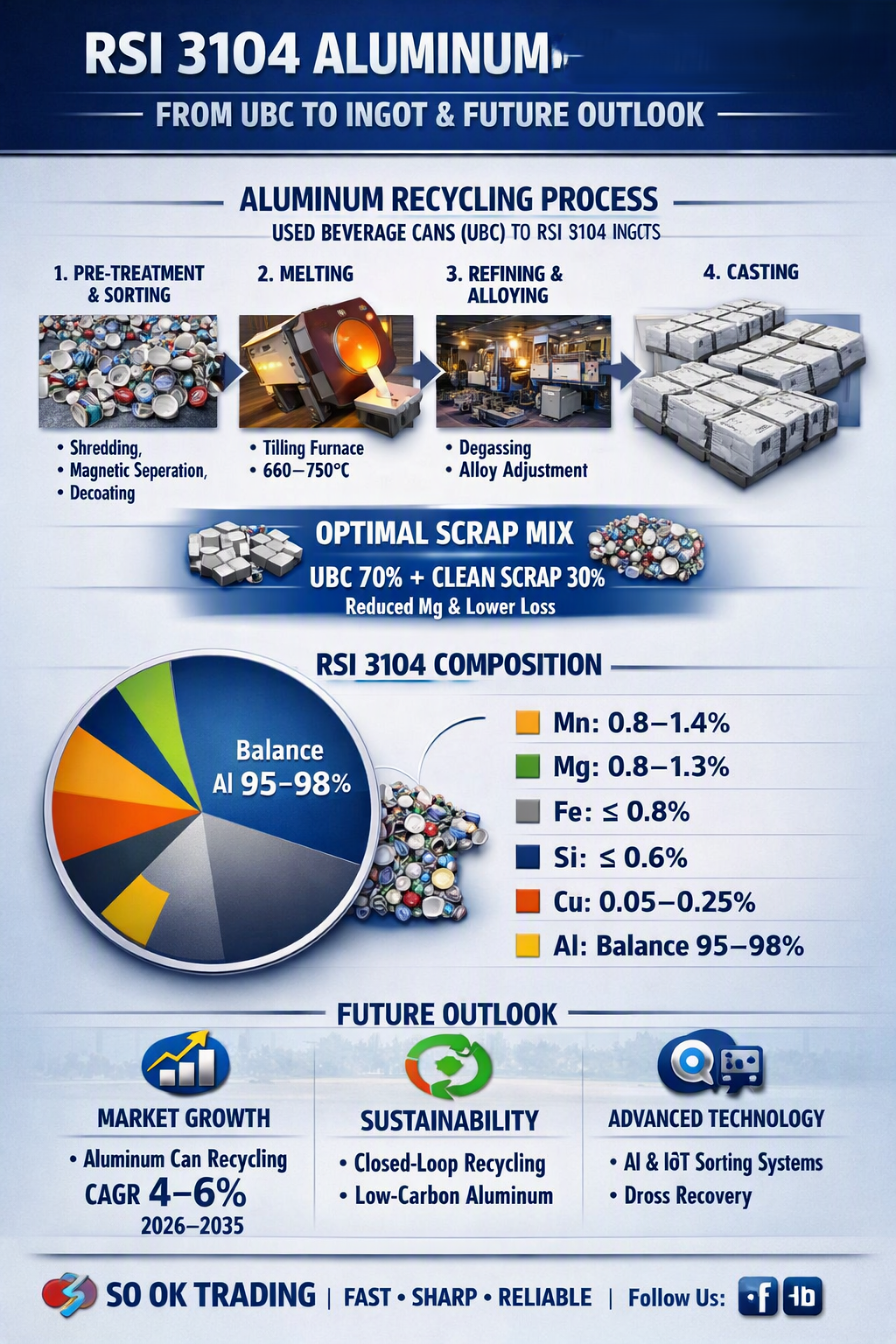
RSI 3104 Production Process
Pre-treatment & Sorting
Shredding: Breaking down UBC bales into small pieces
Magnetic Separation: Removing steel and contaminants with magnets
Delacquering/Decoating: Removing paint and coatings in a furnace at ~500–550°C to minimize dross formation
Melting: Using a tilting furnace with vortex or electromagnetic systems, maintaining 660–750°C for fast melting and reduced oxidation
Refining & Alloying
Composition Adjustment: Measured by spectrometer, adjusted to spec (Al ~97%, Mn ~1%, Mg ~1%)
Degassing & Fluxing: Inert gas (Ar/N₂ + low Cl) to remove hydrogen and capture impurities
Filtering: Ceramic foam filter before casting
Casting
Pour molten metal into sow molds (500+ kg) or ingot molds (20–25 kg)
Allow solidification, inspect quality, and bundle into pallets for rolling mills
Chemical Standards of Al 3104
Mn: 0.80–1.40% → Improves strength and corrosion resistance
Mg: 0.80–1.30% → Works with Mn to enhance strength
Fe ≤ 0.80%, Si ≤ 0.60% → Must be controlled to avoid excess
Cu 0.05–0.25% → Slightly increases strength
Al balance: ~95–98%
⚠️ Note: Can ends made from 5182 alloy contain high Mg (~4–5%). Without adjustment, this exceeds 3104 specs, requiring demagging or dilution with pure/clean aluminum scrap.
Loss & Dross Management
UBC: High melting loss (15–20%)
Clean scrap: Low melting loss (1–3%)
Recommended Mix: UBC 70% + Clean Scrap 30%
Keeps Mg within spec without demagging
Reduces average melting loss (UBC ~16%, Clean Scrap ~2%)
Dilutes Fe and Si impurities
Improves casting stability and yield
Outlook: Aluminum Loop & RSI 3104
Closed-loop recycling will become the global standard in packaging, as aluminum can be recycled infinitely without loss of properties
RSI 3104 will see greater use in can body stock and industries requiring lightweight, strong, and sustainable materials
Market Growth (CAGR): Aluminum can recycling expected to grow at ~4–6% annually between 2026–2035
Key Drivers
Rising demand for canned beverages
Global ESG and Net Zero policies
Investment in recycling technologies and dross recovery
Future Directions
AI & IoT for molten metal quality monitoring and UBC sorting
Development of low-carbon aluminum using renewable energy in smelting
Expansion in Southeast Asia, with Thailand playing a key role as a production and export hub
Conclusion
Producing RSI Ingot 3104 from UBC is not just recycling — it is the heart of the Aluminum Loop, linking the packaging industry to Circular Economy and Net Zero goals. With optimized mix ratios and strict quality control, RSI 3104 will remain a strategic material driving global aluminum market growth and opening new business opportunities in the coming decade.
SO OK TRADING : Your Business Partner SO OK TRADING : FAST SHARP RELIABLE
VISIT US : WWW.SOOKTRADING.COM FACEBOOK : SO OK TRADING
SO OK TRADING — The true expert in aluminum packaging and non-ferrous metals from Thailand