EV + Solar Cell + Non-Ferrous Metals Clean Energy Transforming the Global Green Economy — Outlook 2026 SO OK TRADING | 22 SEP 2026
EV + Solar Cell + Non-Ferrous Metals
Clean Energy and Global Green Economy : Outlook : SO OK TRADING : September 22, 2026
Introduction
The world is moving into the era of the Green Macroeconomy, where clean energy is no longer just an option but the core driver of a new economy and society. The electric vehicle (EV) and solar cell industries have become central pillars, tightly interconnected, and are driving massive demand for non-ferrous metals in the global market. With China dominating the supply chain, this has led to geopolitical competition and the largest energy transition in history.
Content
1. Global Overview
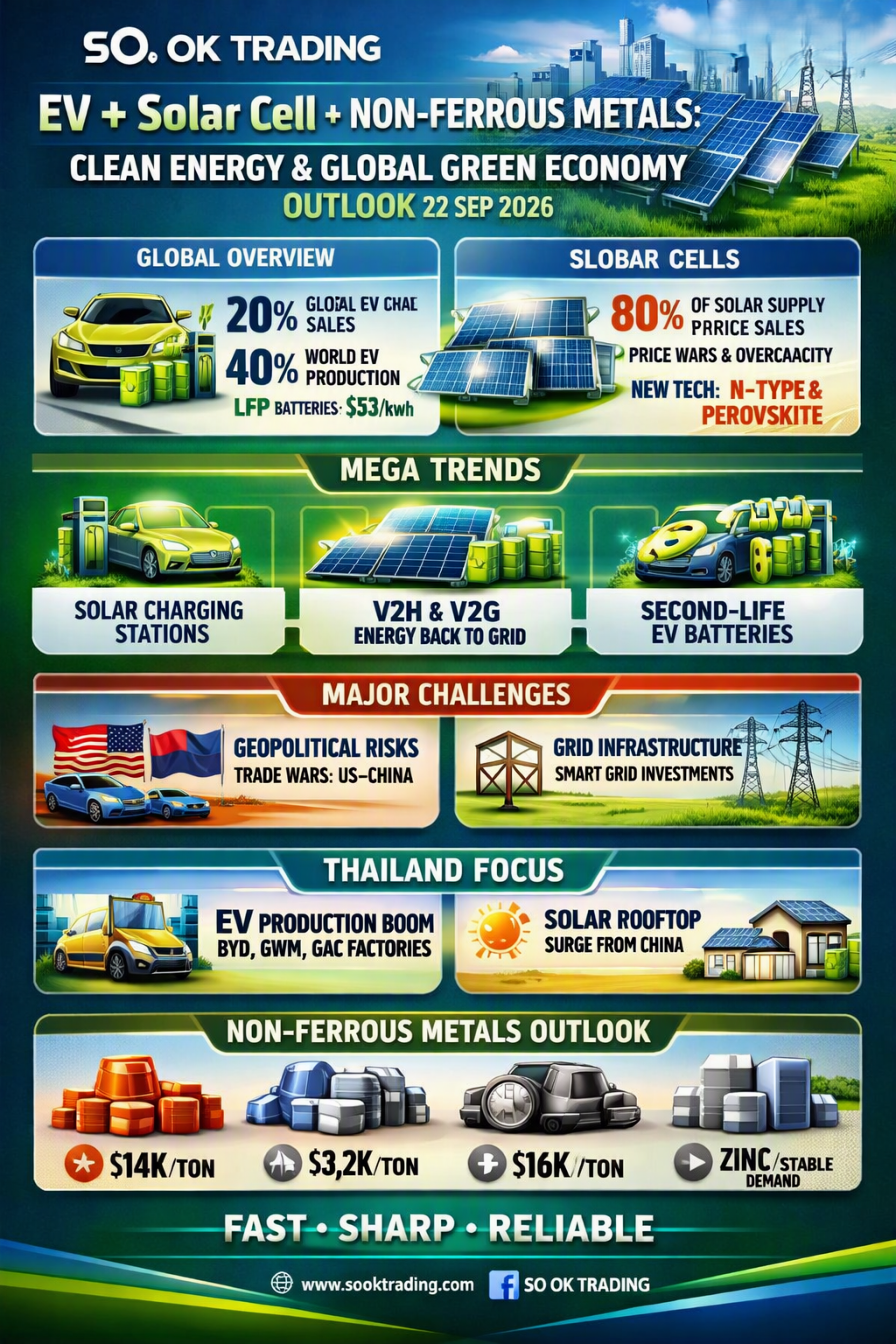
EV: China and Europe dominate the market. EV sales account for nearly 20% of total global car sales, with China producing about 40% of the world’s EVs. LFP battery costs have dropped to just $53/kWh, making EVs much more affordable. The U.S. and Europe have increased tariffs on Chinese EV imports to protect domestic industries.
Solar Cell: China produces 80–90% of the world’s solar panels. Prices have fallen, making them widely accessible, but overcapacity has triggered fierce price competition. The U.S. has imposed AD/CVD tariffs to restrict Chinese products. New technologies such as N-Type, TopCon, and Perovskite are emerging.
2. Mega-Trend “Solar + Storage + EV”
Solar-powered Mobility: EV charging stations worldwide are shifting to solar charging stations.
V2H & V2G: EVs serve as mobile batteries for homes and can sell electricity back to the grid.
Second-life EV Batteries: Degraded EV batteries are recycled for solar storage systems, reducing costs and electronic waste.
3. Macroeconomic Challenges
Geopolitical Risks: U.S.–China and Europe–China trade wars increase costs.
Grid Infrastructure: Rising electricity demand from EVs and renewables strains global grids, pushing countries to invest in smart grids.
4. Situation in Thailand
EV Thailand: The market is shifting from imports to serious local production under the EV 3.5 policy, which requires automakers to manufacture locally by 2026–2027. Chinese brands such as BYD, Changan, Geely, and GAC are establishing factories. The challenge lies in ICE component industries needing rapid adaptation, and charging stations remain insufficient.
Solar Thailand: Solar panel imports have surged 88.7%, with over 99% coming from China. Residential rooftop solar is booming, with payback periods shortened to 4–5 years. Industrial adoption is driven by cost reduction and green branding, but export markets face pressure from AD/CVD tariffs.
5. EV + Solar Connection
EV and battery factories consume large amounts of electricity, prompting installation of solar rooftops to cut costs and reduce Scope 2 emissions.
Solar-to-EV Home Trend: Households install solar systems with BESS and EV chargers to power cars with clean energy.
Charging stations are increasingly powered by green electricity, aligning with liberalized electricity market policies.
6. Relationship with Non-Ferrous Metals Market (LME)
Copper: EVs use 3–4 times more copper than ICE cars. Prices have surged past $14,000/ton.
Aluminium: Used in EV structures and solar mounting, prices remain above $3,200/ton.
Nickel: Key for NMC batteries, but oversupply has driven prices down to $16,000/ton.
Zinc: Used for anti-corrosion coatings in solar farm structures.
Three Mega-Trends in LME
Expansion of contracts for battery metals such as lithium hydroxide and cobalt.
Supply Chain Split: Western countries erect tariff barriers against Chinese products.
Urban Mining: Recycling EV batteries and solar panels to reduce new mining.
Outlook 2026–2027
EV Industry Outlook: Global EV sales expected to reach 23 million units, or 30% of total car sales. Competition shifts from “Range” to “Affordability” with cheaper LFP batteries. Chinese automakers accelerate factory setups in target regions to avoid tariffs.
Solar Cell Outlook: New technologies such as N-Type, TopCon, and Perovskite will replace older ones. Overcapacity persists, but recycling and high-efficiency solar development will help balance the market.
Metals Outlook (LME):
Copper: Prices remain high above $14,000/ton due to EV and grid demand.
Aluminium: Prices stay above $3,200/ton from EV and solar mounting demand.
Nickel: Prices fall to $16,000/ton due to oversupply and LFP battery adoption.
Zinc: Steady demand from solar farm infrastructure investment.
Conclusion
The EV + Solar Cell + Metals industries have merged into a new economic structure under the mega-trends of Energy Transition and the AI Boom. Despite volatility from geopolitics and oversupply, this path represents the future of the global green economy, permanently transforming human lifestyles, transportation, and energy consumption.
SO OK TRADING
Your Business Partner
FAST SHARP RELIABLE
Visit: WWW.SOOKTRADING.COM
Facebook: SO OK TRADING
The true leader in Thailand’s non-ferrous metals business