“Global Oil Breaks $100: Price Surge from Crisis to Opportunity — A Geopolitical Turning Point and the Energy Transition” SO OK TRADING | 16 September 2026
Global Oil Surges Past $100: Geopolitical Crisis and the Energy Transition to a New Era
SO OK TRADING | 16 September 2026
✨ Introduction
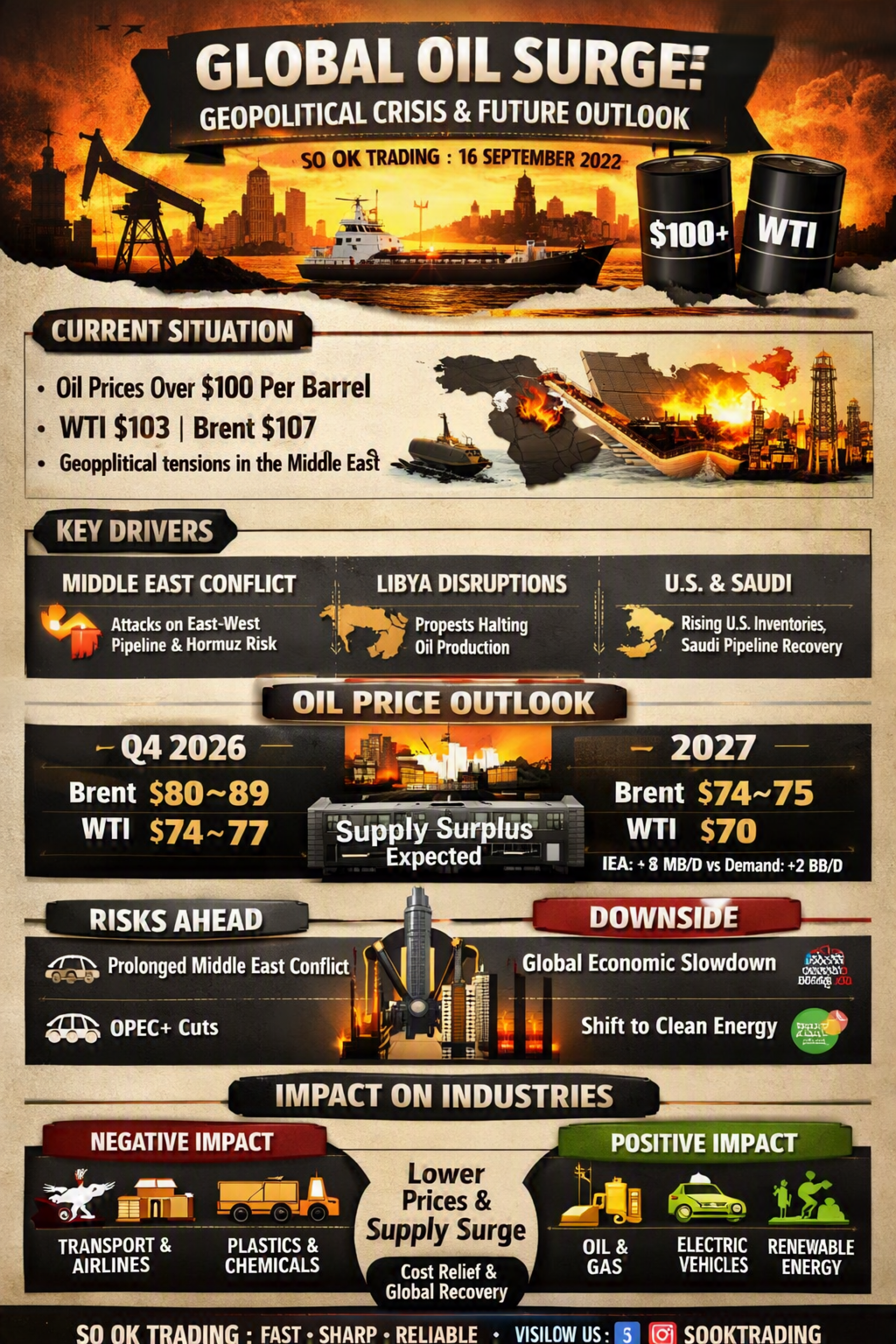
In September 2026, global oil prices remain above $100 per barrel, driven by geopolitical tensions in the Middle East, pipeline attacks, and supply disruptions in several countries. The energy market continues to face significant strain, with WTI reaching $103 and Brent climbing to $107. Market attention is now focused on OPEC+ strategies and the recovery of Saudi pipelines, which may prove pivotal for oil prices in the final quarter of the year.
Key Drivers of Oil Prices
Middle East Crisis: Attacks on Saudi Arabia’s East-West pipeline and heightened risks in the Strait of Hormuz, where over 4 million barrels per day are transported.
Libya: Protests disrupting pipeline operations, adding pressure to global supply despite core production being maintained.
United States & Saudi Arabia: Rising U.S. crude inventories and expectations of Saudi pipeline recovery, temporarily easing upward price momentum.
Oil Price Outlook
Q4 2026: Brent projected at $80–89, WTI at $74–77.
2027: Brent expected at $74–75, WTI at $70.
The market is anticipated to enter a supply surplus, with the IEA forecasting an additional 8 million barrels/day in supply, while demand rises by only 2 million barrels/day.
⚠️ Risk Factors
Upside Risks: Prolonged Middle East conflict, further OPEC+ production cuts.
Downside Risks: Global economic slowdown, accelerated clean energy transition, internal OPEC+ price wars.
Impact on Thai Industries
❌ Negative Impact: Transport, logistics, airlines (fuel costs 30–40% of total expenses); petrochemicals and plastics; construction and ceramics.
✅ Positive Impact: Upstream energy and refining; electric vehicles (EV); renewable energy (solar, wind, biomass).
Global Industry Impact
High oil prices are pushing up energy costs worldwide, especially in aviation, logistics, petrochemicals, and heavy manufacturing. On the other hand, expensive oil is accelerating the shift toward EV adoption and renewable energy, reshaping the global energy landscape.
Conclusion
2026 marks a year of volatility in the global energy market. However, 2027 is expected to bring a new balance as supply recovers and oil prices decline.
“Today’s high oil prices are the driving force behind tomorrow’s clean energy future.”
SO OK TRADING — FAST • SHARP • RELIABLE www.sooktrading.com Facebook: SO OK TRADING