“Thai Agriculture Market 2026: Transforming into a High-Value & Tech-Driven Era — OUTLOOK Rising Stars and Future Trends 2030 by SO OK TRADING”
Thai Agriculture Market 2026: Outlook and Trends of Thai Agricultural Products 2027–2030
Article by SO OK TRADING – 6 SEP 2026
✨ Introduction The year 2026 marks a crucial turning point for Thailand’s agricultural sector — shifting from “quantity production” to “value creation and innovation.” Agriculture is not only a major source of national income but also reflects Thailand’s adaptation to global trends in health, sustainability, and digital technology .
As global competition intensifies and environmental regulations tighten, Thai farmers must accelerate transformation through Agri-Tech, high-value agriculture, and online Fair Trade marketing to maintain competitiveness and unlock new global markets .
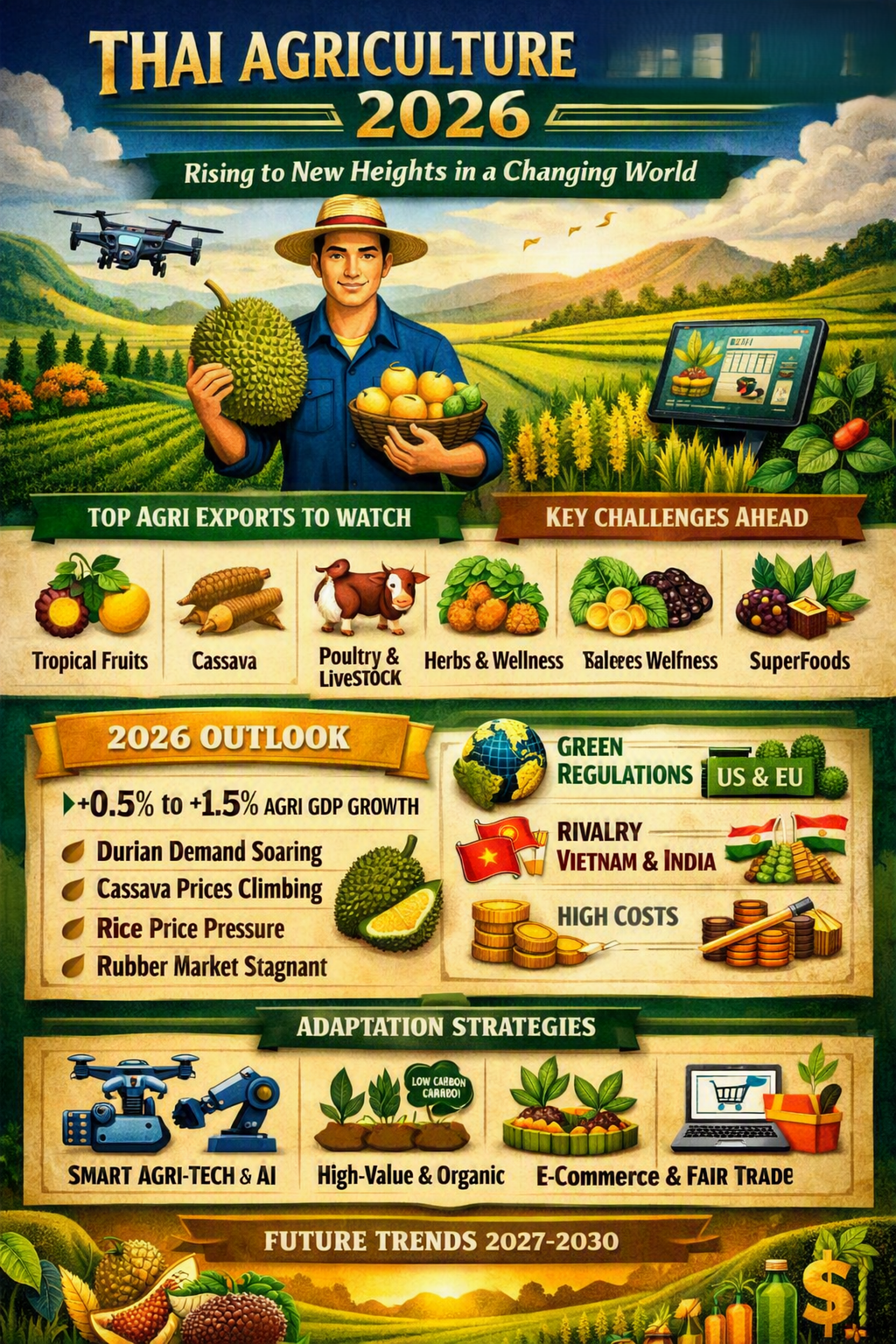
Rising Agricultural Products
Tropical Fruits: Durian, mangosteen, mango dominate Chinese and Asian markets
Cassava: A future crop linked to clean energy and animal feed
Poultry & Livestock: Supported by safe production standards
Herbs & Wellness Products: Fingerroot, ginger, galangal, and wellness products expanding rapidly
Superfoods & New Economic Crops: Wolffia, cacao, vanilla, avocado, hemp
⚠️ Challenges for Thai Agriculture
Green Protectionism: Strict low-carbon and traceability regulations in the US and EU
Competition from Vietnam & India: Lower production costs
High Production Costs: Fertilizers, chemicals, and energy
Market Liberalization (WTO 2026–2028): Imports of onions, potatoes, garlic, and coffee beans
Outlook and Price Trends
Agricultural GDP 2026: Expected growth of 0.5%–1.5% (“moderate growth”)
Tropical Fruits (Durian, Mangosteen): Prices remain high due to Chinese demand despite rising competition
Cassava: Prices supported by clean energy and feed industries, expected to rise further
Rice: Export prices pressured by India’s return to the market, intensifying competition
Rubber: Stable within 0–2% due to floods and EU’s EUDR regulations
Palm Oil & Energy Crops: Prices fluctuate with global energy markets
Herbs & Wellness Products: Strong growth, especially in Australia where demand exceeds 37%
Adaptation Strategies for Thai Agriculture
Agri-Tech: Use of AI, Big Data, and drones for production planning
High-Value Agriculture: Focus on organic, low-carbon farming and advanced processing
Online Marketing & Fair Trade: Promote farmer-to-consumer platforms to reshape market access
Looking Ahead 2027–2030
Thailand’s agriculture will fully enter the era of Decarbonization & Agri-Tech, driven by four major trends:
Low-Carbon Agricultural Products – Low-carbon rice, low-carbon shrimp
Alternative Proteins & Future Foods – Wolffia, plant-based milk
Regenerative Agriculture – Restoring soil and ecosystems
Agri-Tech Investment – Rising to 25–30% of agricultural GDP
✨ Conclusion Thailand’s agricultural market in 2026 is advancing into a new era that emphasizes “value and innovation” over “volume.” Transitioning to high-value agriculture and adopting technology will be the key to maintaining global competitiveness. Despite challenges from costs and environmental regulations, opportunities in health markets and future foods remain wide open.
SO OK TRADING : FAST SHARP RELIABLE Your trusted partner in the world of high-value agriculture WWW.SOOKTRADING.COM FACEBOOK : SO OK TRADING