Share

“Portland Aluminium: Opening a New Global Perspective on Ingots — Bridging World-Class Quality with Sustainability, Winning Trust in Thai Industry, and Leading the Global Market” SO OK TRADING: 27 AUG 2026
Last updated: 27 Aug 2026
124 Views

Portland Aluminium: The Golden Standard of Ingots and Its Key Role in the Thai Market
SO OK TRADING — FAST • SHARP • RELIABLE Published: 27 August 2026

Introduction
In the fiercely competitive global metals industry, Portland Aluminium has earned recognition as one of the world’s leading Class A ingot brands. It is trusted by manufacturers and procurement teams worldwide, and particularly in Thailand, where many factories remain loyal to Portland despite its higher price compared to competitors. The reason lies not in marketing, but in the brand’s unmatched quality, consistency, and reliability.

 
Global Outlook: Aluminium in the Era of Clean Energy and ESG
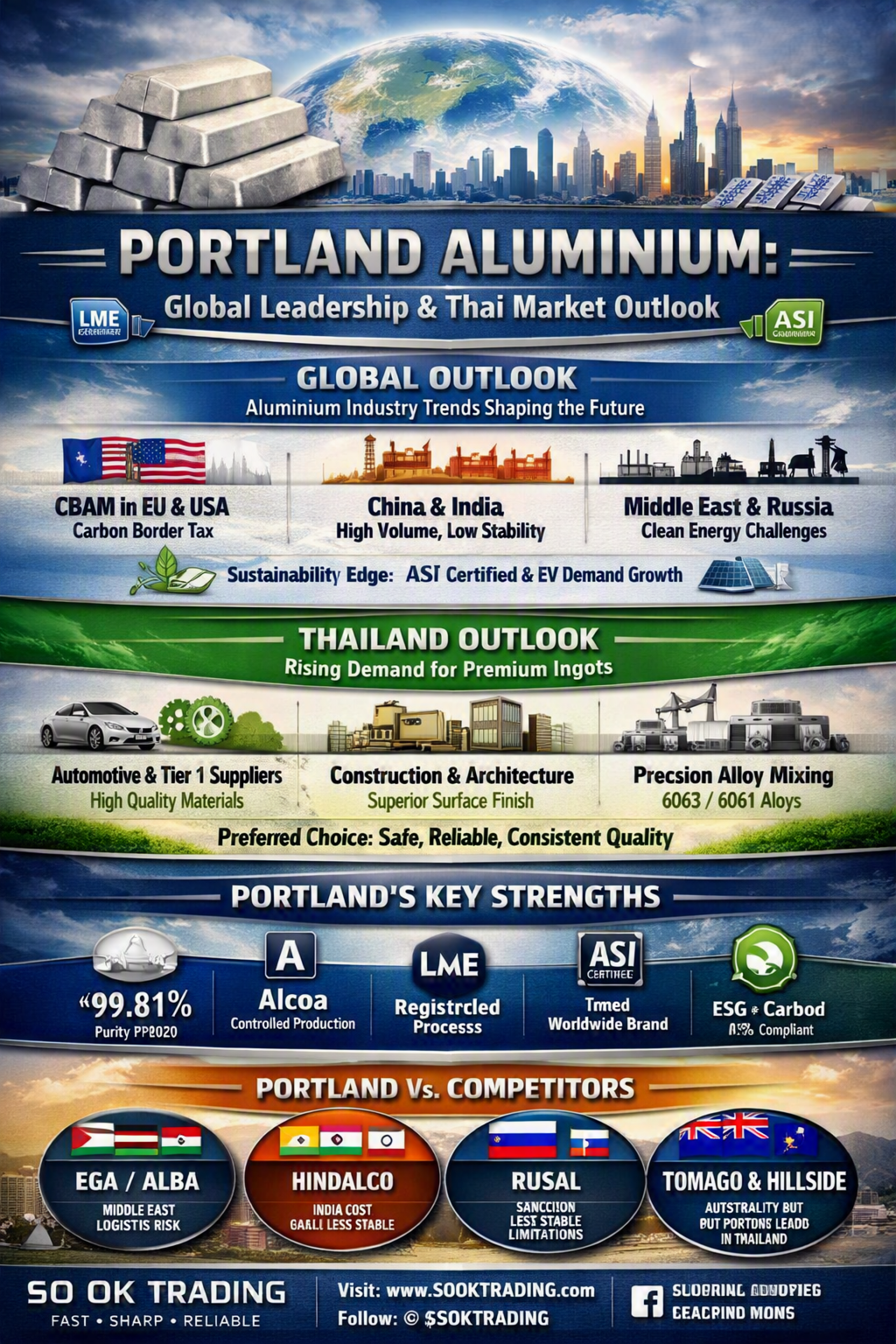
The global aluminium market is undergoing a major transformation driven by environmental pressures and the need to reduce carbon footprints.

Europe & USA: The introduction of CBAM (Carbon Border Adjustment Mechanism) penalizes producers who fail to meet ESG standards.
China & India: Focused on mass production, but challenged by carbon emissions and inconsistent metal stability.
Middle East & Russia: Investing in advanced smelting technologies powered by natural gas and hydropower, yet facing geopolitical risks and sanctions.
Overall, aluminium certified for sustainability (such as ASI Certified) holds the strongest advantage in global markets, especially in electric vehicles (EVs) and high-tech industries.

 
Thai Outlook: Strong Demand for Premium Ingots
Thailand continues to be a growing importer of aluminium ingots, driven by:

Automotive & Tier 1 Suppliers – High-quality ingots are essential to meet international standards and support exports.
Construction & Architecture – Smooth surfaces and easy anodizing are critical for premium finishes.
Alloy Mixing (6063, 6061, etc.) – Factories require stable metal composition for precise QC calculations and reduced defect risks.
Although cheaper alternatives from India and the Middle East exist, many Thai factories still choose Portland as their “Safe Zone,” ensuring minimal defects and consistent quality.

 
Portland Aluminium’s Strengths
Purity up to 99.81% – Exceeding P1020 standards
Alcoa-controlled production – Clean and stable processes
A817 reduction cell technology – Consistency across every batch
LME Registered Brand – Globally recognized and tradable asset
ASI Certified – Fully compliant with ESG and CBAM requirements
 
Why Thai Factories Prefer Portland
Smooth, flawless surfaces – Reduced defects in extrusion and finishing
Easy alloy mixing – Stable composition ensures QC accuracy
Procurement confidence – Eliminates raw material concerns
Market liquidity – Readily available stock and standardized pricing
 
Competitor Comparison
Middle East (EGA, ALBA) – High quality but logistics risks
India (Hindalco, Vedanta) – Lower cost and faster shipping, but less stable
Russia (RUSAL) – Strong in Green Aluminium, but limited by sanctions
Tomago & Hillside – Alcoa-linked brands with strong quality, yet Portland remains the most trusted in Thailand
 
The “Southern Hemisphere Trio” – Portland, Tomago, Hillside
Portland (Victoria, Australia) – Highest stability, premium surface quality
Tomago (New South Wales, Australia) – Australia’s largest smelter, equal quality to Portland, sometimes more cost-effective
Hillside (South Africa) – Massive production capacity, but reliance on coal power weakens its carbon footprint compared to Australia
 
Conclusion
Portland Aluminium is more than a brand — it is the Golden Standard of Ingots trusted by factories in Thailand and worldwide. With superior quality, reduced defects, and sustainability certifications, Portland remains the top choice for high-spec applications and global exports.

For Thai procurement teams, if the goal is maximum quality and absolute confidence, Portland is the answer. For cost-sensitive mass-market production, Indian or Hillside brands may be considered. Yet strategically, Portland continues to be the “brand of peace of mind” and a cornerstone of Thailand’s metals industry.

 
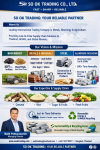
✨ SO OK TRADING — Your trusted partner in Non‑Ferrous Metals from Thailand We deliver Aluminum Ingot P1020 (LME Registered Brand) with world-class standards.

Contact Us www.sooktrading.com sooktrading@outlook.com WhatsApp: +66 9555 64255 Bangkok, Thailand

Related Content
“Gold Plunges Below $4,400 – Bond Yield Hits 18-Year High, Shaking Global Markets as Investors Pause Ahead of Fed Decision Amid Hormuz Crisis” SO OK TRADING | 19 AUGUST 2026
Gold Plunges Below $4,400 – Bond Yield Hits 18-Year High, Pressuring Global Markets SO OK TRADING : 19 August 2026 Gold prices worldwide and in Thailand dropped sharply, pressured by surging U.S. bond yields that reached their highest level in nearly two decades. This spike in yields prompted investors to sell off non-interest-bearing assets such as gold. Nevertheless, the market found some support from ongoing geopolitical tensions in the Middle East and continued gold purchases by central banks worldwide, preventing prices from breaking below key support levels. In this analysis, SO OK TRADING provides an in-depth look at the latest gold market overview, the price outlook for late August, and investment strategies suited to volatile conditions, helping investors plan with confidence and precision. ✨ FAST • SHARP • RELIABLE SO OK TRADING — Your trusted business partner in every turn of the gold market
19 Aug 2026
“Gold Surges Past $4,400 Amid Geopolitical Tensions – Tonight’s U.S. CPI to Decide: Further Rally or Correction” Analysis by SO OK TRADING | August 12, 2026
Gold Surges Amid Geopolitical Tensions – Tonight’s CPI to Decide the Trend Analysis by SO OK TRADING | August 12, 2026 Global gold prices (Gold Spot) have surged past $4,400 per ounce, driven by escalating tensions in the Middle East and speculative buying across global markets. Investors worldwide are now closely watching the release of the U.S. Consumer Price Index (CPI) tonight, which will be the decisive factor in determining whether gold continues its rally or enters a short-term correction. In this article, SO OK TRADING provides an in-depth analysis — covering geopolitical risks, U.S. monetary policy, and technical buying forces that have fueled the sharp rise in gold prices. We also highlight key support and resistance levels, along with investment strategies that traders should consider before tonight’s market moves. ✨ SO OK TRADING — Your Trusted Business Partner FAST • SHARP • RELIABLE
12 Aug 2026
HNY 2026 with a First Analysis on Thai Baht Value
he Thai baht in Q1 2026 is expected to strengthen against the US dollar, driven primarily by a weaker dollar globally, a seasonal tourism boost, and expectations of US Federal Reserve rate cuts. This strength is occurring despite a weak domestic economic outlook and the Bank of Thailand's (BoT) likely continued easing of its policy rate. Exchange Rate Drivers and Forecast External Factors: The primary driver for the strengthening baht is external, mainly the broad weakness of the US dollar as global markets price in expected Fed rate cuts. The baht is also correlated with global gold prices, which have been climbing. Tourism High Season: The period extending into Q1 2026 is the high season for tourism, which typically brings in foreign currency and supports the baht's value. Policy Divergence: The BoT is expected to continue its easing cycle, potentially cutting the policy rate further to 1.00% by Q1 2026 to stimulate the sluggish domestic economy. This divergence from a potentially less aggressive US Fed in Q1 could support the baht in the short term, though some analysts warn the currency could weaken later in 2026. Forecasts: Projections for 2026 generally place the baht in a range of 30.80–33.00 per US dollar. Some models estimate it could trade around 31.06 by the end of Q1. A persistently strong baht below 31 per US$ is seen as a significant risk to the Thai export and tourism sectors. Key Economic Context Weak Growth: Thailand's economy is expected to slow down to a 5-year low growth rate of around 1.6-1.8% in 2026, pressured by US tariffs, global trade tensions, and high household debt. The central bank chief expects an improvement in Q1 2026 after a weak second half of 2025. Political Uncertainty: A general election expected in February 2026 could also introduce volatility, though some historical trends suggest the baht may strengthen following the formation of a new government. Low Inflation: Headline inflation is projected to remain subdued or even negative, providing the central bank with justification for further rate cuts to stimulate demand. In summary, Q1 2026 is characterized by a strong and volatile baht driven by external factors, contrasting sharply with a weak domestic economy and accommodative monetary policy.
1 Jan 2026
This website uses cookies for best user experience, to find out more you can go to our Privacy Policy and Cookies Policy
Powered By MakeWebEasy Logo MakeWebEasy