“Thai Rice 2026: Transforming the Twin Crisis into a Golden Era of Sustainability and Rising as the Global Premium Market Leader”
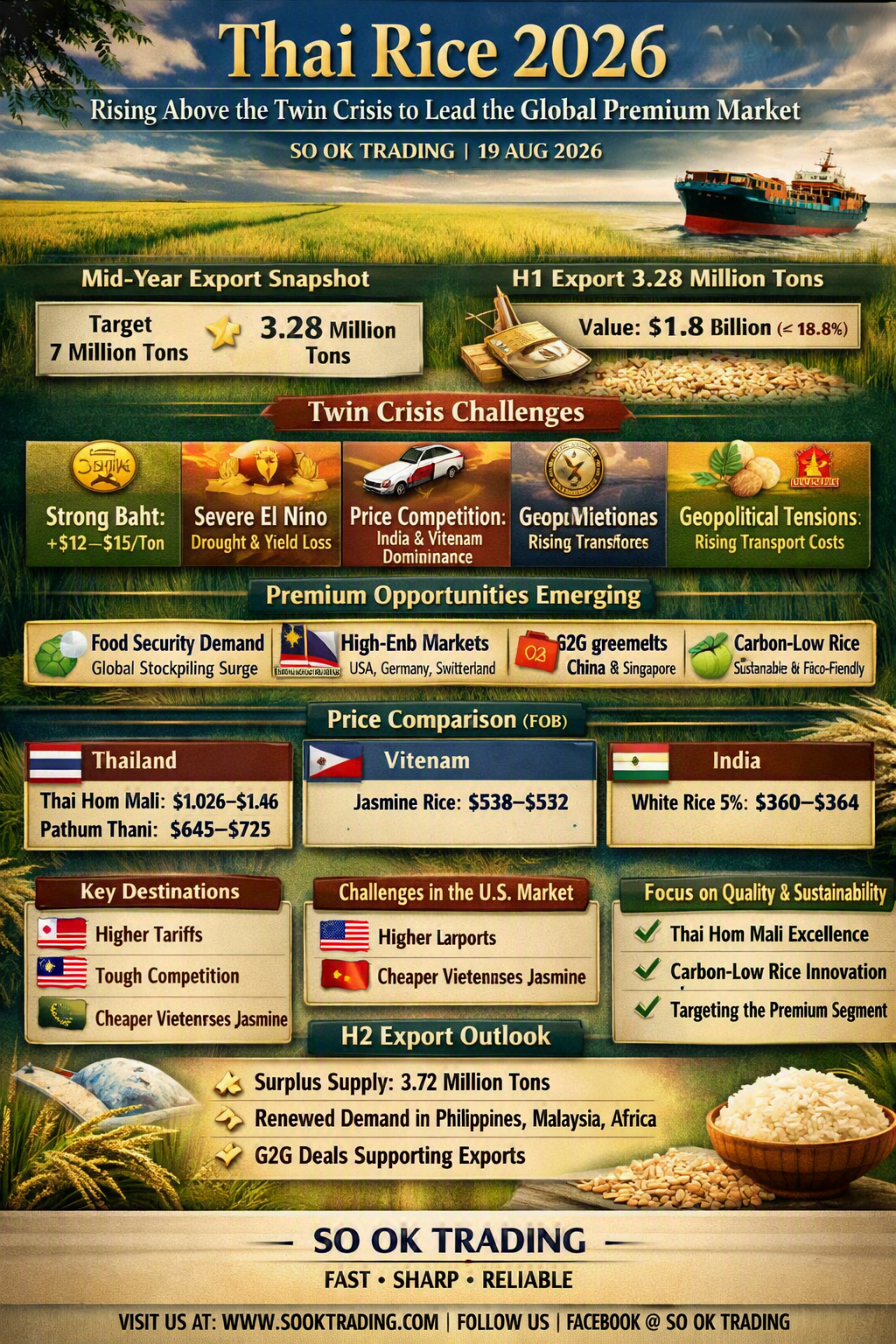
Thai Rice 2026 – Turning the Twin Crisis into Golden Opportunities in the Global Premium Market
SO OK TRADING | 19 AUG 2026
Overview
The year 2026 has been a challenging one for Thai rice exports. With a target of 7 million tons, the first half of the year saw only 3.28 million tons exported, valued at 60.4 billion baht — a decline of 18.8% compared to the previous year. Key factors include price competition from India and Vietnam, reduced imports by Indonesia, high production costs, and a strong baht. However, the second half of the year shows positive signals: global stockpiling, strong demand from the Philippines and Malaysia, and G2G negotiations with China.
⚠️ Major Pressures (Twin Crisis)
Strong Baht: Immediate price increase of $12–$15 per ton
Severe El Niño: Impacting yields and raising global supply risks
Competitors: India dominates low-cost markets; Vietnam pushes affordable Jasmine rice
Geopolitics: Middle East conflicts drive up transport costs
Opportunities & Strategies
Food Security Market: Many nations accelerating imports for reserves
Premium Market: Thai Hom Mali rice remains in demand in the U.S., Germany, and Switzerland
G2G Agreements: Deals with China and Singapore help stabilize exports
Carbon-Low Rice: Sustainability as a key selling point for high-end markets
Market Structure & Prices (FOB)
Thai Hom Mali Rice: $1,026–$1,246 → Highest premium
Pathum Thani Jasmine Rice: $645–$725
Glutinous Rice: $818
White Rice 5%: $380–$495
White Rice 25%: $476–$481
Parboiled Rice 100%: $404
Key Export Destinations
White Rice (47.16%): Iraq, Philippines, Malaysia, Mozambique
Hom Mali Rice (25.33%): U.S., Senegal, Hong Kong, Canada, China
Parboiled Rice (18.34%): South Africa, Yemen, Congo
Glutinous Rice (2.62%): China, Japan, U.S., Belgium
Thai Rice in the U.S. Market
Imports reduced due to high prices
Risk of stricter tariffs
Vietnam competing with cheaper Jasmine rice
Thai Rice in the Chinese Market
Reduced imports of Thai premium rice, shifting to Vietnam
Thailand sustains exports through G2G deals, with the first 40,000-ton shipment delivered
Global Price Comparison (FOB)
India: White Rice 5% → $360–$364 (low-cost advantage)
Vietnam: Jasmine Rice → $538–$542 (affordable fragrant rice)
Thailand: Premium Hom Mali Rice → $1,192–$1,273 (highest quality, most expensive)
Thai Pathum Thani Jasmine Rice → $645–$725
Supply Outlook (Second Half of 2026)
Total production: 35.44 million tons
Main crop: 26.99 million tons (market release Oct–Nov)
Off-season crop: 8.45 million tons
Exportable surplus: 3.72 million tons → supporting the 7 million-ton target
Export Outlook (H2 2026)
Surplus Supply: 3.72 million tons available for global markets
Demand Recovery: Philippines, Malaysia, and Africa as key drivers
Government Measures: G2G deals with China and direct market expansion guarantee minimum volumes
Geopolitical Easing: Lower freight and insurance costs
Export Target: Set at 7 million tons, but actual forecast is 6.7 million tons
Conclusion
Although Thailand faces price disadvantages in the mass market, it continues to secure its premium base with the strengths of “high quality, sustainability, and carbon-low rice.” By combining G2G strategies, expanding premium markets, and leveraging food security demand, Thailand is poised to maintain its position as the “Global Premium Rice Leader.”
✨ SO OK TRADING — Your Trusted Business Partner VISIT US AT: WWW.SOOKTRADING.COM FACEBOOK: SO OK TRADING