“Aluminum Ingot: The Strategic Metal Driving Modern Industry”
Aluminum Ingot and the Modern Metal Industry Ecosystem: Detailed Summary (SO OK TRADING / 9 August 2026)
Overview
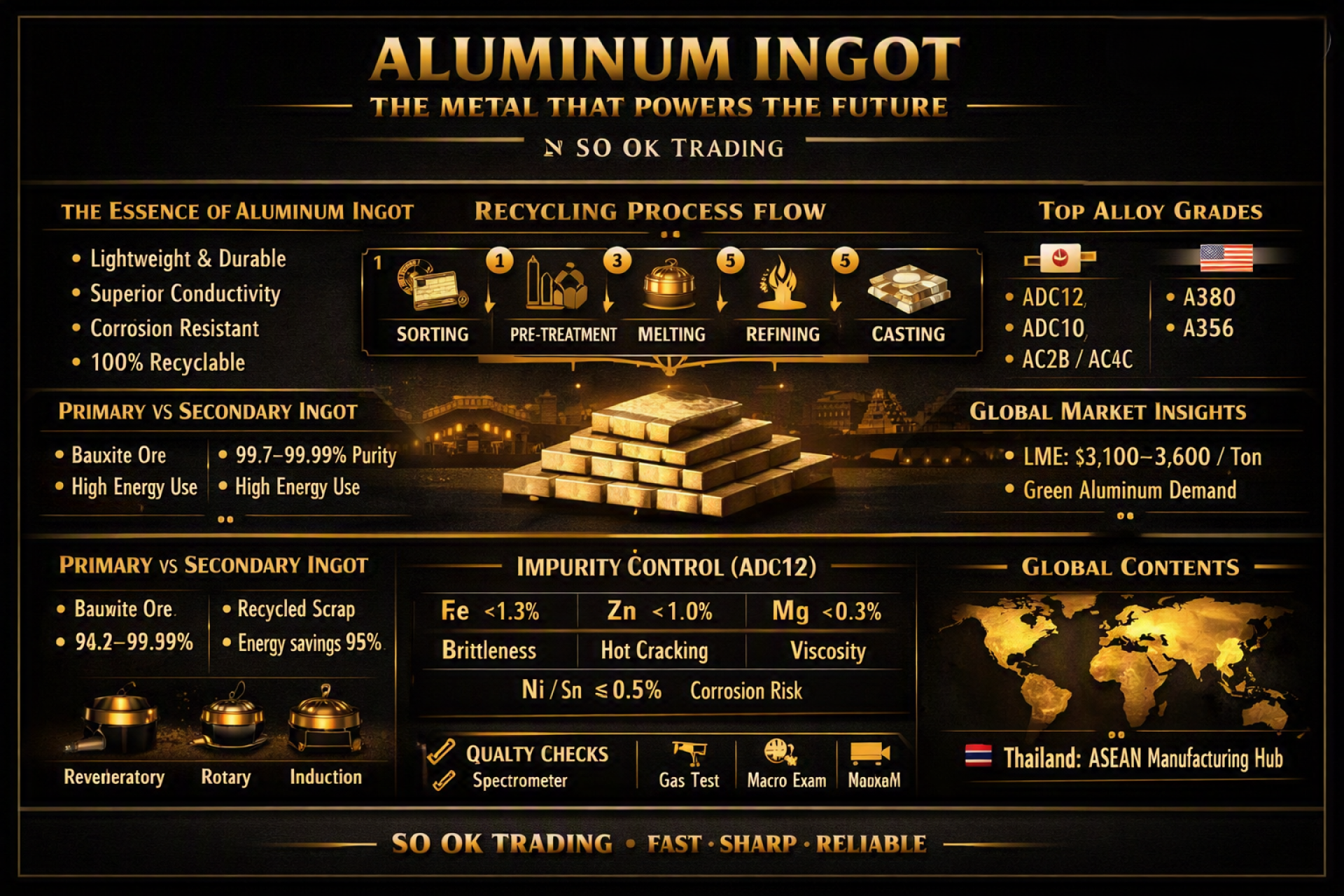
Aluminum ingot — a pure aluminum block — is a foundational material in modern manufacturing. Its lightweight nature, corrosion resistance, and excellent thermal conductivity make it indispensable across automotive, construction, electrical, and electronics industries. These characteristics position aluminum ingot as a strategic metal at the core of the global supply chain.
1. Key Properties of Aluminum Ingot
Lightweight: Reduces structural load and improves fuel efficiency in vehicles.
High thermal and electrical conductivity: Ideal for heat sinks and electrical components.
Natural corrosion resistance: Protective oxide layer prevents rust.
Excellent workability: Melts easily and allows flexible alloy composition adjustments.
These attributes make aluminum ingot highly efficient in both engineering performance and production cost.
2. Types of Aluminum Ingots and Their Applications
Primary Ingot
Source: Bauxite
Process: Bayer → Hall-Héroult
Purity: Above 99.7%
Applications: Billets, aluminum foil, plates, electrical and electronic components
Secondary Ingot
Source: Recycled aluminum scrap
Advantage: Up to 95% energy savings compared to primary production
Applications: Automotive parts (engine covers, cylinder blocks), alloy wheels, motorcycle components
Widely used in die‑casting industries.
3. Detailed Secondary Ingot Production Process
Sorting: Separating aluminum from steel, stainless steel, plastics, etc.
Pre‑treatment: Crushing, paint removal, degreasing.
Melting: 700–750°C, removing dross.
Fluxing & Degassing: Nitrogen/argon gas injection, flux addition, spectrometer analysis for alloy adjustment.
Casting: Cooling, grade stamping, packaging.
Strict quality control is required to meet JIS (Japan) and AA (USA) standards.
4. Popular Alloy Grades in Die‑Casting
Japan (JIS)
ADC12: Most widely used; excellent flowability and wear resistance.
ADC10: Higher toughness; easy to polish.
AC2B / AC4C: Suitable for gravity casting (cylinder heads, wheels).
USA (AA)
A380: Equivalent to ADC12; globally common.
A356: Can undergo T6 heat treatment; very high strength for wheels and structural parts.
5. Impurity Control Requirements for ADC12
Fe ≤ 1.3%: Excess causes brittleness.
Zn ≤ 1.0%: Leads to hot cracking.
Mg ≤ 0.3%: Increases melt viscosity.
Mn ≤ 0.5%: Causes sludge formation.
Ni ≤ 0.5%, Sn/Pb ≤ 0.2%: Causes corrosion and segregation.
6. Types of Furnaces Used in Recycling Plants
Reverberatory Furnace: High capacity; suitable for large scrap pieces.
Rotary Furnace: Uses salt flux; ideal for machining scrap.
Induction Furnace: Precise temperature control; lowest metal loss.
7. Quality Inspection of Aluminum Ingots
Chemical Analysis (OES)
Gas Test (RPT)
Macrostructure Inspection
Mill Certificate / COA
8. Primary Aluminum Ingot: Production Process and Grades
Bauxite mining
Alumina extraction (Bayer Process)
Electrolytic smelting (Hall‑Héroult Process)
Casting into primary ingots
Popular Grades:
P1020A (99.70%): LME standard
P0610 (99.85%): Electrical applications
High Purity 4N (99.99%): Semiconductor applications
9. Macro Factors: LME Pricing and Green Aluminum
LME price range: USD 3,100–3,600/ton
Pricing formula: LME Cash + Regional Premium + MJP
EV demand and Europe’s CBAM policy are accelerating the rise of Green Aluminum.
10. Major Producing Countries and Thailand’s Import Landscape
Major producers: China, India, Russia, Canada, UAE
Thailand: 100% import‑dependent for primary ingot
Average import price since 2025: USD 3,200–4,000/ton
Executive Summary
The aluminum industry is transitioning toward clean energy and a circular economy. Secondary ingot demand is rising rapidly, while primary ingot faces tight supply and high energy costs. Thailand is emerging as ASEAN’s central hub for aluminum importation and processing, driven by growth in EV manufacturing, construction, and high‑tech industries.
SO OK TRADING — Your Trusted Partner in Non‑Ferrous Metals
FAST • SHARP • RELIABLE www.sooktrading.com WhatsApp: +66 955564255 sooktrading@outlook.com Facebook: SO OK TRADING