Share

“The Metal Path to the Future: Aluminum SOW — The Giant Ingot Forging Tomorrow’s World | SO OK TRADING Unveils a New Perspective on the Global Aluminum Market” : 7 AUG 2026
Last updated: 7 Aug 2026
1232 Views

 ALUMINUM SOW — The Pillar of the Modern Aluminum Industry SO OK TRADING : 7 AUG 2026

 
Meaning and Importance
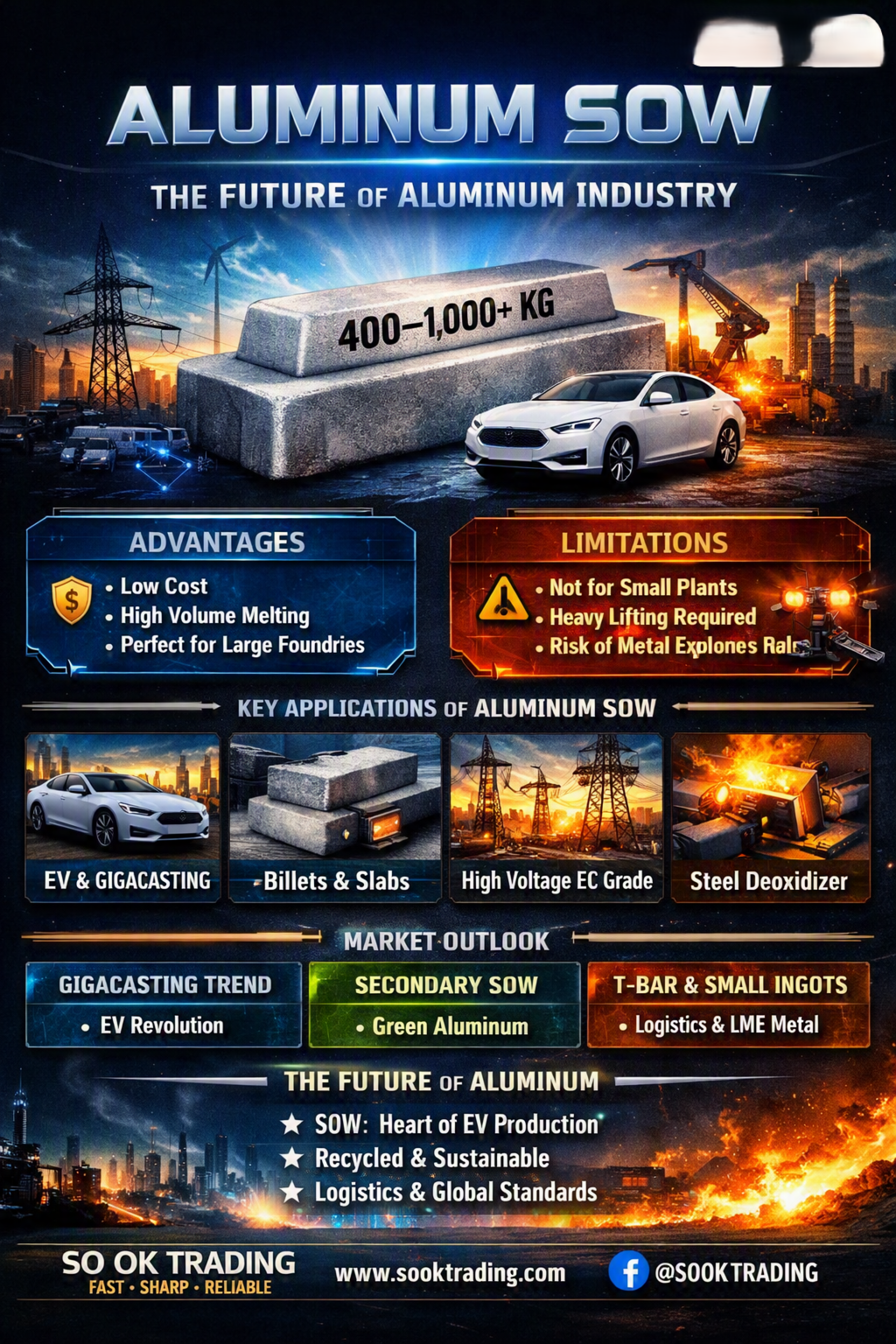
Aluminum SOW, or Sow Ingot, is a massive aluminum block weighing between 400–1,000+ kilograms. It serves as the primary feedstock for upstream industries — from electric vehicle production and high‑voltage power lines to aluminum foil rolling. Its key advantage lies in cost efficiency: melting large volumes at once and offering the lowest unit cost compared to other forms such as T‑Bar or Small Ingot.

The term “Sow” comes from the analogy of a mother pig giving birth to many piglets — symbolizing a large metal block that can be broken down into multiple products.

 
⚖️ Advantages and Limitations: ALUMINUM SOW
Advantages: Lowest cost, space‑efficient storage, ideal for large foundries requiring massive volumes
Limitations: Not suitable for small‑to‑medium plants, requires heavy cranes and large furnaces, risk of molten metal explosion if not properly dried
 
Industrial Applications: ALUMINUM SOW
Electric Vehicles (EVs) → Engine blocks, cylinder heads, alloy wheels, and Gigacasting structures
Extrusion & Rolling Mills → Cast into billets and slabs for foil, EV body panels, and architectural structures
Power & Energy → Production of high‑voltage EC Grade wires requiring high purity
Steelmaking → Used as a deoxidizer to remove oxygen from molten steel
 
Market Outlook and Future Trends
1. Aluminum SOW

Gigacasting: A new trend in EV manufacturing, pioneered by Tesla and BYD, using single large castings — driving demand for SOW sharply upward
Circular Economy: Growing use of recycled scrap to produce Secondary SOW, reducing costs and supporting Green Aluminum initiatives
Outlook: Poised to become the core pillar of EV production and large‑scale foundries worldwide
2. Aluminum T‑Bar

Logistics: Tri‑lock shape makes international transport easier and safer
Electrification: Rising demand for aluminum wires replacing copper in EVs boosts EC Grade T‑Bar usage
Outlook: Steady growth in extrusion and EV wiring sectors
3. Aluminum Small Ingot

Global Benchmark: Still the reference standard for LME contracts (P1020A)
Advantage: Highest liquidity, easy to trade
Outlook: Remains important but increasingly challenged by SOW and T‑Bar in large‑scale production and logistics
 
Summary: ALUMINUM and Its Uses
SOW = King of Cost Efficiency, best for large foundries and EV Gigacasting
T‑Bar = Logistics partner and electrification enabler
Small Ingot = Global benchmark, though future may face challenges from new megatrends
 
Conclusion
Aluminum SOW is evolving from a simple “raw material” into the pillar of circular economy and the EV revolution. While T‑Bar and Small Ingot continue to play niche roles, the future of the aluminum market will be driven by Gigacasting and Green Aluminum.

 
SO OK TRADING: Your Trusted Business Partner SO OK TRADING: FAST • SHARP • RELIABLE www.sooktrading.com Facebook: SOOK TRADING



Related Content
“Recycle Cans, Transform the World with RSI 3104: From Beverage Cans to Aluminum Ingots – The Endless Power of Recycling, Core of the Aluminum Loop and Global Circular Economy” SO OK TRADING: 23 SEP 2026
Aluminum: RSI Ingot 3104 Production from UBC and the Global Circular Economy Outlook SO OK TRADING : September 23, 2026 As the world moves toward sustainability and carbon reduction, the beverage can industry stands out as one of the most complete “model cases” of the Circular Economy. At its core lies the Aluminum Loop — a system in which used beverage cans (UBC) are returned to the melting process to produce RSI Ingot 3104, which can then be rolled into sheets and continuously manufactured into new cans. This process not only reduces the consumption of natural resources but also cuts carbon emissions by more than 60% compared to primary aluminum production, while generating tremendous added value across the industrial supply chain. In this article, SO OK TRADING takes you inside the production of RSI 3104 from UBC scrap — from sorting, melting, and chemical composition adjustment to aluminum ingot casting — and provides an analysis of the future outlook of the Aluminum Loop, which is rapidly becoming a cornerstone of the global circular economy. ✨ RSI 3104 — The Strategic Material of the Future for the Global Packaging Industry Follow this article to understand how “a single used can” can be reborn as “a brand-new can” within the world’s most sustainable recycling system.
23 Sept 2026
COPPER PRICE AND TREND  2026
Copper prices are expected to remain elevated and bullish in 2026, driven by strong demand from the green energy transition (EVs, renewables, grid upgrades) and persistent mine supply constraints/disruptions, with forecasts generally placing prices in the $10,000 to over $12,000 per tonne range, although some analysts foresee a slight cooling to $10,000-$11,000 as market balances tighten. Key factors include IRA spending, AI infrastructure needs, constrained new mine supply, and potential Chinese economic recovery, creating tight markets despite some projected minor surpluses. Key Price Predictions (2026): Goldman Sachs: $10,000 - $11,000/tonne range, averaging $10,710/tonne in H1 2026. J.P. Morgan: Averaging around $12,075/tonne, with potential spikes to $12,500/tonne in Q2. Bank of America: Average of $11,313/tonne, with potential for $15,000/tonne spikes. UBS: $11,000/tonne by Sept 2026. World Bank: Average of $9,800/tonne. Bullish Drivers: Energy Transition: Massive demand for grid expansion, EVs, and renewable infrastructure. AI Infrastructure: Increased demand for data centers. Supply Deficit: Mine disruptions (Grasberg, Kamoa-Kakula, etc.) and difficulty bringing new mines online. China: Potential economic rebound acting as a catalyst. Potential Headwinds/Volatility: Policy-induced Surpluses: E.g., from IRA incentives or scrap availability. Stronger USD: Can weigh on commodity prices. Slower Demand: If China's recovery falters. Overall Outlook: Expect a tight market with strong underlying demand, leading to high prices, but with significant volatility due to policy shifts and mine output fluctuations. The market is moving towards a structural deficit, supporting higher prices long-term
30 Dec 2025
This website uses cookies for best user experience, to find out more you can go to our Privacy Policy and Cookies Policy
Powered By MakeWebEasy Logo MakeWebEasy