Share

“Thai Baht Weakens Further! Q3 2026 Outlook — SO OK TRADING Analyzes Baht Trends Amid Global Economic Storms”
Last updated: 24 Jul 2026
104 Views

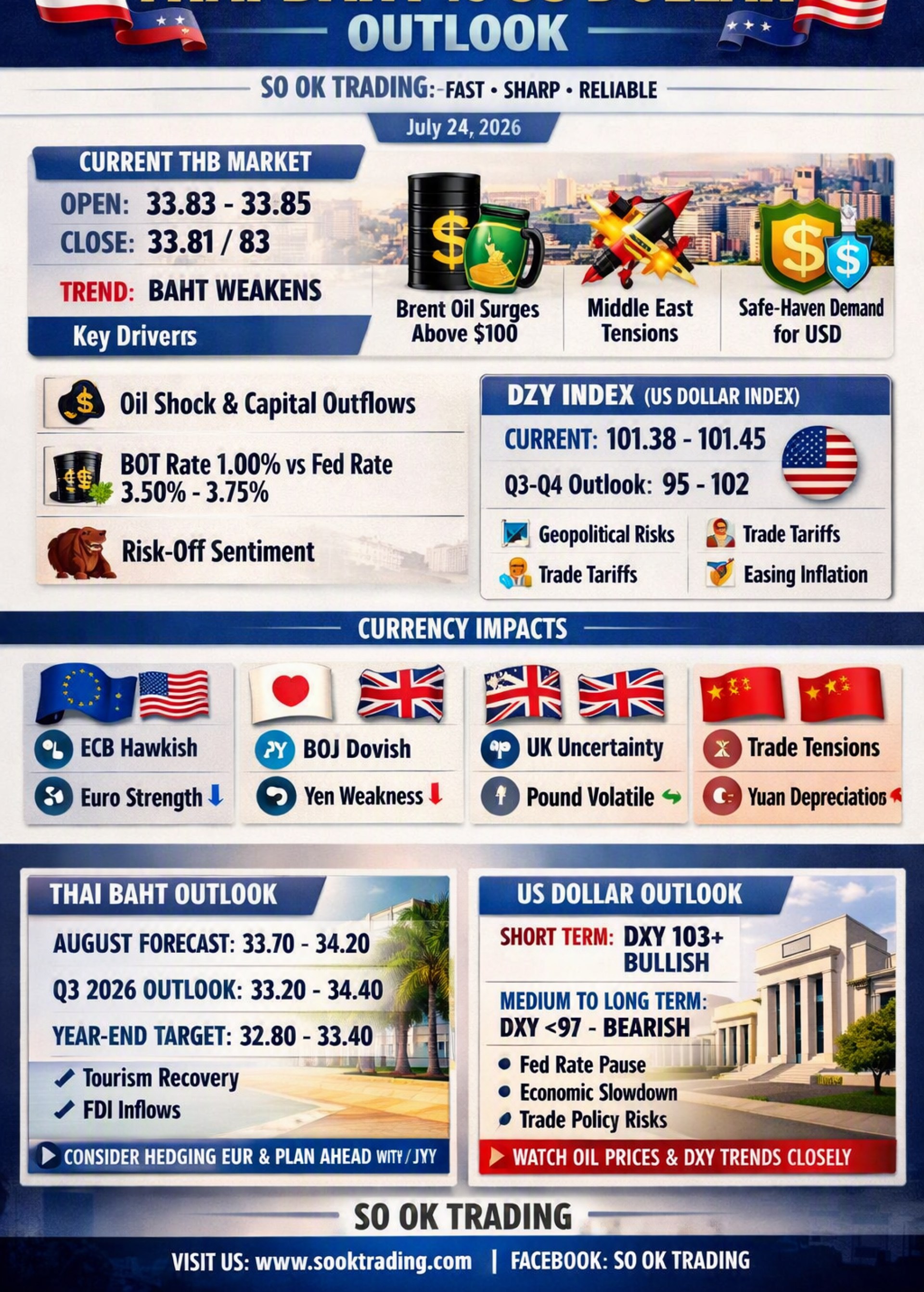
Thai Baht Market Analysis (July 24, 2026) — OUTLOOK
SO OK TRADING : FAST • SHARP • RELIABLE

 
Thai Baht Overview Today
The Thai Baht opened at 33.83 – 33.85 THB/USD and moved within the range of 33.70 – 34.00 THB/USD. It closed at 33.81/83 THB/USD, continuing its weakening trend under external pressures from the US economy and global factors.

 
Key Factors Impacting the Baht
️ Brent crude oil surged above $100/barrel
⚔️ Geopolitical tensions in the Middle East (US considering a major strike on Iran)
US Dollar strengthening as a Safe-Haven asset
 
Pressures on the Baht
Oil Shock: Rising oil prices → higher USD demand for imports → current account strain → capital outflows
Thai Monetary Policy: BOT holds interest rate at 1.00%, while Fed is at 3.50% – 3.75% → widening rate differential → capital outflows
Safe-Haven Demand: Investors sell risk assets and shift to USD → Baht under pressure
 
US Dollar Index (DXY) and Impacts
Current: 101.38 – 101.45 points (up from 99.00–100.00 in June 2026)
Q3–Q4 Outlook: Expected to move within 95.00 – 102.00 points
Supporting factors: War risks, US import tariffs
Pressuring factors: US labor market slowdown, easing inflation
 
Impact on Major Currencies vs USD
THB: Weakens in line with DXY, but may rebound if geopolitical tensions ease
EUR: Likely to strengthen as ECB signals rate hikes
JPY: Weakens significantly due to rate differentials, despite BOJ’s attempts to raise rates
GBP: Volatile but supported by domestic factors
CNY: Weakens under pressure from US tariff measures
 
Thai Baht (THB) Outlook
August 2026: Expected range 33.70 – 34.20 THB/USD, pressured by risk-off sentiment
Q3 2026: Expected range 33.20 – 34.40 THB/USD, reflecting oil price pressures and capital outflows
Year-End 2026: If geopolitical tensions ease and USD weakens, Baht may rebound
Supporting factors: Tourism revenue (Sept–Dec high season), FDI inflows into Data Centers and Cloud Services
 
US Dollar (USD) Outlook
Short Term (Q3 2026): Likely to remain strong on Safe-Haven demand and Fed rate hike expectations → DXY may reach 103.6 points if US economy stays resilient
Medium–Long Term (Q4 2026): If labor market slows and inflation continues to ease, Fed may pause hikes → DXY could fall below 97 points
Risk factors: US import tariffs may disrupt global trade and pressure regional economies
 
Strategic Recommendations
JPY/CNY Users: Baht strengthening → good timing for currency exchange or forward contracts
EUR Users: Euro likely to strengthen → advisable to hedge or lock in costs
Investors: Closely monitor DXY and oil prices as key drivers of Baht direction in Q3
 
✨ Summary The Thai Baht continues to weaken under pressure from rising oil prices and a stronger USD, but tourism and FDI inflows provide support against sharp declines. Toward year-end, easing geopolitical risks could allow the Baht to rebound. The US Dollar remains strong in the short term due to Safe-Haven demand, but faces long-term risks of weakening if the US economy slows.

 
SO OK TRADING — Your Business Partner SO OK TRADING : FAST • SHARP • RELIABLE

www.sooktrading.com Facebook: SO OK TRADING


Related Content
HNY 2026 with a First Analysis on Thai Baht Value
he Thai baht in Q1 2026 is expected to strengthen against the US dollar, driven primarily by a weaker dollar globally, a seasonal tourism boost, and expectations of US Federal Reserve rate cuts. This strength is occurring despite a weak domestic economic outlook and the Bank of Thailand's (BoT) likely continued easing of its policy rate. Exchange Rate Drivers and Forecast External Factors: The primary driver for the strengthening baht is external, mainly the broad weakness of the US dollar as global markets price in expected Fed rate cuts. The baht is also correlated with global gold prices, which have been climbing. Tourism High Season: The period extending into Q1 2026 is the high season for tourism, which typically brings in foreign currency and supports the baht's value. Policy Divergence: The BoT is expected to continue its easing cycle, potentially cutting the policy rate further to 1.00% by Q1 2026 to stimulate the sluggish domestic economy. This divergence from a potentially less aggressive US Fed in Q1 could support the baht in the short term, though some analysts warn the currency could weaken later in 2026. Forecasts: Projections for 2026 generally place the baht in a range of 30.80–33.00 per US dollar. Some models estimate it could trade around 31.06 by the end of Q1. A persistently strong baht below 31 per US$ is seen as a significant risk to the Thai export and tourism sectors. Key Economic Context Weak Growth: Thailand's economy is expected to slow down to a 5-year low growth rate of around 1.6-1.8% in 2026, pressured by US tariffs, global trade tensions, and high household debt. The central bank chief expects an improvement in Q1 2026 after a weak second half of 2025. Political Uncertainty: A general election expected in February 2026 could also introduce volatility, though some historical trends suggest the baht may strengthen following the formation of a new government. Low Inflation: Headline inflation is projected to remain subdued or even negative, providing the central bank with justification for further rate cuts to stimulate demand. In summary, Q1 2026 is characterized by a strong and volatile baht driven by external factors, contrasting sharply with a weak domestic economy and accommodative monetary policy.
1 Jan 2026
“Gold Consolidation: Slowing Down… Yet Still on a Long-Term Uptrend. Resting to Surge — This Game Is Far from Over!”   SO OK TRADING : 15 MAY 2026
Gold Consolidation: Still a Long-Term Game to Watch After hitting record highs earlier this year, global gold prices (Gold Spot) are now consolidating within the $4,610 – $4,700 per ounce range. Meanwhile, domestic gold (96.5%) has dropped sharply to 71,100 – 71,750 THB, pressured by a stronger Thai baht. Despite short-term profit-taking and dollar strength, gold continues to be supported by geopolitical tensions and ongoing central bank purchases, which help sustain its long-term appeal.
15 May 2026
This website uses cookies for best user experience, to find out more you can go to our Privacy Policy and Cookies Policy
Powered By MakeWebEasy Logo MakeWebEasy