“SO OK TRADING Analysis: Global Oil Market Amid Middle East Conflict — Q3–Q4 2026” New Wave of Escalation
Middle East Conflict and Global Oil Price Impact in 2026
Article by SO OK TRADING • July 22, 2026
Escalating Tensions
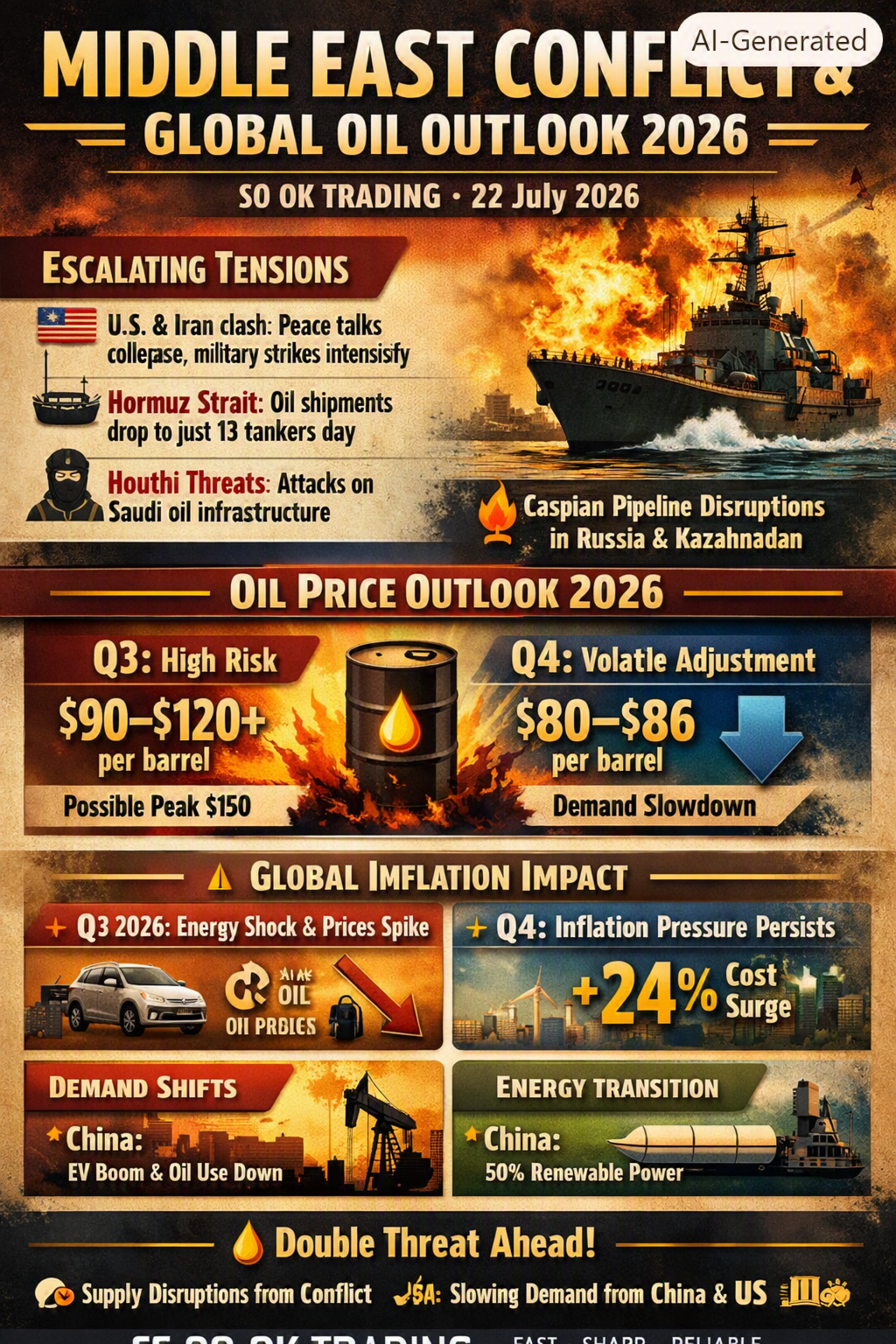
The year 2026 has become one of the most closely watched in global energy — the “energy battlefield” is in full swing. The ceasefire agreement between the United States and Iran has collapsed, leading to intensified military clashes in the Persian Gulf.
Strait of Hormuz: The world’s main oil shipping route faces severe restrictions, with daily tanker traffic reduced to just 13 vessels — a sign of extreme risk.
Houthi Forces: Threats to blockade shipping lanes and attack Saudi oil infrastructure.
External Factors: Russia–Kazakhstan’s CPC pipeline was disrupted after drone strikes in the Black Sea, further tightening global supply.
⛽ Oil Price Outlook Q3–Q4/2026
Q3 begins with strong upward pressure from war and shipping disruptions. Brent crude hovers near $90 per barrel, with potential spikes to $95. Analysts warn that in the worst case, prices could surge past $100–120, or even $150 if full-scale war breaks out.
By Q4, the picture shifts slightly. While geopolitical risks remain, slowing demand from China and the U.S. is expected to ease prices toward $80–86 per barrel. If no further escalation occurs, the market may enter a “breathing space” after the mid-year surge.
In short: Q3 is tense and prone to sharp spikes, while Q4 is volatile but adjusting downward — though still high compared to long-term averages.
Global Inflation Outlook Q3–Q4/2026
The oil price surge in Q3 reignites global inflation pressures. Rising energy costs immediately push up transportation, consumer goods, and industrial inputs. Rystad Energy warns that if oil breaches $100, the world could face a new inflation shock.
In Q4, even as oil prices stabilize, inflationary effects persist. Elevated energy costs have already seeped into production structures. The World Bank projects overall energy prices in 2026 to rise by 24%, dragging fertilizer and food costs higher worldwide.
Shifts in Demand
China: Crude oil demand in 2026 is down 4.9%, with refined products (gasoline/diesel) plunging 6.4%. EV adoption and renewable energy capacity surpassing 1.8 billion kW are structurally reducing fossil fuel reliance. Strategic reserves stand at 900–1,400 million barrels.
United States: Demand slows under inflationary pressure, but production increases and reserve releases stabilize supply. Energy agreements with China expand WTI and LNG exports, reducing reliance on the Middle East.
⚡ Global Energy Transition
China: Renewable energy installations reach 50% of total capacity, with actual clean power generation at 43–45%.
United States: Under Trump’s “American Energy Dominance” policy, drilling permits rise 55%. LNG exports surpass 100 million metric tons, while WTI crude is aggressively released into global markets.
✨ Summary
2026 resembles an energy rollercoaster. Q3 is marked by war-driven surges and shipping blockades, while Q4 sees adjustment yet remains elevated. Global economies and consumers continue to feel dizzy from inflation that refuses to ease.
The global energy market faces two simultaneous pressures:
Supply disruptions from war and blocked shipping routes.
Slowing demand from China and the U.S. amid structural energy shifts.
The result: oil prices could swing between $75–86 in the baseline case, and spike to $120–150 in worst-case scenarios.
✨ SO OK TRADING — FAST • SHARP • RELIABLE Your trusted business partner in global energy and trade