“2026 Global Turning Point: The Trump Era Shakes the World — From Washington to Beijing, Toward a New Bipolar Balance of Power”
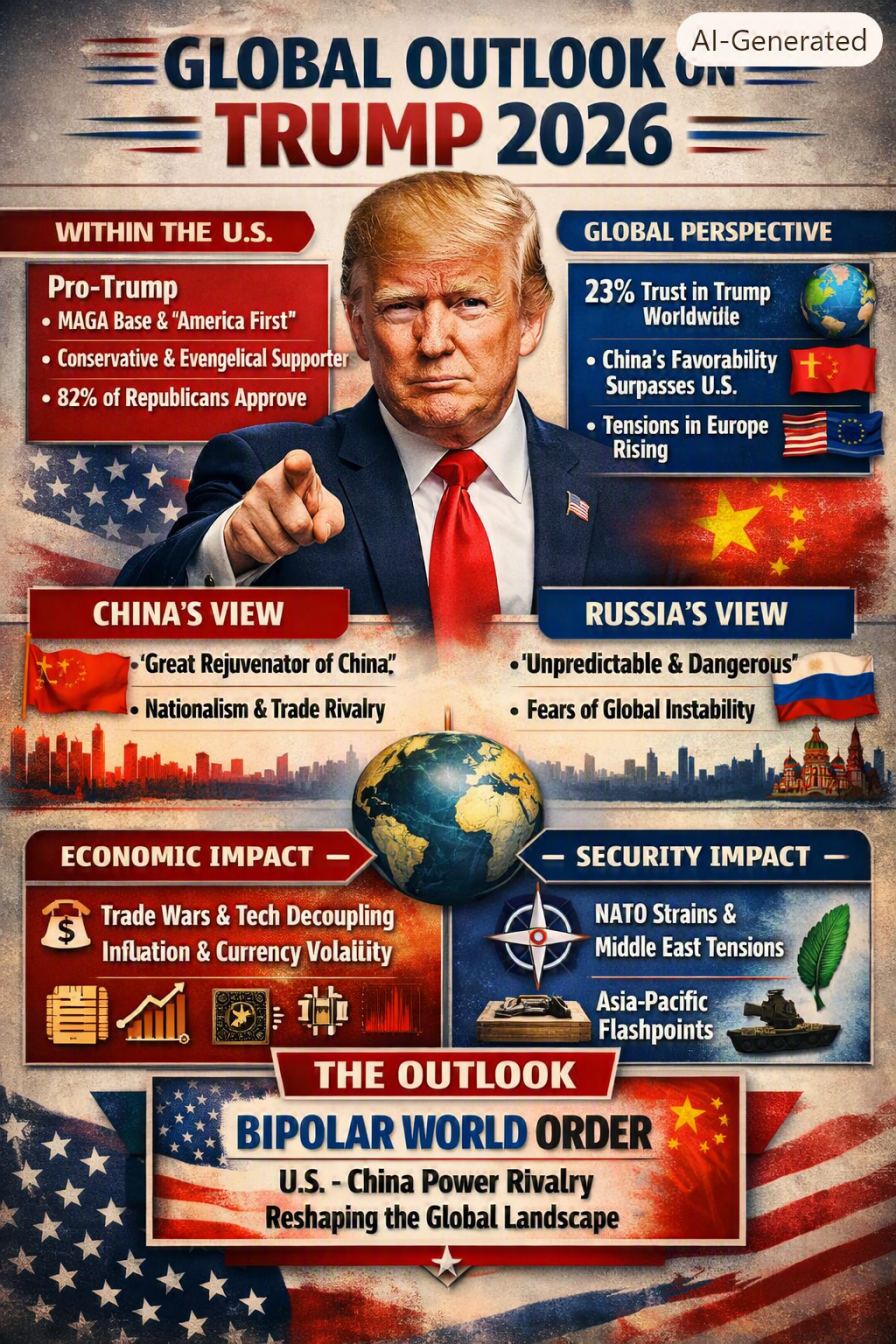
Global Perspectives and Roles of Donald Trump (Second Term – 2026)
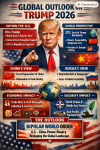
1. Within the United States
Supporters (Pro-Trump)
The MAGA base and “America First” policies remain solid.
White Christian and conservative groups see him as defending traditional values and being strict on immigration.
Over 82% of Republican supporters believe the country is better under his leadership.
Opponents (Anti-Trump)
59% of citizens disapprove of his performance, and 55% believe the country is heading in the wrong direction.
The economy is perceived as worsening (61% negative views), with Trump blamed for the decline.
Foreign policy, especially regarding Iran, faces heavy criticism (69% distrust).
More than 90% of Democrats view him as “dangerous” or “corrupt.”
2. Global Perspectives
Overall Negative Image
Global confidence has dropped to a historic low, with only 23% trusting Trump.
For the first time in over 20 years, China is viewed more positively than the U.S.
European leaders such as Macron and Merz criticize him for pushing the world into an “Age of Disorder.”
Remaining Allies
Israel, Poland, Japan, India, South Korea, and the Philippines still see the U.S. as a counterbalance to China.
3. Country-Specific Views
China
Mockingly referred to as “Chuan Jianguo” (Trump the builder of China).
Seen as stimulating nationalism and unity within China.
Concerns remain over trade wars and technological restrictions.
Russia
From past hopes to current suspicion and distrust.
Viewed as “unpredictable and dangerous.”
While some appreciate his disruption of the old order, many fear the consequences if the global system collapses.
4. Structural Impacts
Global Economy
Trade wars and tariffs: Supply chains disrupted, costs rising, inflation spreading across regions.
Tech decoupling: The U.S. restricts high-tech exports to China, forcing a technological divide.
Currency and interest rate volatility: Pressure on the Fed creates global uncertainty, especially for emerging markets with dollar-denominated debt.
Global Security
NATO shaken: Questioning Article 5 pushes Europe to strengthen independent military capabilities.
Middle East: Hardline policies toward Iran increase risks of military confrontation.
Asia-Pacific: Confrontation with China over Taiwan and the South China Sea creates new flashpoints.
5. Outlook and U.S. Role
Global Economy
The U.S. remains the world’s financial center, with the dollar as the primary reserve currency.
“America First” policies push the world into a “Bipolar Economy” between the U.S. and China.
Emerging markets face pressure from volatile interest rates and currency fluctuations.
Global Security
The U.S. role as “security guarantor” has visibly diminished.
European and Asian allies seek alternatives, such as military and economic groupings independent of the U.S.
The world is shifting from multilateralism to a system where “interests and power” dominate negotiations.
✦ Summary
Donald Trump in his second term is seen as a decisive yet unpredictable leader.
Domestic: Conservative support remains strong, but the majority of citizens disapprove of his governance.
Global: Confidence has plummeted, with Western allies seeking new alternatives.
China and Russia: View him as both a catalyst and a threat.
Outlook: The world is entering a “Bipolar Order” where the U.S. is no longer the sole guarantor of stability, yet remains a critical variable shaping global economic and security directions.