“SO OK INSIGHT: Dollar Strong – Baht Weak, Global Economic Shock Signals · July 2026”
Thai Baht Outlook and U.S. Dollar Index – July 2026
Article by SO OK TRADING | July 17, 2026
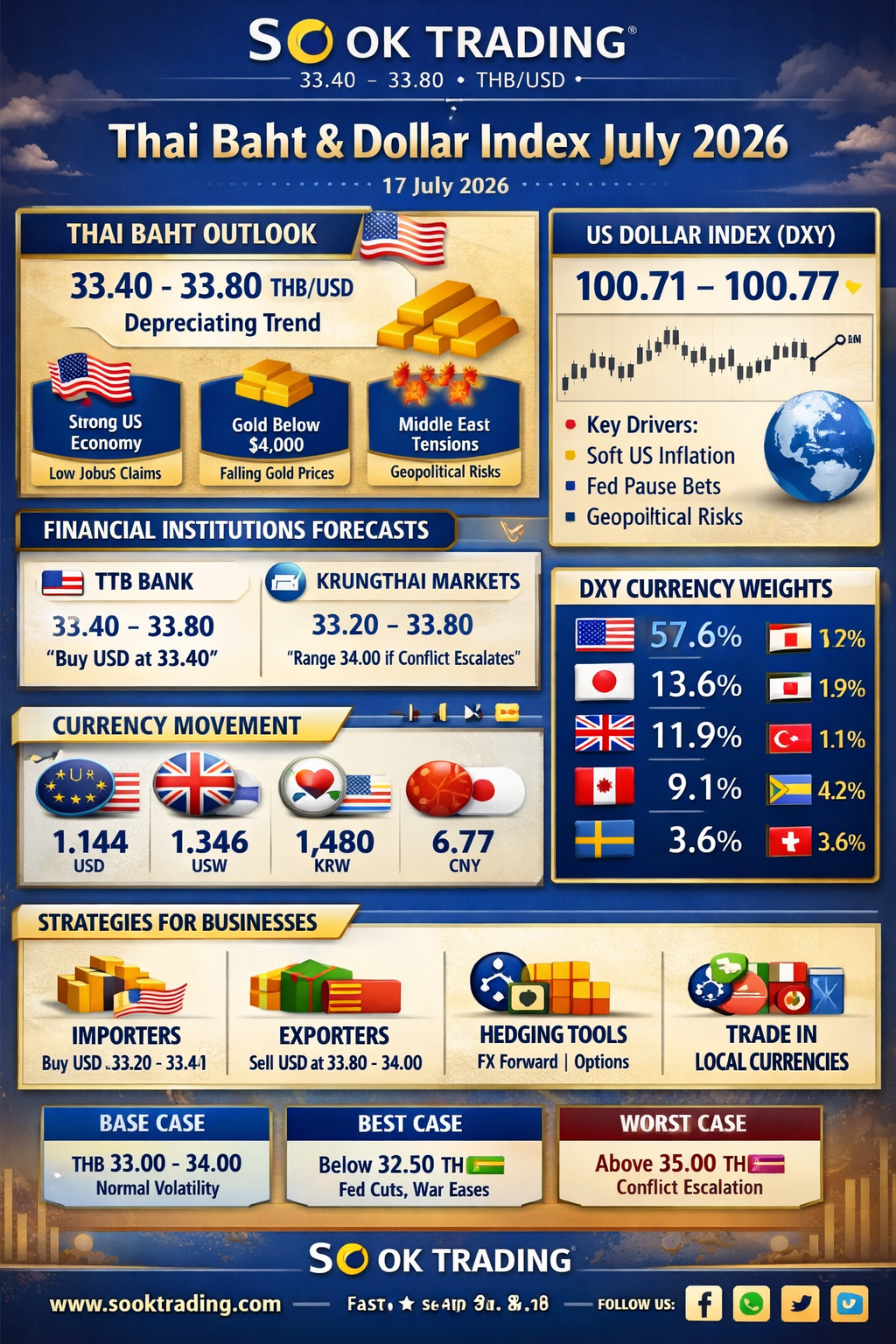
In July 2026, global financial markets continue to monitor the Thai Baht, which shows a clear depreciating trend and fluctuates within a two-way risk range of 33.40 – 33.80 THB/USD. Key pressures include stronger-than-expected U.S. economic performance, falling global gold prices, and prolonged geopolitical tensions in the Middle East.
Key Drivers: Global Economy · U.S. Economy · Thai Economy · Baht Forecast
Strong U.S. Economy: Jobless claims declined and the manufacturing index surged → U.S. dollar and bond yields rose, pressuring the Baht.
Gold Price Decline: Dropped below $4,000/oz → Triggered gold buying and added pressure on the Baht.
Geopolitical Tensions: Conflicts in the Middle East and the Strait of Hormuz → Oil prices surged, pushing investors toward safe-haven U.S. dollar assets.
Financial Institutions’ Views
TTB Bank: Forecast range 33.40–33.80 THB/USD. Depreciating trend → Recommend gradual USD buying at 33.40 and selling at 33.80.
Krungthai GLOBAL MARKETS: Forecast range 33.20–33.80 THB/USD. No clear direction → If conflict escalates, may test 34.00.
U.S. Dollar Index (DXY)
As of July 17, 2026, DXY traded at 100.71–100.77, with a daily range of 100.44–100.83 and a 52-week range of 95.55–101.80.
Key Influences
U.S. inflation (CPI & PPI) lower than expected → Pressured DXY.
Market reduced expectations of Fed rate hikes.
U.S.–Iran tensions → Supported safe-haven demand for the dollar.
DXY Composition (Major Currency Weights)
Euro (EUR): 57.6% – Strong inverse correlation with USD.
Japanese Yen (JPY): 13.6% – Safe haven, weakens when interest rate gap widens.
British Pound (GBP): 11.9% – Moves in line with EUR.
Canadian Dollar (CAD): 9.1% – Closely tied to oil prices.
Swedish Krona (SEK): 4.2% – Sensitive to global risk sentiment.
Swiss Franc (CHF): 3.6% – Strongest safe-haven currency.
Other key currencies: Chinese Yuan (CNY), Australian Dollar (AUD), New Zealand Dollar (NZD).
Major Currency Movements (July 17, 2026)
Euro (EUR): 1.144 USD/EUR → Supported by weaker U.S. inflation.
Pound (GBP): 1.346 USD/GBP → BoE expected to keep rates higher for longer.
Korean Won (KRW): 1,480 KRW/USD → Strong rebound from capital inflows.
Chinese Yuan (CNY): 6.77 CNY/USD → PBOC maintained stability.
Singapore Dollar (SGD): 1.290 SGD/USD → Slight depreciation.
Japanese Yen (JPY): 162.42 JPY/USD → Continued weakness due to wide interest rate gap.
Recommended Exchange Strategies for Thai Businesses
Importers: Buy USD at 33.20–33.40 when DXY falls or Fed signals rate cuts.
Exporters: Sell USD at 33.80–34.00 during risk-off events (conflict escalation or gold price drop).
Risk Management Tools
FX Forward → Lock in rates in advance.
FX Options → Buy rights to limit risk exposure.
FCD Accounts → Use export USD revenue directly for imports.
Local Currency Settlement → Trade in CNY, JPY, SGD to reduce USD volatility.
Q3 2026 Baht Outlook
The Baht is expected to depreciate with high volatility (Sideways Up), trading in the range of 33.00–34.00 THB/USD.
Scenarios (Krungthai GLOBAL MARKETS)
Base Case: 33.00–34.00 THB/USD.
Best Case: Below 32.50 THB/USD if conflict eases and Fed cuts rates more than expected.
Worst Case: 35.00–36.00 THB/USD if conflict escalates and Thai economy worsens.
✨ In the second half of 2026, the Baht is expected to weaken and remain highly volatile. Thai businesses should actively use financial tools to hedge risks and set strategies aligned with their operations.
SO OK TRADING Your Business Partner FAST • SHARP • RELIABLE www.sooktrading.com Facebook: SO OK TRADING