“Aluminum Dominates Thai Kitchens – Rising Star of the Home Cooking Era, Transforming into the New PFAS-Free & Smart Kitchen Market Outlook by SO OK TRADING (2026–2035)”
Thai Aluminum Cookware Market – Industry Direction and Outlook 2026–2035
By SO OK TRADING | July 14, 2026
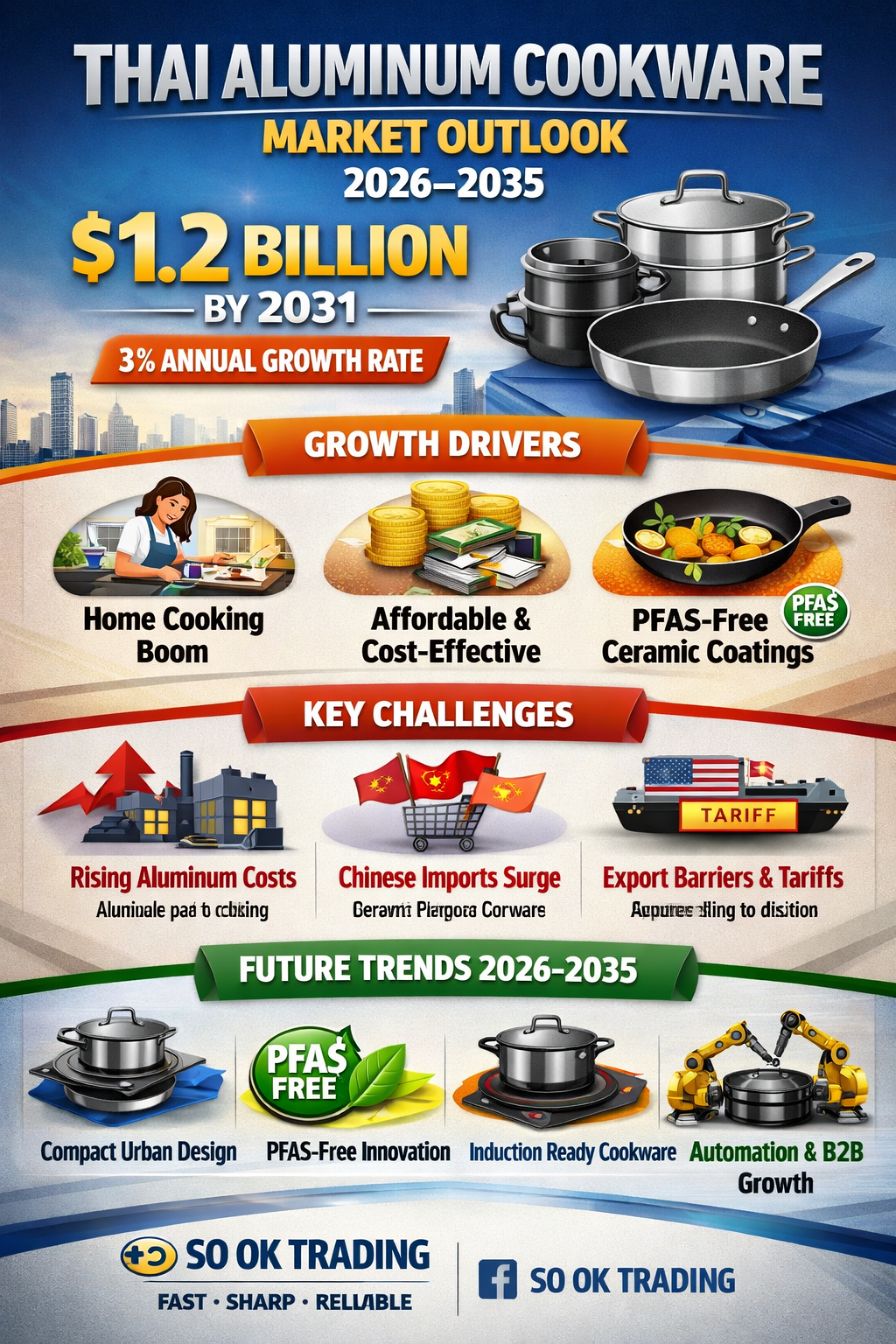
As Thai consumers increasingly return to cooking at home, aluminum cookware is emerging as the star of the kitchen. With its lightweight design, fast heat conduction, and affordable price, aluminum cookware remains accessible even in times of economic volatility. Today, the market value exceeds THB 1 billion, and is projected to reach THB 1.207 billion by 2031, with an average annual growth rate of around 3%.
Growth Drivers – Thai Aluminum Cookware Industry
One of the most important drivers is the Home Cooking trend, which continues to rise. Young professionals and families in urban areas are choosing to cook at home to save costs and maintain healthier lifestyles, leading to a clear increase in demand for basic cookware such as pots, pans, and aluminum utensils.
Additionally, price competitiveness ensures aluminum cookware remains the “first choice” for the mass market and small restaurants, as it is more affordable than stainless steel or cast iron. At the same time, manufacturers are innovating with non-stick, ceramic, and PFAS-free coatings, targeting premium and health-conscious segments — the fastest-growing category today.
⚠️ Challenges Facing the Industry
Despite growth, several pressures remain:
Rising raw material costs: Global aluminum price volatility forces Thai manufacturers to improve production efficiency to maintain competitive pricing.
Chinese competition: Low-cost imports flood the market via e-commerce platforms, pushing Thai producers to focus on niche markets or B2B contracts.
Export tariffs: Thai factories that relied heavily on the U.S. market must diversify into India, South Korea, and ASEAN countries.
Consumer Behavior
Thai consumers are divided into two main groups:
Budget-conscious buyers (Raw Aluminum): Focus on affordability, often purchasing from wholesale shops or local markets, with little concern for brand loyalty.
Health-conscious buyers (Non-stick Aluminum): Prioritize safety, checking for PFAS/PFOA-free coatings and induction compatibility, especially among condo dwellers.
Manufacturer Strategies
Global brands entering the mass market: Leveraging omnichannel and influencer marketing while shifting production bases to Thailand to reduce tariff risks.
Traditional Thai factories: Investing in automation to cut labor costs and expanding into B2B partnerships with restaurants and hotels for stable revenue streams.
Export–Import Outlook
Exports: The U.S. accounts for over 40% of Thailand’s aluminum cookware exports, with non-stick and Thai-style designs leading the way.
Imports: China dominates with over 80% market share, supplying low-cost cookware that forces Thai producers to pivot toward niche or contract manufacturing.
Industry Outlook 2026–2035
The Thai cookware market is entering a decade of transformation, driven by four megatrends:
Urbanization – Modular & stackable designs for compact living spaces.
PFAS-Free Era – By 2030, PFAS/PFOA coatings will be rejected, shifting toward ceramic and eco-friendly materials.
Induction-Compatible Era – Gas bans in new residences will push demand for induction-ready cookware with stainless steel bases.
Automation & B2B – Factories will adopt automation and partner with restaurant chains and hotels for long-term growth.
✨ Conclusion
The Thai aluminum cookware market remains a rising star, growing steadily despite cost pressures and foreign competition. With evolving consumer behavior and continuous innovation, manufacturers that adapt quickly will secure strong positions both domestically and internationally.
The future is clear: Thai cookware is moving toward maximum safety (PFAS-Free), compact designs for urban living, and production aligned with new technologies.
SO OK TRADING – Your Trusted Business Partner FAST • SHARP • RELIABLE www.sooktrading.com Facebook: SO OK TRADING