Share

“War Shakes the World, Energy Boils, Economy Trembles” — When the USA–Iran Conflict Reignites : July 9, 2026 : SO OK TRADING
Last updated: 9 Jul 2026
345 Views

 “US–Iran War Shakes Global Energy and Economy”
Reignited on July 9, 2026 — Impacting Wallets Worldwide By SO OK TRADING

 
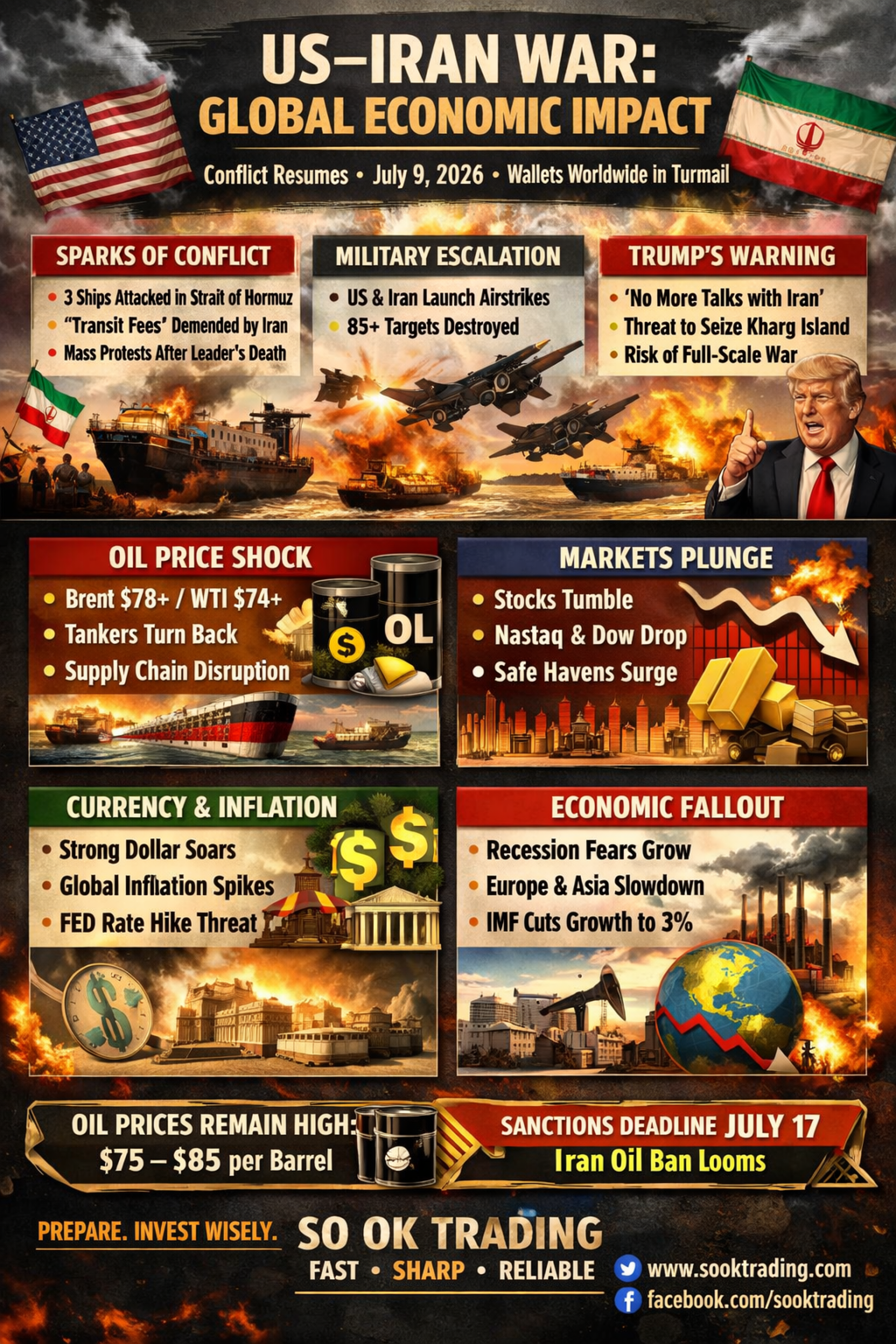
The World Heats Up Once Again! The fragile ceasefire agreement (MOU) between the United States and Iran has collapsed, igniting a new wave of military clashes that reverberate across geopolitics and the global economy. Oil prices surge, stock markets tumble, and the dollar strengthens — shaking everything from energy giants to ordinary households.

 
⚔️ Latest Military Escalation

The US launched airstrikes on more than 80 targets, destroying missile bases, IRGC speedboats, and radar systems in key port cities.
Iran retaliated immediately, striking over 85 US military bases in Kuwait and Bahrain with missiles and drones.
Damage spread to civilian infrastructure, including railway bridges, airports, and power grids.
 
⛽ Energy and Global Economic Impact

Oil prices jumped 5%: Brent hit $78.80 per barrel, WTI reached $74.30.
Oil and LNG tankers turned back, avoiding the Strait of Hormuz, disrupting global energy supply routes.
US stock markets fell, with Nasdaq and Dow Jones down about 0.8% under inflationary pressure.
The IMF cut global growth forecasts to 3.0%, with Europe and Asia hit hardest.
 
Currency and Inflation Shock

The US dollar strengthened as investors flocked to safe-haven assets.
Surging energy prices reignited global inflation, raising production costs and living expenses.
The Federal Reserve now has a one-in-three chance of raising interest rates this month to curb inflation, reversing earlier expectations of cuts.
US 10-year Treasury yields climbed to their highest since May.
 
Regional Economic Fallout

Europe (Eurozone): Suffers most from accumulated energy costs, growth forecast cut to 0.9%.
China & India: Heavy reliance on energy imports via the Strait of Hormuz (75%) led to growth downgrades — China to 4.6%, India to 6.4%.
United States: Relatively stable, but still exposed to global market turbulence.
 
️ Trump’s Stance and War Outlook (July 8, 2026)

Declared at NATO: “Negotiating with Iran is a waste of time.”
Threatened heavier strikes and hinted at seizing Kharg Island, Iran’s key oil export hub.
If seized, it would mean US ground forces entering — escalating into a potential full-scale war.
Trump, however, insists the situation will not spiral into all-out war, though the world watches closely.
 
Energy Market Outlook (Update July 9, 2026)

Oil prices remain high, trading in the $75–85 per barrel range.
July 17 deadline: US sanctions on Iranian oil set to take full effect, tightening global supply further.
Fed may raise interest rates to fight inflation, adding pressure to global financial markets.
 
Key Takeaways for Businesses and Investors

Energy is the core risk: Every move in the Strait of Hormuz shakes global oil prices instantly.
Currency & Interest Rates: Stronger dollar and possible Fed hikes weigh on global markets.
Global volatility: Europe and Asia suffer most, while the US remains relatively resilient.
Diversify risk: Gold and safe-haven assets remain crucial in uncertain times.
 
✨ “This war shakes not only energy, but also currencies and the entire global economy.” SO OK TRADING — FAST • SHARP • RELIABLE www.sooktrading.com Facebook: SO OK TRADING

Related Content
Global Plastic Crisis 2026: Rising Costs as War and Naphtha Shake the Industry
Global Plastic Crisis 2026: How War and Naphtha Shook the Industry Article by SO OK TRADING | April 5, 2026 Plastic — once considered a basic raw material of everyday life — has now become a “scarce commodity” shaking the world in April 2026. The ongoing Middle East conflict and the global naphtha shortage have delivered a heavy blow to the petrochemical industry, driving plastic prices sharply upward and impacting every sector, from food packaging to automotive components. This article explores: The roots of the crisis — from the Hormuz Strait blockade to factory shutdowns in the Middle East The impact on prices and costs — with plastic prices soaring over 37% in just one month The situation in Thailand and worldwide — as industries face severe shortages Adaptation strategies — with governments and businesses racing to implement solutions This is not just about “rising costs” — it is about “shortages” that are reshaping global industry in unprecedented ways. SO OK TRADING Your Trusted Business Partner FAST • SHARP • RELIABLE
5 Apr 2026
“RDF Transforms Waste into Thailand’s Clean Energy Future — Igniting the Economy and Driving the Transition to Renewable Power”   SO OK TRADING: June 13, 2026
RDF – Waste-Derived Fuel and the Future of Renewable Energy in Thailand By SO OK TRADING | June 13, 2026 ♻️ Waste is no longer just “garbage” — it has become the energy of the future! RDF (Refuse-Derived Fuel) is fuel produced from municipal solid waste, carefully sorted and processed to make it suitable for combustion, generating sustainable heat and electricity. As the world moves toward Net Zero Carbon, and industries adapt to Europe’s CBAM regulations, RDF has emerged as Thailand’s new energy solution — cutting costs while reducing dependence on coal.
13 Jun 2026
“Energy Pulse 2026: Naphtha Recovery – Positive Signals from the Global Energy Crisis Toward a New Market Balance” Article by SO OK TRADING | May 18, 2026
Naphtha Crisis 2026 – Latest Situation Update Positive Outlook | SO OK TRADING Since the outbreak of the Middle East conflict in late February, the global energy market has been shaken dramatically. Crude oil prices surged past $150 per barrel, driving Asian naphtha prices to nearly double. By mid‑May, prices corrected to $897 per ton, though still 62.54% higher than last year. Even as prices begin to ease, supply chain “lag effects” remain — shipping delays of 15–20 days and congested ports due to competition for raw material shipments from the Middle East continue to pressure industries across Asia. In Thailand, SCGC declared force majeure and temporarily shut down the Rayong Olefins plant, while PTTGC and SCGC are studying the establishment of a joint venture to enhance flexibility and reduce long‑term costs. In Japan, leading snack brand Calbee announced a packaging strategy shift, reducing color printing on 14 products to black‑and‑white to cope with ink and resin shortages — reflecting the rising trend of “minimalist design” during the crisis. At the same time, recovery signals are emerging: Naphtha prices dropped from the peak of $1,020 → $897 per ton Spreads rebounded: Ethylene–Naphtha +250–280 / Propylene–Naphtha +310–330 Plastic prices remain high but show signs of stabilization If the Middle East situation does not flare up again, this crisis is expected to ease by late June – early July 2026. SO OK TRADING FAST • SHARP • RELIABLE Your Trusted Business Partner
18 May 2026
This website uses cookies for best user experience, to find out more you can go to our Privacy Policy and Cookies Policy
Powered By MakeWebEasy Logo MakeWebEasy