Share

“China: The Global Resource Game Master — Rare Earth Revolution and Mineral Empire Towards Future Energy” SO OK TRADING : July 6, 2026
Last updated: 6 Jul 2026
88 Views

 China: The Global Powerhouse of Mineral Resources and Energy
BASE METAL | PRECIOUS METAL | RARE EARTH | ENERGY OUTLOOK 2026–2040 By SO OK TRADING — FAST • SHARP • RELIABLE July 6, 2026

 
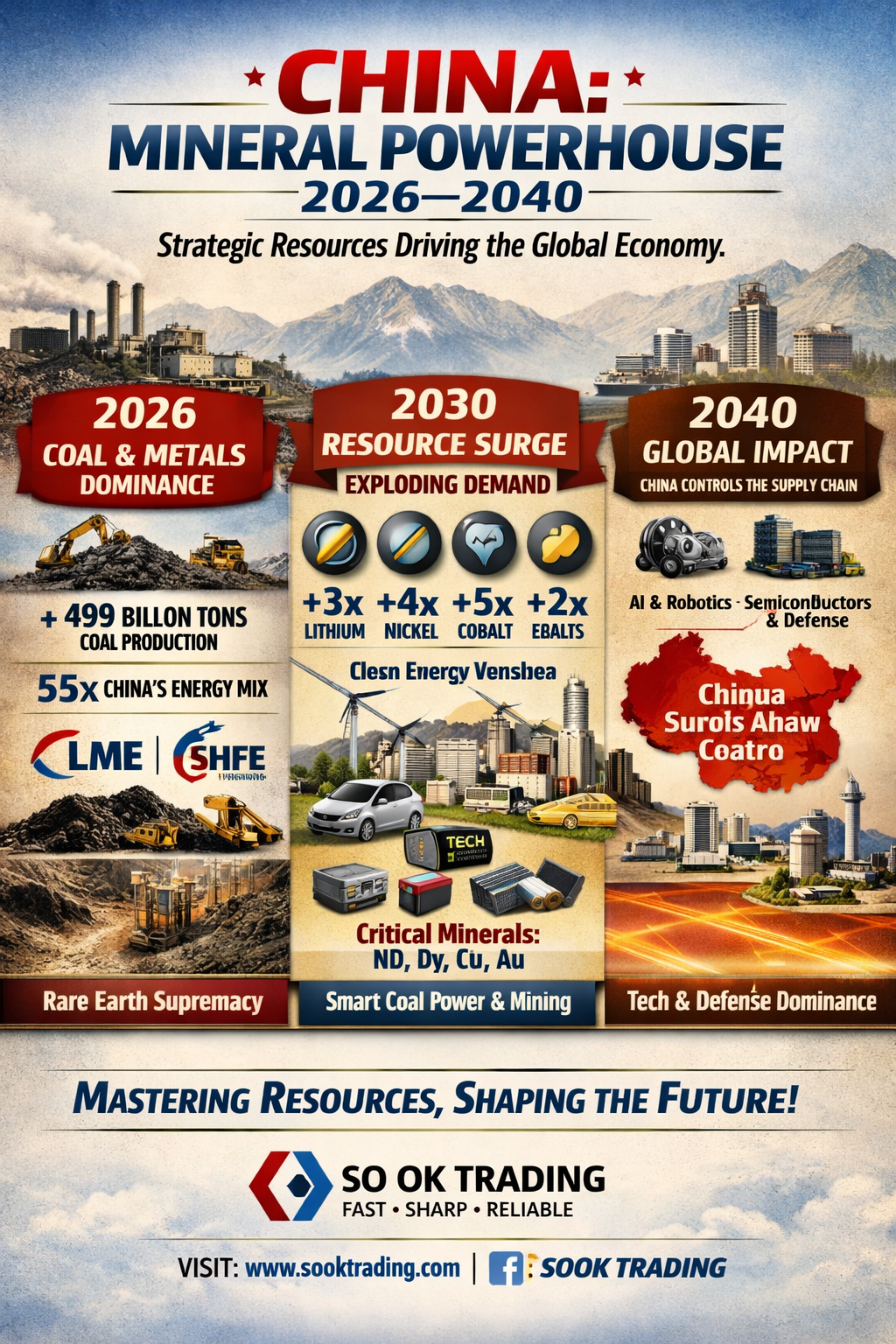
When speaking of the “treasures beneath the earth” that drive the global economy in this century, no one can overlook China. The country not only ranks first in the production of 17 types of minerals but also possesses vast strategic reserves spread across its territory — from rare earths essential for advanced technologies to precious metals that underpin global finance and the new energy industry.

China is not merely a producer but the game master of global resources. By consolidating mines into state-owned giants such as China Northern Rare Earth Group and China Rare Earth Group, it secures pricing power and strategic stability. This makes China both the “factory of the world” and the controller of strategic resources, influencing innovations in military technology, AI, and beyond.

 
⚙️ Rare Earth & Future Technologies

Bayan Obo (Inner Mongolia): The largest rare earth deposit in the world, supplying magnets and high-tech electronics.
Ganzhou (Jiangxi): Known as the “Capital of Rare Earths” and “World Tungsten City,” playing a vital role in the global supply chain.
Sichuan & Hunan: Sources of lithium, fluorite, and tin — critical for EV batteries.
 
⚡ New Energy, Batteries & Lithium

Jijiaoshan (Hunan): A massive lithium deposit directly feeding EV battery factories.
Salt Lakes (Qinghai & Tibet): Producing lithium carbonate from brine, with major investments from Ganfeng Lithium and BYD.


Related Content
Copper Usage and Trend of it use and price
Copper's excellent electrical/thermal conductivity, corrosion resistance, and antimicrobial properties make it vital for electrical wiring, plumbing (pipes, fittings), and electronics; it's also crucial in construction (roofing, gutters), transportation (EVs, radiators), machinery (motors, pumps), and has uses in medicine (hospital surfaces), art, and agriculture (fungicides). Its role is growing with the energy transition (solar, wind, EV infrastructure). Key Applications by Industry Electrical & Electronics: Wires, cables, circuit boards, motors, transformers, switches, connectors (essential for data centers, AI, EVs). Construction: Plumbing (pipes), roofing, gutters, downspouts, architectural details, door handles (due to antimicrobial nature). Transportation: Vehicle wiring, motors, radiators, braking systems, marine hardware (anti-fouling). Industrial Machinery: Heat exchangers, pumps, valves, bearings, industrial piping. Medical: Hospital surfaces, doorknobs, equipment (reduces bacteria). Consumer Goods: Cookware, jewelry, musical instruments, tools, decorative items. Agriculture: Copper sulfate used as fungicide and algaecide. Why Copper is Used High Conductivity: Best for transferring electricity and heat efficiently. Corrosion Resistance: Resists weathering and soil corrosion, ideal for water/plumbing. Malleability & Ductility: Easy to shape and draw into wires. Antimicrobial: Kills microbes, reducing infection spread. Durability & Recyclability: Long-lasting and highly sustainable
21 Dec 2025
ทิศทางการใช้ อลูมิเนียมในอนาคต (ปี2026) , ทิศทางราคาอลูมิเนียม และ สถานะการณ์ Carbon Footprint
ทิศทางในอนาคตของอลูมิเนียมไทยมุ่งเน้น ความยั่งยืน (Sustainability) และ เทคโนโลยีขั้นสูง (Advanced Technology) โดยจะเน้น อลูมิเนียมคาร์บอนต่ำ และ อลูมิเนียมรีไซเคิล เพื่อตอบโจทย์อุตสาหกรรมยานยนต์ไฟฟ้า (EV) และการก่อสร้างที่เป็นมิตรต่อสิ่งแวดล้อม พร้อมพัฒนา การเคลือบผิวใหม่ๆ และระบบเศรษฐกิจหมุนเวียน (Circular Economy) เช่น โครงการ Aluminium Loop เพื่อลดต้นทุน เพิ่มมูลค่า และรักษาความสามารถในการแข่งขันในตลาดโลก. แนวโน้มสำคัญ: การเติบโตในอุตสาหกรรมยานยนต์ไฟฟ้า (EV): รถ EV ต้องการใช้อลูมิเนียมเพิ่มขึ้นมากเพื่อลดน้ำหนัก ช่วยประหยัดพลังงานและเพิ่มระยะทางวิ่ง. ความต้องการอลูมิเนียมคาร์บอนต่ำ (Low-Carbon Aluminium): ตอบสนองมาตรการสิ่งแวดล้อมทั่วโลก (เช่น EU CBAM) โดยเฉพาะการใช้อลูมิเนียมรีไซเคิลสูง ซึ่งลดการปล่อยคาร์บอนได้มาก. เศรษฐกิจหมุนเวียน (Circular Economy): โครงการอย่าง "Aluminium Loop" ขับเคลื่อนการรีไซเคิลบรรจุภัณฑ์อลูมิเนียมครบวงจร เพื่อลดขยะและสร้างมูลค่า. นวัตกรรมการเคลือบผิว (Coating Innovations): การเคลือบผิวแบบใหม่ๆ เพื่อเพิ่มฟังก์ชัน เช่น ป้องกันแบคทีเรีย (Anti-microbial) ทำความสะอาดง่าย (Easy-to-clean) สร้างผิวสัมผัสใหม่. การก่อสร้างแบบสำเร็จรูปและโมดูลาร์ (Modular Construction): ใช้อลูมิเนียมมากขึ้นในการผลิตชิ้นส่วนสำเร็จรูปนอกสถานที่ เพื่อความแม่นยำและลดของเสีย. การบูรณาการพลังงานหมุนเวียน (Renewable Energy): ใช้อลูมิเนียมในโครงสร้างรองรับแผงโซลาร์เซลล์ และระบบพลังงานสะอาดอื่นๆ. ความท้าทาย: ต้นทุนพลังงาน & ห่วงโซ่อุปทาน: ความผันผวนของราคาพลังงานและความท้าทายในห่วงโซ่อุปทาน. การแข่งขัน: ประเทศคู่แข่งเร่งพัฒนาเทคโนโลยีรีไซเคิล ทำให้ไทยต้องพัฒนาต่อเนื่องเพื่อรักษาผู้นำ. โอกาส: ไทยมีศักยภาพด้านแรงงานฝีมือ และอุตสาหกรรมต้นน้ำ-กลางน้ำ-ปลายน้ำที่ครบวงจร. การปรับตัวสู่การผลิตคาร์บอนต่ำสร้างโอกาสทางธุรกิจใหม่ๆ โดยเฉพาะการเป็นผู้นำด้านอลูมิเนียมรีไซเคิล. สรุป: อลูมิเนียมไทยจะก้าวสู่ยุคใหม่ที่เน้น "เขียว" (Green) และ "ฉลาด" (Smart) โดยการรีไซเคิลและเทคโนโลยีจะเป็นหัวใจสำคัญในการสร้างการเติบโตและความยั่งยืน.
16 Dec 2025
This website uses cookies for best user experience, to find out more you can go to our Privacy Policy and Cookies Policy
Powered By MakeWebEasy Logo MakeWebEasy