Share

“Peace Restored, Metals on Fire! Hormuz Strait Reopens, Global Supply Unlocked – Copper Surges, Aluminium Plunges, Zinc Fragile, Lead Oversupplied. In‑Depth Analysis of the Global Metals Market After the USA–IRAN Agreement”
Last updated: 16 Jun 2026
1306 Views

“Peace Restored, Metals Ignite! Hormuz Strait Reopens, Global Supply Unlocked – Copper Surges, Aluminium Plunges, Zinc Fragile, Lead Oversupplied” : SO OK TRADING | 16 June 2026

 
With the USA–IRAN agreement and the reopening of the Hormuz Strait, the global metals market (LME) has reignited overnight! The easing of geopolitical tensions has “unlocked” the supply chain for base metals, driving prices in sharply different directions depending on the metal.

Some, like Aluminium, are correcting downward as inventories rebound, while Copper is soaring on demand from AI and clean energy. Zinc remains balanced but vulnerable to industrial recovery, and Lead faces oversupply due to the EV transition away from lead-acid batteries.

 
Global Metals Market Analysis: Price + Stock + Situation

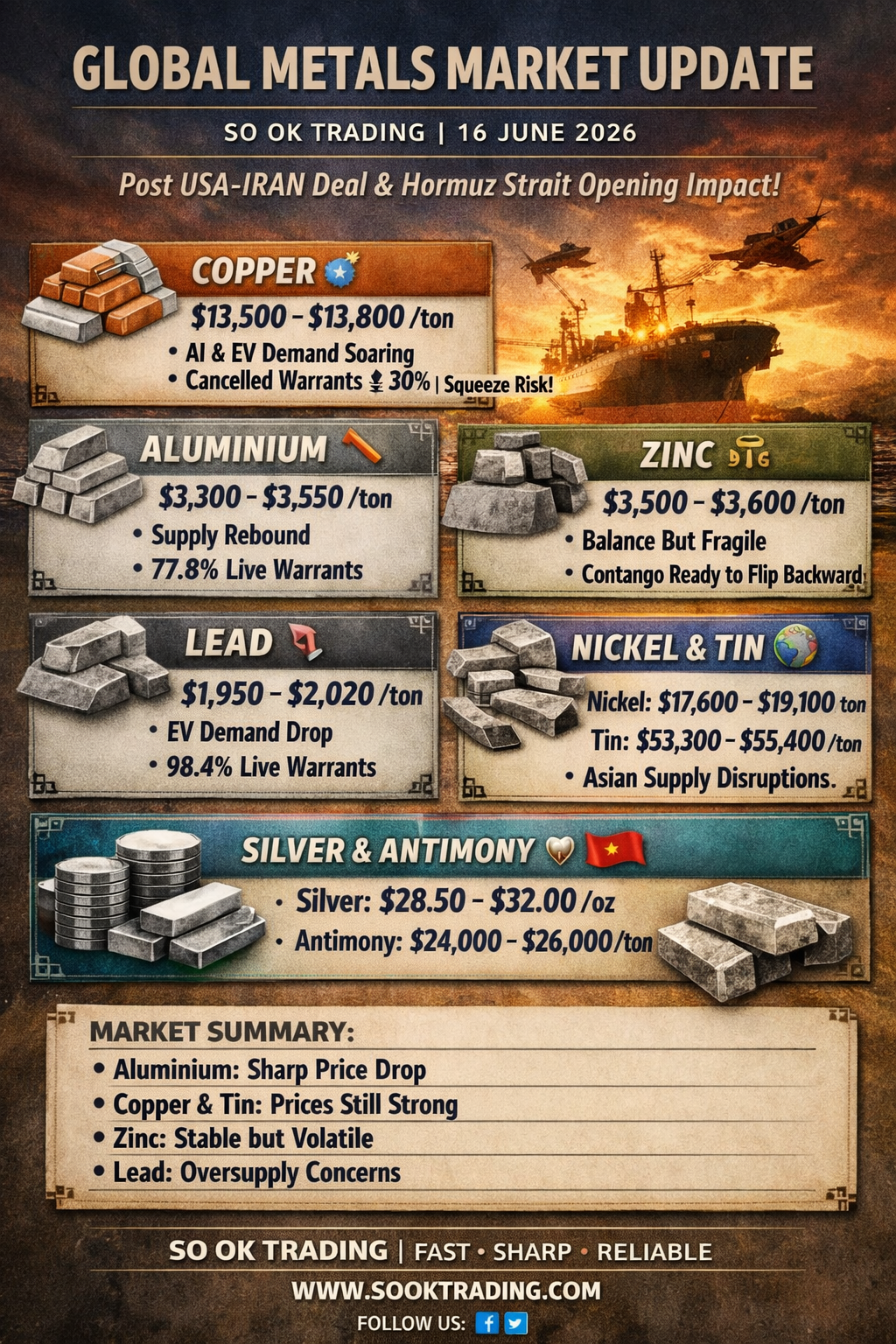
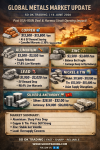
Copper: $13,500 – $13,800/ton. LME stocks ~361,600 tons (strategic build). Demand from AI, EV, and renewable energy is absorbing supply quickly. Cancelled Warrants up nearly 30% → squeeze risk.
Aluminium: $3,300 – $3,550/ton. Stocks ~322,000 tons (recovering from yearly low). Severe backwardation easing, supply gradually returning. Live Warrants at 77.8%.
Zinc: $3,500 – $3,600/ton. Stocks ~107,750 tons (very low). Steel & auto recovery could trigger backwardation. Currently mild contango.
Lead: $1,950 – $2,020/ton. Stocks rising (+14,000 tons). EV shift reduces lead-acid battery demand. Market in contango with 98.4% live warrants.
Nickel & Tin: Nickel $17,600 – $19,100/ton (volatile, driven by Indonesian battery output). Tin $53,300 – $55,400/ton (Myanmar mine closures & crackdown on illegal mining).
Silver & Antimony: Silver $28.50 – $32.00/oz (safe haven + solar demand). Antimony $24,000 – $26,000/ton (tight supply from China export restrictions).
 
Key Insight: The global metals market is split into two clear camps:

Correction metals (Aluminium, Lead) → prices falling as stocks recover
Demand-driven metals (Copper, Tin, Silver, Antimony) → prices holding strong on long-term structural demand
Investors must time their entry carefully to seize opportunities in this post-war transition.

 
SO OK TRADING – FAST • SHARP • RELIABLE Your trusted partner in global metals and international trade Visit: www.sooktrading.com Facebook: SO OK TRADING

Related Content
HNY 2026 with a First Analysis on Thai Baht Value
he Thai baht in Q1 2026 is expected to strengthen against the US dollar, driven primarily by a weaker dollar globally, a seasonal tourism boost, and expectations of US Federal Reserve rate cuts. This strength is occurring despite a weak domestic economic outlook and the Bank of Thailand's (BoT) likely continued easing of its policy rate. Exchange Rate Drivers and Forecast External Factors: The primary driver for the strengthening baht is external, mainly the broad weakness of the US dollar as global markets price in expected Fed rate cuts. The baht is also correlated with global gold prices, which have been climbing. Tourism High Season: The period extending into Q1 2026 is the high season for tourism, which typically brings in foreign currency and supports the baht's value. Policy Divergence: The BoT is expected to continue its easing cycle, potentially cutting the policy rate further to 1.00% by Q1 2026 to stimulate the sluggish domestic economy. This divergence from a potentially less aggressive US Fed in Q1 could support the baht in the short term, though some analysts warn the currency could weaken later in 2026. Forecasts: Projections for 2026 generally place the baht in a range of 30.80–33.00 per US dollar. Some models estimate it could trade around 31.06 by the end of Q1. A persistently strong baht below 31 per US$ is seen as a significant risk to the Thai export and tourism sectors. Key Economic Context Weak Growth: Thailand's economy is expected to slow down to a 5-year low growth rate of around 1.6-1.8% in 2026, pressured by US tariffs, global trade tensions, and high household debt. The central bank chief expects an improvement in Q1 2026 after a weak second half of 2025. Political Uncertainty: A general election expected in February 2026 could also introduce volatility, though some historical trends suggest the baht may strengthen following the formation of a new government. Low Inflation: Headline inflation is projected to remain subdued or even negative, providing the central bank with justification for further rate cuts to stimulate demand. In summary, Q1 2026 is characterized by a strong and volatile baht driven by external factors, contrasting sharply with a weak domestic economy and accommodative monetary policy.
1 Jan 2026
This website uses cookies for best user experience, to find out more you can go to our Privacy Policy and Cookies Policy
Powered By MakeWebEasy Logo MakeWebEasy