Share

“Peace Restored, Metals on Fire! Hormuz Strait Reopens, Global Supply Unlocked – Copper Surges, Aluminium Plunges, Zinc Fragile, Lead Oversupplied. In‑Depth Analysis of the Global Metals Market After the USA–IRAN Agreement”
Last updated: 16 Jun 2026
1307 Views

“Peace Restored, Metals Ignite! Hormuz Strait Reopens, Global Supply Unlocked – Copper Surges, Aluminium Plunges, Zinc Fragile, Lead Oversupplied” : SO OK TRADING | 16 June 2026

 
With the USA–IRAN agreement and the reopening of the Hormuz Strait, the global metals market (LME) has reignited overnight! The easing of geopolitical tensions has “unlocked” the supply chain for base metals, driving prices in sharply different directions depending on the metal.

Some, like Aluminium, are correcting downward as inventories rebound, while Copper is soaring on demand from AI and clean energy. Zinc remains balanced but vulnerable to industrial recovery, and Lead faces oversupply due to the EV transition away from lead-acid batteries.

 
Global Metals Market Analysis: Price + Stock + Situation

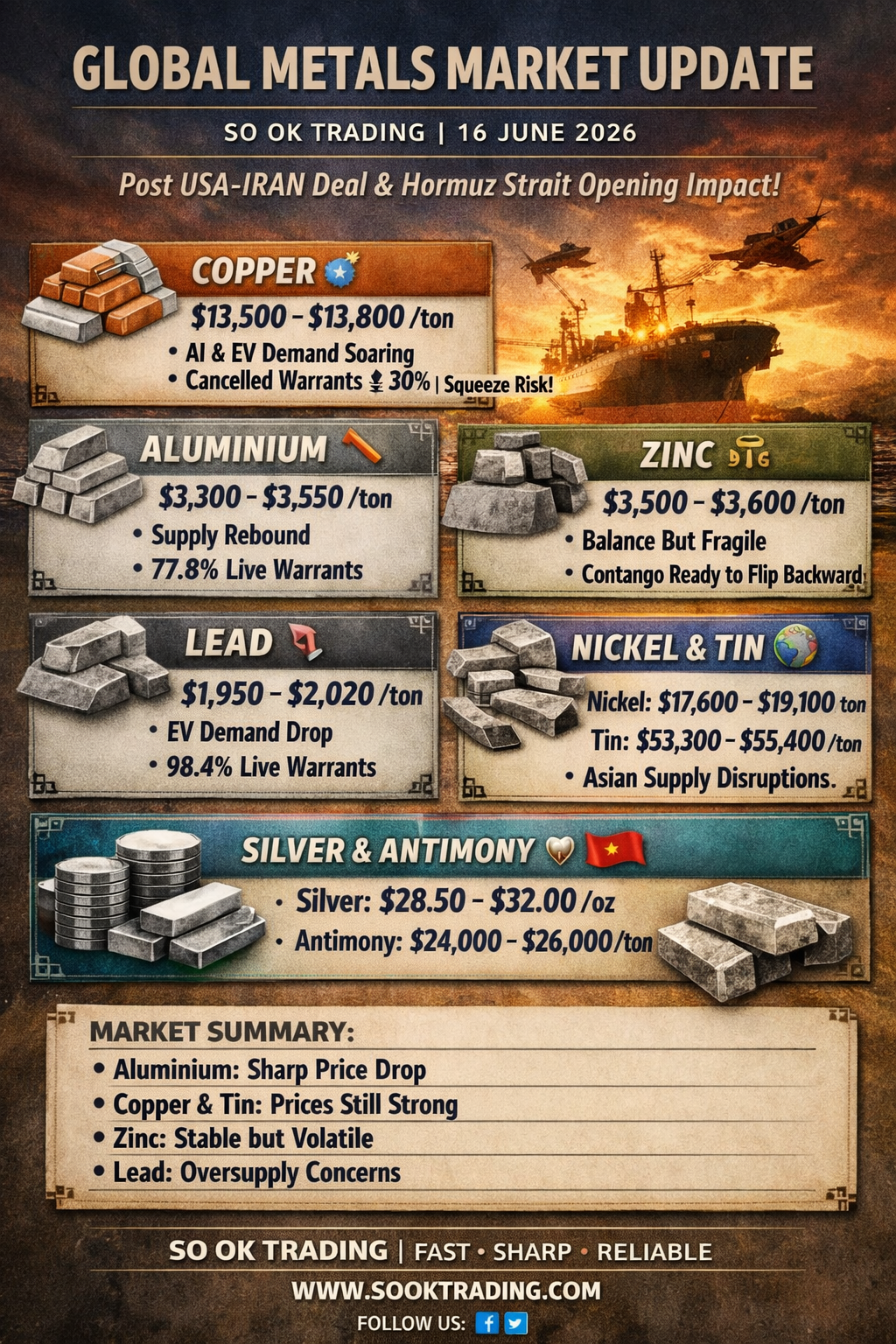
Copper: $13,500 – $13,800/ton. LME stocks ~361,600 tons (strategic build). Demand from AI, EV, and renewable energy is absorbing supply quickly. Cancelled Warrants up nearly 30% → squeeze risk.
Aluminium: $3,300 – $3,550/ton. Stocks ~322,000 tons (recovering from yearly low). Severe backwardation easing, supply gradually returning. Live Warrants at 77.8%.
Zinc: $3,500 – $3,600/ton. Stocks ~107,750 tons (very low). Steel & auto recovery could trigger backwardation. Currently mild contango.
Lead: $1,950 – $2,020/ton. Stocks rising (+14,000 tons). EV shift reduces lead-acid battery demand. Market in contango with 98.4% live warrants.
Nickel & Tin: Nickel $17,600 – $19,100/ton (volatile, driven by Indonesian battery output). Tin $53,300 – $55,400/ton (Myanmar mine closures & crackdown on illegal mining).
Silver & Antimony: Silver $28.50 – $32.00/oz (safe haven + solar demand). Antimony $24,000 – $26,000/ton (tight supply from China export restrictions).
 
Key Insight: The global metals market is split into two clear camps:

Correction metals (Aluminium, Lead) → prices falling as stocks recover
Demand-driven metals (Copper, Tin, Silver, Antimony) → prices holding strong on long-term structural demand
Investors must time their entry carefully to seize opportunities in this post-war transition.

 
SO OK TRADING – FAST • SHARP • RELIABLE Your trusted partner in global metals and international trade Visit: www.sooktrading.com Facebook: SO OK TRADING

Related Content
ALUMINUM PRICE TREND 2026
An analysis of the aluminum market in 2026 indicates a likely continued market deficit and upward price pressure, driven by constrained supply and resilient demand from green energy sectors. However, significant volatility is expected due to policy uncertainties and the potential for new Indonesian supply to eventually balance the market. Key Drivers and Projections for 2026 Supply Side Analysis Capacity Constraints: China's primary aluminum output is approaching its self-imposed 45 million-tonne capacity cap, limiting global supply growth. Power Challenges: Smelters outside of China face intense competition for power from energy-intensive sectors like AI data centers, which are willing to pay higher prices for long-term contracts. This has kept significant capacity offline in Europe and the US. Production Disruptions: Outages and potential shutdowns at existing smelters in Iceland and Mozambique further tighten the market. Scrap Supply Pressure: The EU's planned implementation of the Carbon Border Adjustment Mechanism (CBAM) and potential scrap export tariffs in spring 2026 are expected to impact global scrap flows, creating regional shortages and price volatility. New Capacity: Indonesia is a key source of new supply, with several projects in the pipeline. However, analysts suggest the pace of the ramp-up may be slower than expected due to infrastructure and policy challenges, meaning it is unlikely to fully offset near-term tightness. Demand Side Analysis Green Transition Demand: Demand from "green" sectors such as solar panels, new energy vehicles, and energy transition infrastructure remains strong, providing fundamental support for the market. Substitution Effect: Aluminum's wide price discount relative to copper has encouraged substitution in electrical applications, acting as a tailwind for demand and prices. Construction and Automotive: The construction and automotive industries continue to be major consumers, with growing demand for lightweight, low-carbon aluminum products. Price Forecasts and Volatility The market is expected to remain in a deficit in 2026, with estimates ranging from 200,000 to 600,000 tonnes. This structural tightness is leading most analysts to forecast sustained or rising prices. Bullish Views: Analysts at Bank of America project prices of $3,000/tonne as early as 2026. J.P. Morgan also expects prices to approach $3,000/tonne in Q1 2026. ING forecasts an average price of $2,900/tonne for the year. Bearish/Conservative Views: Goldman Sachs is an outlier, forecasting prices to decline to $2,350/tonne by Q4 2026, anticipating a market surplus later in the year. SMM forecasts a "high first, then lower" pattern, with prices finding equilibrium in the $2,700–$2,800/tonne range by year-end. Premiums: Regional premiums, particularly the US Midwest premium, are expected to remain high and volatile due to tariffs and regional supply dynamics, creating a disconnect from the LME benchmark price. In essence, 2026 is projected to be a year of high volatility where participants need to focus on scenario readiness rather than relying on a single price forecast, as geopolitical and energy policies significantly influence regional supply and costs
31 Dec 2025
Global Plastic Crisis 2026: Rising Costs as War and Naphtha Shake the Industry
Global Plastic Crisis 2026: How War and Naphtha Shook the Industry Article by SO OK TRADING | April 5, 2026 Plastic — once considered a basic raw material of everyday life — has now become a “scarce commodity” shaking the world in April 2026. The ongoing Middle East conflict and the global naphtha shortage have delivered a heavy blow to the petrochemical industry, driving plastic prices sharply upward and impacting every sector, from food packaging to automotive components. This article explores: The roots of the crisis — from the Hormuz Strait blockade to factory shutdowns in the Middle East The impact on prices and costs — with plastic prices soaring over 37% in just one month The situation in Thailand and worldwide — as industries face severe shortages Adaptation strategies — with governments and businesses racing to implement solutions This is not just about “rising costs” — it is about “shortages” that are reshaping global industry in unprecedented ways. SO OK TRADING Your Trusted Business Partner FAST • SHARP • RELIABLE
5 Apr 2026
“Thai Baht Weakens Further! Q3 2026 Outlook — SO OK TRADING Analyzes Baht Trends Amid Global Economic Storms”
Thai Baht Market Analysis — July 24, 2026 By SO OK TRADING : FAST • SHARP • RELIABLE The Thai Baht continues to show a weakening trend today, pressured by surging Brent crude prices above $100 per barrel and escalating geopolitical tensions in the Middle East. Meanwhile, the US Dollar has regained strength as a safe-haven asset. In this analysis, we provide a comprehensive overview of the market, key driving factors, and the Outlook for both the Thai Baht (THB) and the US Dollar (USD) from Q3 through the end of 2026, enabling businesses and investors to plan their strategies with precision.
24 Jul 2026
This website uses cookies for best user experience, to find out more you can go to our Privacy Policy and Cookies Policy
Powered By MakeWebEasy Logo MakeWebEasy