Share

“Thailand Agriculture’s Dual Battle 2026: Durian’s Golden Year VS Rice’s Challenging Era — From Farms to the World, A New Path Forward” SO OK TRADING | 4 JUNE 2026

Last updated: 4 Jun 2026
5161 Views

Thailand Agriculture Market 2026 – Rising Stars VS Global Challenges
By SO OK TRADING | 4 June 2026

 
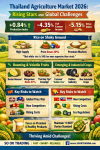
In 2026, Thailand’s agricultural market is walking a path of “dual realities.” On one side, production is gradually recovering thanks to favorable weather ️. On the other, global competition continues to pressure prices , causing overall farmer income to drop −4.35% YoY. While the production index rose +0.84%, the price index fell −5.15%.

 
Thai Rice: A Shaky Pillar
Production: Adequate water in reservoirs keeps output high, though some farmers are slowing second and third crop cycles due to cost concerns.
Price: Heavily pressured by India’s return to exports, pushing global rice prices down by more than 20%.
Market: Thai white rice is losing price competitiveness, but premium segments like Jasmine rice and brown rice remain strong.
“Thai white rice is nearly $40/ton more expensive than rivals.” – Kasikorn Research, 2025
 
Economic Fruits: Durian Strong, Mangosteen Volatile
Durian: Production is rising, though smaller fruit sizes are an issue. Premium durian prices remain high, while general grades average only 90–95 THB/kg.
Mangosteen: National output down 6%, with the East dropping 33%. Prices opened at 150 THB/kg but later averaged 65–85 THB/kg.
Government Strategy: The “Thai Help Thai” campaign and live commerce initiatives are being used to stabilize mixed-grade fruit prices.
 
Industrial & Emerging Crops
Cassava: Demand from China and ethanol industries makes this a “golden year.”
Rubber: Supported by growth in the automotive sector.
Future Crops: Cocoa, chili, and macadamia are being promoted as sustainable alternatives.
Pet Food: Exports are booming under the global “Pet Humanization” trend.
 
⚠️ Key Risks to Watch
Global Price War: India’s export comeback hits Thai rice hard.
New Competitors: Vietnam, Philippines, Malaysia, and Cambodia are expanding durian exports to China.
Rising Costs: Fertilizer, energy, and logistics expenses remain high.
Environmental Regulations: Trade partners are tightening rules on carbon footprints and deforestation.
 
Summary
Thai Rice: Must pivot toward premium and health-focused varieties (brown rice, low-GI rice) to escape India’s price war.
Thai Durian: Must uphold the strict “4 NOs” export standard — No unripe, No worms, No fake tags, No residues — to maintain trust in the Chinese market.
Overall Market: Production is recovering, but prices remain volatile. Building strong brands and elevating quality is the key to survival and long-term growth.
 
SO OK TRADING’s View 2026 is a “dual battlefield” for Thai agriculture. Rice faces a global price war, while durian shines as a revenue star. By raising quality standards and building premium brands, Thailand will not only survive but also “grow with dignity” on the global stage .

 
SO OK TRADING | FAST • SHARP • RELIABLE Your Trusted Business Partner www.SOOKTRADING.com Facebook: SO OK TRADING

Related Content
US–Iran War Nears End: “Global Market Shift – Gold Pauses, Oil Declines, Base Metals Surge” SO OK TRADING : 14 JUNE 2026
Gold Pauses – Oil Drops – Base Metals Surge: Global Market Shift ✨ The global market is undergoing a major turning point! Gold: Watch for short‑term selling pressure, but long‑term investors see this as a fresh accumulation opportunity. Oil: Sharp decline after peace news, with a clear downtrend emerging. Base Metals: Strong rebound, reflecting renewed confidence in the global economy.
14 Jun 2026
“SO OK TRADING In-Depth Analysis: USD Weakness – THB Strength Reflecting Global Currency Outlook, August–September 2026”   (August 21, 2026)
“USD Weakness – THB Strength: Global Currency Outlook : SO OK TRADING : August 22, 2026” In August, global financial markets are closely watching the weakening of the U.S. dollar (USD). This trend is driven by multiple pressures: the Federal Reserve’s (Fed) inclination toward rate cuts, the surge in U.S. public debt, and capital flows shifting toward regions with faster economic recovery such as Europe and Asia. As a result, the Thai baht has continued to strengthen, reaching 32.68 per USD, its highest level in two months. Meanwhile, gold prices have surged, and Thai investors are facing risks of FX losses despite positive momentum in overseas equities. This analysis by SO OK TRADING provides an in-depth outlook on global currencies for August–September 2026, covering major currencies (USD, EUR, GBP, JPY, CNY, SGD, AUD, KRW) and comparing monetary policy directions between the Bank of Japan (BOJ) and the European Central Bank (ECB) — both of which are becoming pivotal forces in shaping global market dynamics. Additionally, we highlight strategies for risk management and investment positioning during the upcoming “September Cluster” — a critical period marked by three major central bank meetings (ECB, Fed, BoE) that will set the tone for currency markets in the final quarter of the year.
22 Aug 2026
“Energy Pulse 2026: Naphtha Recovery – Positive Signals from the Global Energy Crisis Toward a New Market Balance” Article by SO OK TRADING | May 18, 2026
Naphtha Crisis 2026 – Latest Situation Update Positive Outlook | SO OK TRADING Since the outbreak of the Middle East conflict in late February, the global energy market has been shaken dramatically. Crude oil prices surged past $150 per barrel, driving Asian naphtha prices to nearly double. By mid‑May, prices corrected to $897 per ton, though still 62.54% higher than last year. Even as prices begin to ease, supply chain “lag effects” remain — shipping delays of 15–20 days and congested ports due to competition for raw material shipments from the Middle East continue to pressure industries across Asia. In Thailand, SCGC declared force majeure and temporarily shut down the Rayong Olefins plant, while PTTGC and SCGC are studying the establishment of a joint venture to enhance flexibility and reduce long‑term costs. In Japan, leading snack brand Calbee announced a packaging strategy shift, reducing color printing on 14 products to black‑and‑white to cope with ink and resin shortages — reflecting the rising trend of “minimalist design” during the crisis. At the same time, recovery signals are emerging: Naphtha prices dropped from the peak of $1,020 → $897 per ton Spreads rebounded: Ethylene–Naphtha +250–280 / Propylene–Naphtha +310–330 Plastic prices remain high but show signs of stabilization If the Middle East situation does not flare up again, this crisis is expected to ease by late June – early July 2026. SO OK TRADING FAST • SHARP • RELIABLE Your Trusted Business Partner
18 May 2026
This website uses cookies for best user experience, to find out more you can go to our Privacy Policy and Cookies Policy
Powered By MakeWebEasy Logo MakeWebEasy