Share

“Aluminum Scrap = The New Gold of Recycling : Driving the Circular Economy, Rising as a Global Strategic Asset — Aluminum Scrap 2026” SO OK TRADING | 30 MAY 2026
Last updated: 30 May 2026
116 Views

Aluminum Scrap: From Waste to Strategic Asset in the Circular Economy Era
SO OK TRADING | 30 May 2026

Aluminum scrap, once regarded as mere “waste,” is now being elevated into a premium raw material fiercely contested in global markets. In 2026, prices have surged to their highest level in four years, positioning aluminum scrap as the “new gold” of recycling and future industries.

 
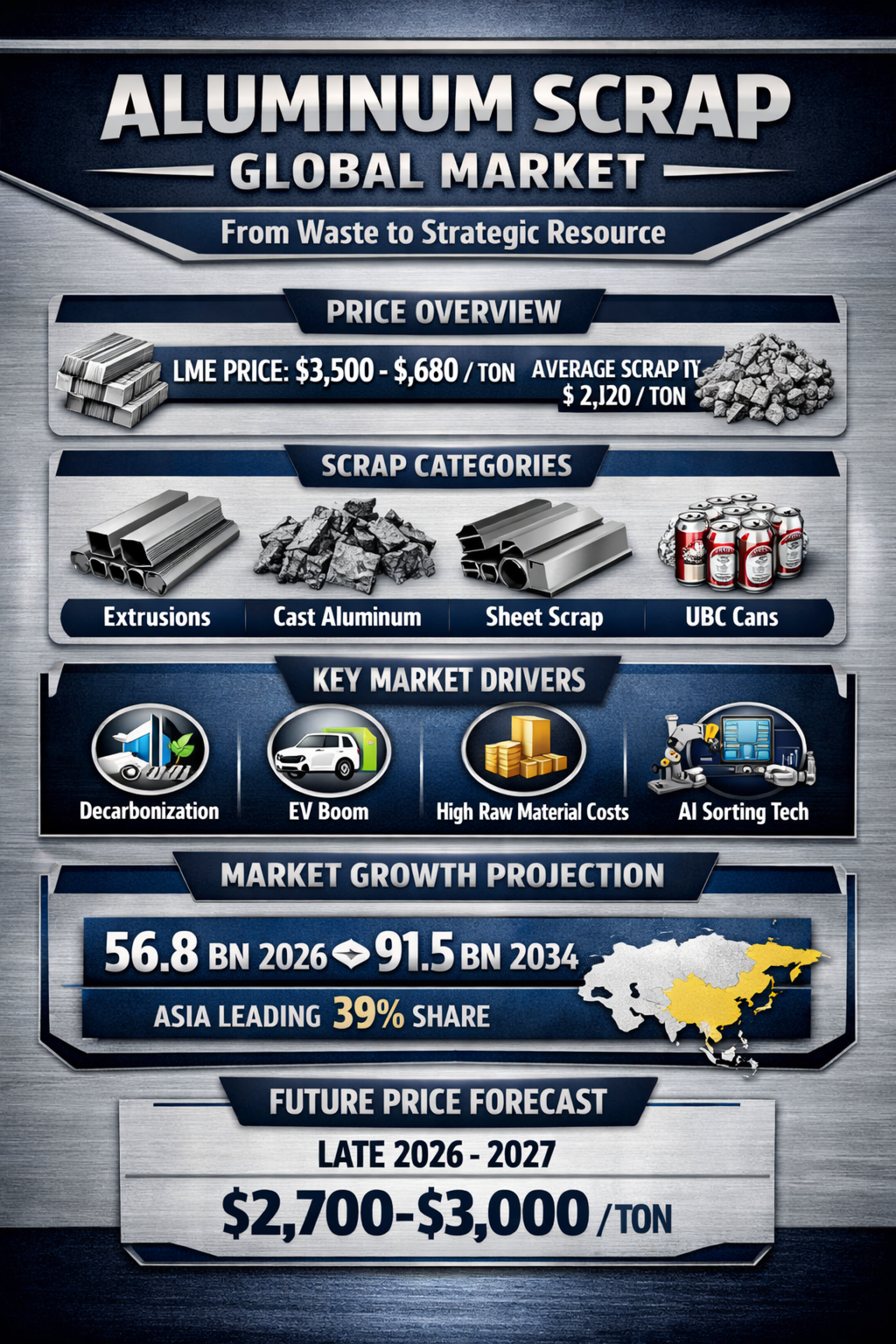
Types of Aluminum Scrap
Extrusions (ISRI: Tabor/Tata) Clean window and door frames, the highest value category.
Cast Aluminum (ISRI: Tense) Engine parts, cylinder heads—strong and valuable.
Sheet Aluminum (ISRI: Taint/Tabor) Pots, pans, thin sheets, fenders.
UBC (Used Beverage Cans) Soda and beer cans, easy to recycle with a dedicated market.
Special Grades: Alloy wheels (Troma), bare wire (Talon/Taste), litho plates (Tabloid), mixed/dirty scrap (Talk).
 
Current Prices (May 2026)
Global Market (LME Cash): USD 3,680 – 3,735 / ton ≈ 138 – 145 THB/kg
Average Scrap Price: USD 2,150 – 2,520 / ton ≈ 80 – 98 THB/kg
Thailand Retail Buying Prices

Bare Wire: 80–81 THB/kg
Alloy Wheels: 81 THB/kg
Clean Extrusions: 70–74 THB/kg
UBC Cans: 64–68 THB/kg
 
Market Drivers
Decarbonization Policies Recycling aluminum consumes 95% less energy than primary smelting, helping brands comply with EU CBAM regulations.
EV Transition Surging demand for lightweight materials and recycled components.
High Primary Costs Smelters turn to scrap to reduce expenses.
AI Sorting Technology Advanced systems deliver cleaner scrap, enabling use in high-tech industries.
 
Global Market Outlook
Market value projected to grow from USD 56.77 billion (2026) to USD 91.49 billion (2034).
Asia-Pacific leads with 39% market share, driven by China and India.
Risk: Collection networks lag behind demand, keeping supply tight.
 
Future Price Forecast
Short Term (Q2–Q3 2026): Prices remain bullish at USD 3,500 – 3,900 / ton, influenced by geopolitical tensions and Guinea’s bauxite export controls.
Medium Term (Late 2026–2027): Prices expected to stabilize at USD 2,700 – 3,000 / ton as new supply from Indonesia enters the market.
Long Term: World Bank projects USD 2,700 / ton, still above historical averages (USD 2,419 / ton in 2024).
 
SO OK TRADING
Your trusted partner in the new era of metals FAST | SHARP | RELIABLE www.sooktrading.com Facebook: SO OK TRADING


Related Content
“Recycled Aluminum: From Scrap to Global Standard – Circular Economy Reshaping Industry with Aluminum Remelt – Remelt Revolution: Transforming the Metal Industry for Net Zero”
Recycled Aluminum: From Scrap to the New Global Standard As industries worldwide accelerate toward Net Zero and embrace the Circular Economy, Aluminum Remelt Ingots are no longer just an “alternative material.” They are becoming the main driver that every nation relies on for sustainability and economic competitiveness. With outstanding properties—lightweight, strong, corrosion-resistant, and excellent thermal and electrical conductivity—remelt ingots are now essential across diverse industries: automotive, construction, electronics, and packaging, all of which demand high-quality, eco-friendly materials. Most importantly, recycling aluminum consumes up to 95% less energy than producing primary aluminum, dramatically reducing both costs and carbon footprints. At the same time, global demand continues to rise, especially for ADC12, which is highly sought after in China, Japan, and Thailand, along with A356 and AC4B for automotive and high-strength applications. Global Shifts in 2025–2026 - China: Expanding production capacity to support electric vehicle (EV) manufacturing and construction, with stricter import standards for scrap aluminum. - United States: The world’s highest remelt usage (81%), driven by energy efficiency and carbon reduction, reinforced by strict tariffs under Section 232 (raised to 50%). - Japan: Fully dependent on imports and recycling, leveraging advanced sorting technologies and increasing the use of green aluminum in high-end automotive manufacturing. - Thailand: Rising as ASEAN’s scrap hub, exporting heavily to China and the U.S., with an aluminum can recycling rate of 86% and new circular economy initiatives such as the Aluminium Loop. From Scrap → To the Hero of Tomorrow Aluminum Remelt Ingots are rapidly evolving into the new global standard across industries. For those in the metals and manufacturing sectors, now is the time to adapt and seize opportunities in the global market.
21 Feb 2026
HNY 2026 with a First Analysis on Thai Baht Value
he Thai baht in Q1 2026 is expected to strengthen against the US dollar, driven primarily by a weaker dollar globally, a seasonal tourism boost, and expectations of US Federal Reserve rate cuts. This strength is occurring despite a weak domestic economic outlook and the Bank of Thailand's (BoT) likely continued easing of its policy rate. Exchange Rate Drivers and Forecast External Factors: The primary driver for the strengthening baht is external, mainly the broad weakness of the US dollar as global markets price in expected Fed rate cuts. The baht is also correlated with global gold prices, which have been climbing. Tourism High Season: The period extending into Q1 2026 is the high season for tourism, which typically brings in foreign currency and supports the baht's value. Policy Divergence: The BoT is expected to continue its easing cycle, potentially cutting the policy rate further to 1.00% by Q1 2026 to stimulate the sluggish domestic economy. This divergence from a potentially less aggressive US Fed in Q1 could support the baht in the short term, though some analysts warn the currency could weaken later in 2026. Forecasts: Projections for 2026 generally place the baht in a range of 30.80–33.00 per US dollar. Some models estimate it could trade around 31.06 by the end of Q1. A persistently strong baht below 31 per US$ is seen as a significant risk to the Thai export and tourism sectors. Key Economic Context Weak Growth: Thailand's economy is expected to slow down to a 5-year low growth rate of around 1.6-1.8% in 2026, pressured by US tariffs, global trade tensions, and high household debt. The central bank chief expects an improvement in Q1 2026 after a weak second half of 2025. Political Uncertainty: A general election expected in February 2026 could also introduce volatility, though some historical trends suggest the baht may strengthen following the formation of a new government. Low Inflation: Headline inflation is projected to remain subdued or even negative, providing the central bank with justification for further rate cuts to stimulate demand. In summary, Q1 2026 is characterized by a strong and volatile baht driven by external factors, contrasting sharply with a weak domestic economy and accommodative monetary policy.
1 Jan 2026
“Thailand’s Steel Market Heats Up: Steel Price Storm 2026
Steel Price Storm 2026 – Turning Crisis into Opportunity By SO OK TRADING | May 17, 2026 The Thai steel market is heating up like never before! Prices have already surged 10–15%, and another round of increases is expected in Q2 as electricity and energy costs continue to climb
17 May 2026
This website uses cookies for best user experience, to find out more you can go to our Privacy Policy and Cookies Policy
Powered By MakeWebEasy Logo MakeWebEasy