“Thai Rubber Showdown in China – STR20: The Secret Weapon Driving the EV Boom, Surging Demand, Thailand Leads the Way, Winning the Hearts of Chinese Tire Factories, and Turning the Game to Victory” SO OK TRADING : 23 MAY 2026
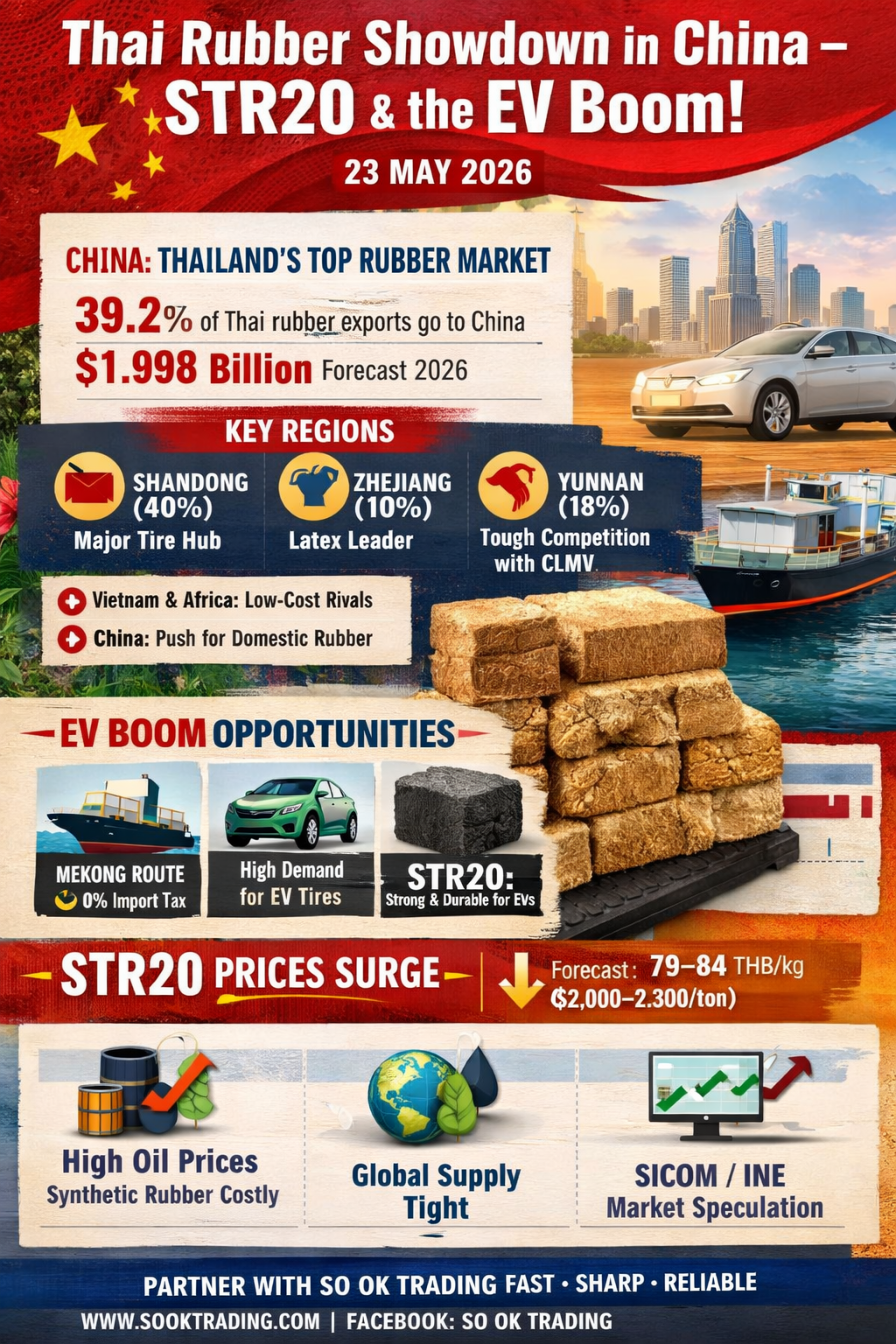
Thai Rubber Battles in China – STR20, the Secret Weapon for the EV Boom
SO OK TRADING : May 23, 2026
China Remains Thailand’s No.1 Export Market
China accounts for 39.2% of Thailand’s rubber exports. Although 2026 export value is expected to grow only 1.8% (around USD 1.998 billion), China remains a strategic market Thai exporters cannot ignore.
Deep Dive into 3 Key Provinces – Strengths and Weaknesses
Shandong (40%) China’s largest tire production base. Thailand dominates the market here, with imports projected to rise another 4% (USD 960 million).
Zhejiang (10%) Thailand shines in concentrated latex, holding over 59% market share. However, Vietnam pressures with cheaper prices.
Yunnan (18%) Thailand is at a heavy disadvantage, with only 1% share, as CLMV countries benefit from lower transport costs.
⚠️ Challenges Facing Thai Exporters
Competitors from Vietnam, Myanmar, and Côte d’Ivoire are expanding production, offering lower prices (though quality still lags behind Thailand).
China is pushing domestic rubber planting to reduce imports.
Opportunities and Support Measures for Thai Rubber Exports to China
Mekong River route → Lower transport costs + 0% import duty.
EV Boom in China → Driving demand for natural rubber.
Thai STR20 → Becoming the key raw material, as it withstands EV battery weight and torque better than other rubber types.
STR20 Prices – Staying Strong
FOB Laem Chabang: THB 78/kg (USD 1,900/ton)
June–August 2026 outlook: THB 79–84/kg (USD 2,000–2,300/ton)
3 Positive Factors Supporting Prices
High crude oil prices → Synthetic rubber more expensive → Chinese factories turn to natural rubber.
Global supply tightness due to leaf fall disease and fertilizer issues.
Futures markets (SICOM/INE) buoyed by speculative buying.
⚠️ Risks Thai Exporters Must Watch
African rubber (Côte d’Ivoire) enjoys duty-free access.
CLMV countries building processing plants with Chinese investment → Lower costs than Thailand.
Strong baht and China’s stock control policies.
✨ Strategies for Thai Exporters
Maintain STR20 standards with superior quality and cleanliness.
Build Green Advantage and sustainability certifications.
Shift product structure toward downstream processed rubber to add value.
Capitalize on EV Boom, as STR20 demand will increase.
Big Picture
China remains the main arena where Thai rubber must compete on price, quality, and marketing strategy. STR20 is the “secret weapon” helping Thailand maintain leadership in the EV era and fierce competition.
SO OK TRADING : Your Business Partner SO OK TRADING : FAST • SHARP • RELIABLE
WWW.SOOKTRADING.COM Facebook: SO OK TRADING
For inquiries about Thai STR20 rubber, please contact SO OK TRADING. Thank you very much!