Share

SCRAP WARS 2026: The Clean Metal Battle for a Low‑Carbon Era – Recycled Aluminum as the Strategic Resource of the Future, From Scrap to Golden Power Transforming the Global Aluminum Market : SO OK TRADING : May 21, 2026
Last updated: 21 May 2026
1012 Views

 SCRAP WARS 2026: The Battle for Aluminum Scrap – From Waste to Global Gold
May 21, 2026 | SO OK TRADING

 
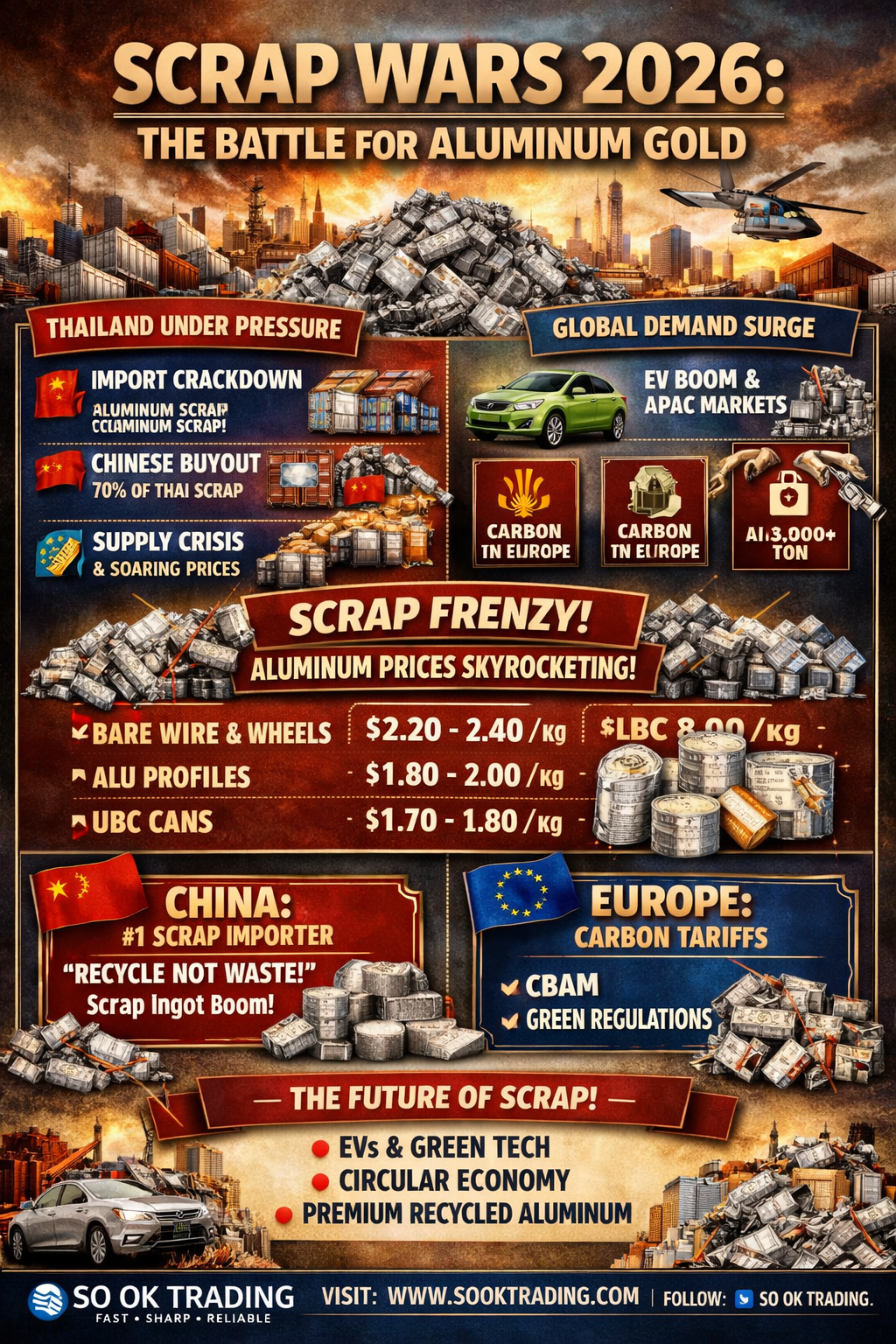
♻️ The Golden Year of Recycling has begun! In 2026, aluminum scrap in Thailand is no longer just “leftovers” — it has become a strategic raw material fiercely contested across the globe.

 
Pressures on the Thai Market
Import Crackdown: Strict container inspections, E‑waste ban → foreign supply is harder to access.
Chinese Buyout: Over 70% of Thai scrap exported to China → domestic smelters face shortages and appeal to the government.
Global Price Crisis: Major Middle Eastern smelters disrupted → Thai factories scramble for scrap to produce secondary aluminum, saving up to 95% energy.
 
Prices Surge – Supply Tightens
Bare Wire / Alloy Wheels: 79–81 THB/kg
Construction Profiles: 65–70 THB/kg
Heavy Parts: 60–68 THB/kg
UBC Cans: 62–64 THB/kg
Small smelters without long‑term contracts are shutting down due to lack of supply.

 
Global Game Changers
LME Aluminum above $3,500/ton → worldwide shift to scrap.
EV & ABS demand soaring → lightweight aluminum boosts range.
APAC dominance → China, India, Japan buying premium ASEAN scrap.
AI Sorting revolution → cleaner scrap, higher prices.
EU CBAM carbon tariffs → export restrictions, carbon certificates required.
 
China: From “Waste Ban” to “Resource Absorption”
Policy eased: imports allowed if processed into RSI (Recycling Scrap Ingots).
Premium scrap import tariffs reduced.
Redefinition: from “Waste” to “Recycled Raw Materials.”
Thailand becomes China’s No.1 scrap supplier (21.1% of imports).
 
Europe: CBAM in Full Effect
Carbon certificates mandatory for imports.
Pre‑consumer scrap tightly controlled.
EU preparing to restrict scrap exports → keeping resources for its own green industries and circular economy.
 
Future Outlook for Aluminum Scrap
EV & Transport: demand for high‑grade ABS scrap will keep rising.
Green Building: construction industry adopting recycled materials.
Packaging & Beverages: UBC recycling surpassing 90%, circular economy model.
Clean Energy: solar panels and wind turbines driving new demand.
AI Sorting: precise alloy separation (5xxx, 6xxx) entering premium markets.
Global Policies: China absorbs, EU stockpiles, US tightens → competition intensifies.
 
Insights for Traders
Clean, well‑graded scrap = high price & strong demand
Contaminated scrap = blocked & hard to sell
Scrap is transforming from “waste” into an energy bank and the gold of the low‑carbon era. Whoever controls clean supply and precise grading will dominate the recycling game and lead the global market entering the Golden Year of Recycling.

 
SO OK TRADING Your trusted partner in the global recycled metals market FAST • SHARP • RELIABLE www.sooktrading.com Facebook: SO OK TRADING


Related Content
HNY 2026 with a First Analysis on Thai Baht Value
he Thai baht in Q1 2026 is expected to strengthen against the US dollar, driven primarily by a weaker dollar globally, a seasonal tourism boost, and expectations of US Federal Reserve rate cuts. This strength is occurring despite a weak domestic economic outlook and the Bank of Thailand's (BoT) likely continued easing of its policy rate. Exchange Rate Drivers and Forecast External Factors: The primary driver for the strengthening baht is external, mainly the broad weakness of the US dollar as global markets price in expected Fed rate cuts. The baht is also correlated with global gold prices, which have been climbing. Tourism High Season: The period extending into Q1 2026 is the high season for tourism, which typically brings in foreign currency and supports the baht's value. Policy Divergence: The BoT is expected to continue its easing cycle, potentially cutting the policy rate further to 1.00% by Q1 2026 to stimulate the sluggish domestic economy. This divergence from a potentially less aggressive US Fed in Q1 could support the baht in the short term, though some analysts warn the currency could weaken later in 2026. Forecasts: Projections for 2026 generally place the baht in a range of 30.80–33.00 per US dollar. Some models estimate it could trade around 31.06 by the end of Q1. A persistently strong baht below 31 per US$ is seen as a significant risk to the Thai export and tourism sectors. Key Economic Context Weak Growth: Thailand's economy is expected to slow down to a 5-year low growth rate of around 1.6-1.8% in 2026, pressured by US tariffs, global trade tensions, and high household debt. The central bank chief expects an improvement in Q1 2026 after a weak second half of 2025. Political Uncertainty: A general election expected in February 2026 could also introduce volatility, though some historical trends suggest the baht may strengthen following the formation of a new government. Low Inflation: Headline inflation is projected to remain subdued or even negative, providing the central bank with justification for further rate cuts to stimulate demand. In summary, Q1 2026 is characterized by a strong and volatile baht driven by external factors, contrasting sharply with a weak domestic economy and accommodative monetary policy.
1 Jan 2026
Thai Rubber Export Outlook 2026 & Global Rubber Trends 2026: Standards, Quality: Article By SO OK TRADING
Natural rubber is not just an export product—it is a strategic raw material the world relies on. This infographic highlights the growth opportunities of TSR 20 and Blend Rubber in key markets such as China, the EU, India, and Japan, while showcasing the role of SO OK TRADING in confidently driving Thai rubber into advanced global industries.
7 Feb 2026
This website uses cookies for best user experience, to find out more you can go to our Privacy Policy and Cookies Policy
Powered By MakeWebEasy Logo MakeWebEasy