Share

Copper Cathode: The Lifeblood of the Global Economy The Heart of the Energy Transition The Strategic Metal the World Demands Insights by SO OK TRADING
Last updated: 10 May 2026
1065 Views

Copper Cathode: The Strategic Metal of the Future : SO OK TRADING : 10 MAY 2026

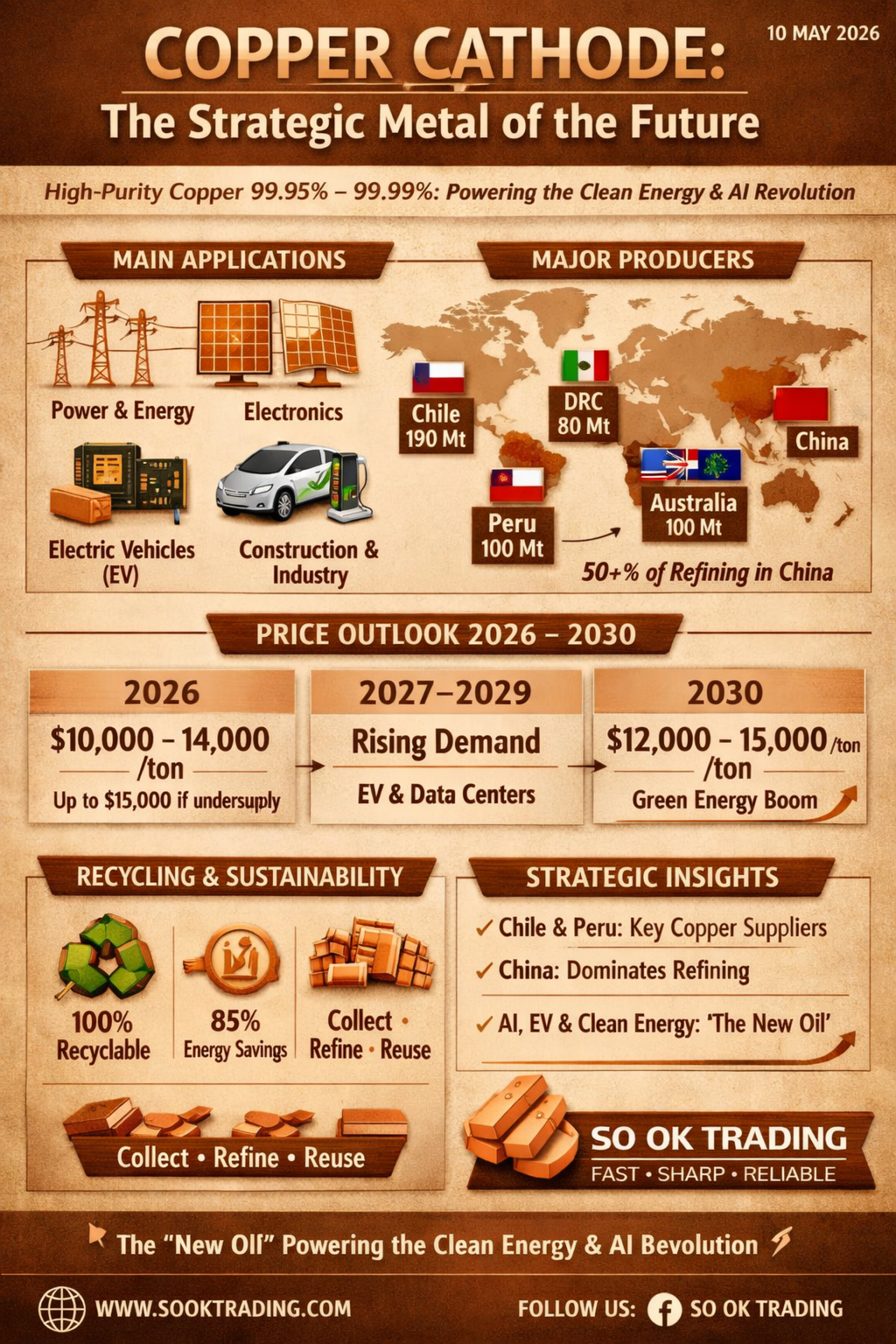
Copper Cathode is high-purity copper (99.95%–99.99%) produced through electrolytic refining. It is the backbone of the global metals industry, valued for its conductivity and durability, and recognized as the “strategic metal” of the clean energy and AI era.

 
⚡ Key Applications – Copper Cathode

Power & Energy: wires, transformers, motors, solar cells, wind turbines
Electronics: PCB boards, signal connectors
Electric Vehicles (EVs): battery systems, motors, internal wiring
Construction & Heating Systems: copper pipes in air conditioning, plumbing systems
Alloys & Machinery: brass, bronze, heavy industrial components
 
Quality Standards

LME Grade A: purity ≥ 99.99%
Impurity control: sulfur ≤ 15 ppm, iron ≤ 10 ppm
Must be flat sheets, free of rust or oil stains
 
Major Producing Countries

Chile: World’s No.1, reserves of 190 million tons, home to Escondida – the largest copper mine globally
Australia: ~100 million tons, key production hub in the Southern Hemisphere
Peru: another copper powerhouse in the Andes, ~100 million tons
DRC: 80 million tons, heavily invested in by China
Russia: 80 million tons, influential in Eurasian markets
Mexico, USA, China, Poland, Indonesia together account for over 20% of global reserves
The top five countries alone control more than half of the world’s copper resources.

 
Strategic Relationships

China: Though only 8th in reserves, it is the “smelter of the world”, holding nearly 60% of global cathode production capacity, importing massive volumes from Chile and Peru.
Chile & Peru: Strategic hubs with high-grade, low-cost ores and Pacific ports for efficient exports.
US & Europe: Increasing investments in African copper mines to reduce reliance on China.
 
Copper Price Outlook (2026–2030)

2026: Expected range $10,000–14,000/ton, potentially hitting $15,000/ton if shortages occur
2027–2029: Prices remain high, driven by EV and data center demand
2030: Forecast $12,000–15,000/ton, supported by new mining costs and clean energy demand
Key Drivers

AI & Data Centers: additional copper demand of ~1 million tons by 2030
 
Energy Transition & Supply Risks

EVs and global power grids: clean energy demand projected to reach 20% of total by 2035
Supply risks: South American politics, geopolitical tensions, and aluminum substitution trials
 
♻️ Copper Recycling

100% recyclable without loss of properties
Saves up to 85% energy compared to new production
Process: sorting → shredding → smelting & electrolytic refining → casting & fabrication
 
⚡ Copper is increasingly recognized as the “strategic mineral of modern industry” in the 21st century:

The heart of the clean energy transition
A core material for AI and the digital economy
A strategic resource linking producers (Chile/Peru) and consumers (China)
Copper Cathode is not just a metal — it is the lifeblood of the global economy’s future ⚡

 
SO OK TRADING : Your Trusted Business Partner SO OK TRADING : FAST SHARP RELIABLE VISIT US AT : WWW.SOOKTRADING.COM FACEBOOK : SO OK TRADING



Related Content
ALUMINUM PRICE TREND 2026
An analysis of the aluminum market in 2026 indicates a likely continued market deficit and upward price pressure, driven by constrained supply and resilient demand from green energy sectors. However, significant volatility is expected due to policy uncertainties and the potential for new Indonesian supply to eventually balance the market. Key Drivers and Projections for 2026 Supply Side Analysis Capacity Constraints: China's primary aluminum output is approaching its self-imposed 45 million-tonne capacity cap, limiting global supply growth. Power Challenges: Smelters outside of China face intense competition for power from energy-intensive sectors like AI data centers, which are willing to pay higher prices for long-term contracts. This has kept significant capacity offline in Europe and the US. Production Disruptions: Outages and potential shutdowns at existing smelters in Iceland and Mozambique further tighten the market. Scrap Supply Pressure: The EU's planned implementation of the Carbon Border Adjustment Mechanism (CBAM) and potential scrap export tariffs in spring 2026 are expected to impact global scrap flows, creating regional shortages and price volatility. New Capacity: Indonesia is a key source of new supply, with several projects in the pipeline. However, analysts suggest the pace of the ramp-up may be slower than expected due to infrastructure and policy challenges, meaning it is unlikely to fully offset near-term tightness. Demand Side Analysis Green Transition Demand: Demand from "green" sectors such as solar panels, new energy vehicles, and energy transition infrastructure remains strong, providing fundamental support for the market. Substitution Effect: Aluminum's wide price discount relative to copper has encouraged substitution in electrical applications, acting as a tailwind for demand and prices. Construction and Automotive: The construction and automotive industries continue to be major consumers, with growing demand for lightweight, low-carbon aluminum products. Price Forecasts and Volatility The market is expected to remain in a deficit in 2026, with estimates ranging from 200,000 to 600,000 tonnes. This structural tightness is leading most analysts to forecast sustained or rising prices. Bullish Views: Analysts at Bank of America project prices of $3,000/tonne as early as 2026. J.P. Morgan also expects prices to approach $3,000/tonne in Q1 2026. ING forecasts an average price of $2,900/tonne for the year. Bearish/Conservative Views: Goldman Sachs is an outlier, forecasting prices to decline to $2,350/tonne by Q4 2026, anticipating a market surplus later in the year. SMM forecasts a "high first, then lower" pattern, with prices finding equilibrium in the $2,700–$2,800/tonne range by year-end. Premiums: Regional premiums, particularly the US Midwest premium, are expected to remain high and volatile due to tariffs and regional supply dynamics, creating a disconnect from the LME benchmark price. In essence, 2026 is projected to be a year of high volatility where participants need to focus on scenario readiness rather than relying on a single price forecast, as geopolitical and energy policies significantly influence regional supply and costs
31 Dec 2025
“Lead Outlook 2026–2030: Recycled Lead — The New Core of Clean Energy and AI Infrastructure” Article by SO OK TRADING | April 19, 2026
The Global Lead Market is Shifting: From Traditional Raw Material to the Era of Clean Energy Recycling SO OK TRADING | April 19, 2026 In 2026, the global lead market has begun a steady recovery after a period of volatility caused by oversupply and competition from lithium batteries. Demand from the automotive battery industry, backup power systems, and clean energy infrastructure is driving “recycled lead” to become the new core of the heavy metals industry. Lead prices are expected to continue rising — from USD 1,900–2,050 per ton in 2026 to USD 2,400 per ton by 2030. This reflects the global transition toward a green economy and the expansion of investments in clean-energy-powered data centers worldwide. SO OK TRADING sees “recycled lead” not just as an option, but as the primary raw material of the future, meeting the demands of cost efficiency, environmental responsibility, and industrial sustainability. SO OK TRADING: FAST • SHARP • RELIABLE Your trusted business partner in a world of change
19 Apr 2026
This website uses cookies for best user experience, to find out more you can go to our Privacy Policy and Cookies Policy
Powered By MakeWebEasy Logo MakeWebEasy