Global Recycled Lead Market 2026: Green Metal Transforming Energy and Circular Economy SO OK TRADING | May 1, 2026
♻️ Global Recycled Lead Market 2026: Green Metal Transforming Energy and Circular Economy
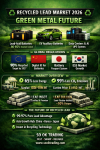
In 2026, the lead ingot (Lead Ingot) market is shifting from a “traditional metal” to Green Metal, becoming the driving force behind the circular economy and clean energy. In particular, Recycled Lead (Secondary Lead) has emerged as the core raw material for the global battery industry.
Key Applications: Recycled Lead in Batteries
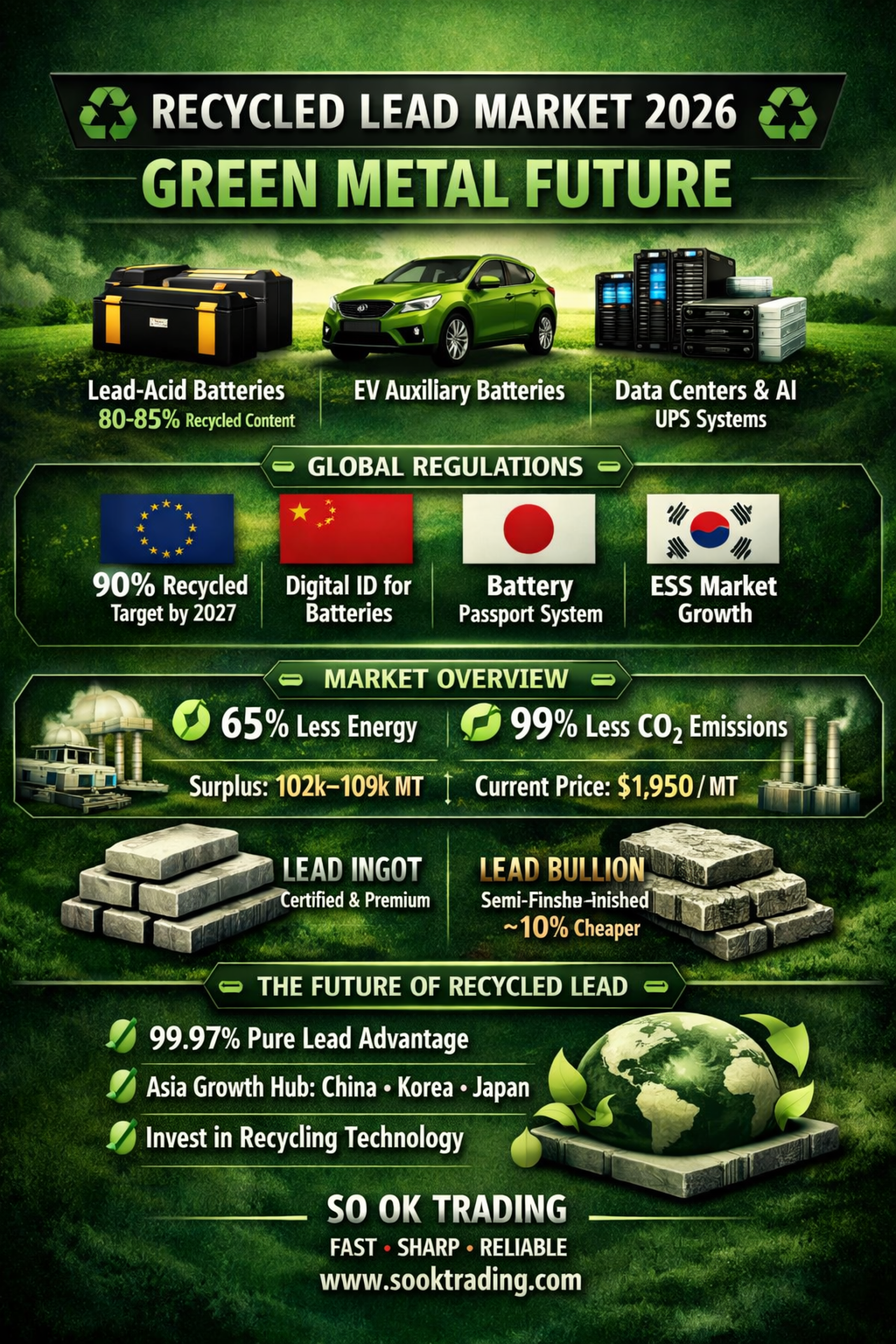
Lead-Acid Batteries continue to dominate the global market, widely used in internal combustion engine vehicles, hybrid cars, and UPS systems for data centers expanding rapidly due to AI and cloud computing.
Electric Vehicles (EVs): While lithium batteries are growing fast, recycled lead remains essential as an auxiliary battery to ensure system stability.
New Batteries in 2026: Contain 80–85% recycled lead, with the proportion expected to rise further in line with global automakers’ sustainability goals.
Global Regulations and Directions
European Union (EU): New battery regulation mandates minimum recycled content, targeting 90% lead recovery by 2027.
China: From April 2026, NEV regulations require batteries to have a Digital Identity for full lifecycle tracking.
Japan: Introduced the Battery Passport system and new laws covering small batteries, ensuring 100% domestic recycling.
South Korea: Recycling market growth driven by demand from ESS (Energy Storage Systems) and data centers.
⚙️ Next-Generation Recycling Technology
Transitioning from traditional Pyrometallurgy to Hydrometallurgy and Iono-metallurgy, significantly reducing lead dust and air pollution.
Producing recycled lead consumes 65% less energy and reduces CO₂ emissions by over 99% compared to primary mining.
Market Overview and Pricing
The global market remains in surplus, with approximately 102,000–109,000 tons oversupply.
Lead prices (LME) are expected to remain stable in the range of $1,900–2,050/MT, currently at $1,950/MT.
Lead Ingot (Refined): Popular as Green Metal, with buyers in Europe and Japan willing to pay a premium for certified recycled products.
Lead Bullion (Unrefined): Priced about 10% lower than ingots, as a semi-finished product that requires further refining.
✨ Summary: Lead and Recycled Lead
Recycled lead is the raw material of the future, meeting cost, environmental, and sustainability needs.
Producers of 99.97% pure recycled lead ingots with certification gain export advantages and higher margins.
The Asia-Pacific region, especially China, South Korea, and Japan, is building a fully circular economy system.
Investment in advanced recycling technologies is the key to reducing costs and enhancing competitiveness.
2026 marks a turning point where recycled lead is no longer just a battery material, but a Green Metal driving the world toward clean energy and a sustainable circular economy.
Contact Us
If you require Lead Bullion or Lead Ingots from recycled batteries, please reach out: www.sooktrading.com → Give Inquiry sooktrading@outlook.com
We supply high-quality Recycled Lead Ingots with guaranteed consistency.
Thank you very much.
SO OK TRADING: Your Trusted Business Partner SO OK TRADING: FAST • SHARP • RELIABLE www.sooktrading.com Facebook: SO OK TRADING