“Naphtha Crisis, Global Plastic Shock 2026: A New Game Toward Bio-based Materials and Circular Economy : By SO OK TRADING : April 22, 2026
Global Plastic Crisis 2026: Petrochemical Shock and the New Game of Industry
Current Situation
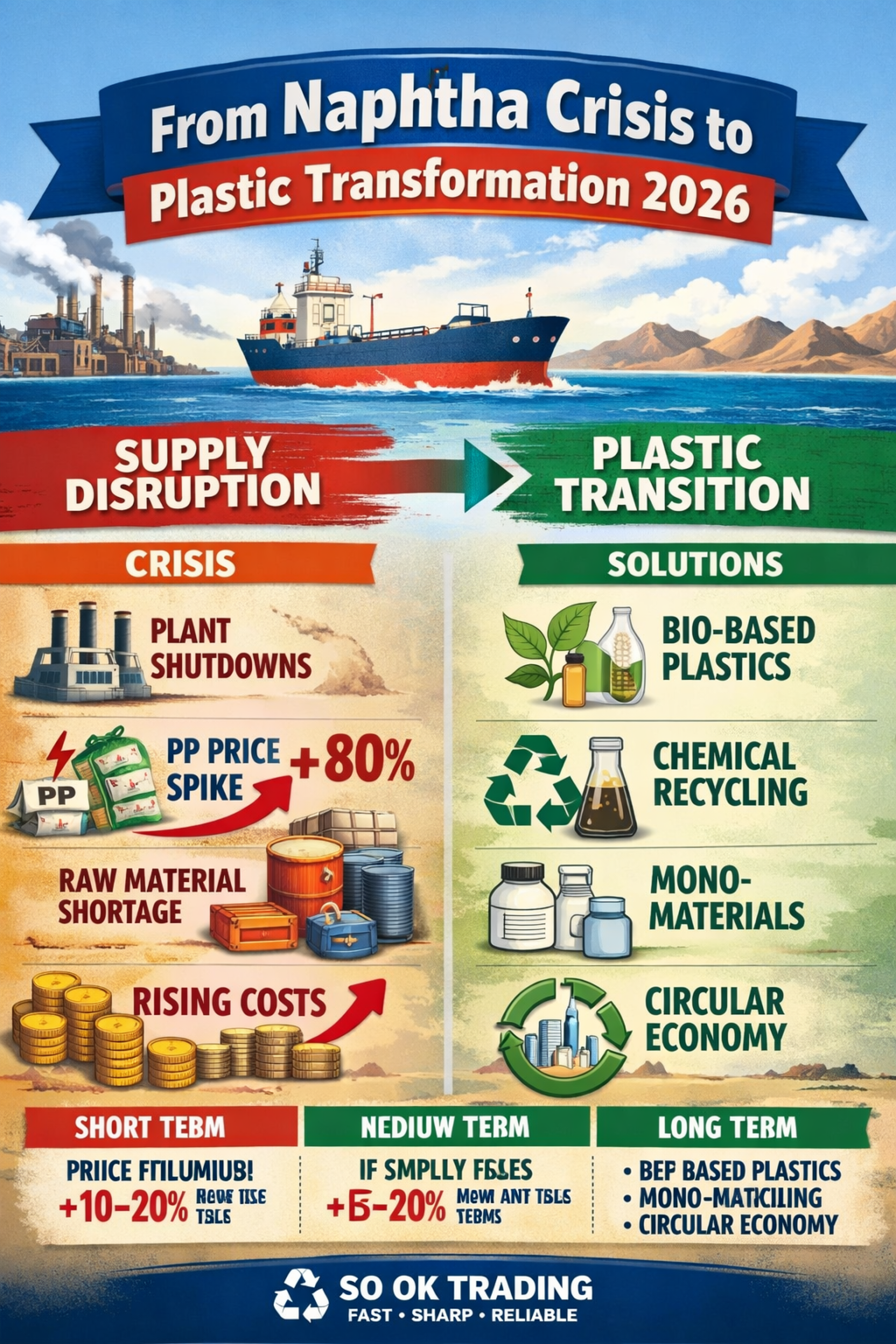
In April 2026, the world is facing a “petrochemical shock.” The closure of the Strait of Hormuz has disrupted upstream raw materials such as naphtha, olefins, and ammonia, forcing more than 10 petrochemical plants in Asia to halt production. Plastic prices have surged by 50–100% within just a few weeks.
Plastics in Severe Shortage
PP (Polypropylene): The most critical shortage, used in food packaging and heat-resistant containers.
PE (Polyethylene): Prices soaring, supply shrinking.
PET: Seasonally tight, with high demand for beverage bottles in summer.
Industry Impacts
Food & Beverage: Packaging shortages drive up export costs.
Consumer Goods: Prices begin rising from May 2026.
Medical Sector: High-quality plastics for medical devices directly affected.
Plastic Factories: Operating at only 50–60%, many at risk of shutdown.
Country Impacts
China: Dalian futures market prices up 37–38%. Export surplus shrinking, reserved for domestic use.
EU: Most vulnerable. PE prices up 100%, hitting record highs. Many factories cut output due to unprofitable costs.
USA: Advantage from domestic shale gas, but downstream product prices still rise 10–15%.
Japan: Packaging film and plastic bag prices up 30%. Naphtha stock only 20 days left.
South Korea: Public hoarding garbage bags. LG Chem halts naphtha production. Government declares plastics an economic security item.
Thailand: Freight rates surge from $1,500 → $7,000 per container. Government declares plastics a controlled commodity and promotes agricultural substitutes.
Vietnam: Packaging industry hit hard, costs soaring, profits shrinking.
National Response Plans
Thailand: Price controls, promotion of bagasse, rice straw, and recycled materials.
EU: Enforcing stricter plastic waste reduction laws, importing more from the US despite higher costs.
China: Partial production cuts, focus on recycled plastics in EV industry, development of coal-to-olefin technology.
Japan: Promoting plastic resource circulation law, investing in chemical recycling.
South Korea: Supporting bio-plastics PHA and PLA from starch and sugar.
Indonesia & Vietnam: Accelerating single-use plastic bans by end of 2026.
Future Scenarios
Short Term (1–3 months): Prices remain high, may rise another 10–20% if Hormuz closure continues.
Medium Term (late 2026): If conflict eases, prices will stabilize but remain 15–20% above pre-war levels.
Long Term: Transition toward bio-based plastics and mono-materials that are easier to recycle, with mandatory recycled content laws and taxation.
This crisis is not just a temporary shortage but a structural turning point for the global plastics industry. The shift is underway from dependence on Middle Eastern oil and gas toward self-reliance, bio-materials, and circular economy. Companies that adapt quickly will lead in the emerging markets.
Naphtha Situation & Solutions (Analysis by SO OK TRADING: April 22, 2026)
Naphtha is a key upstream raw material for plastics and petrochemicals.
Middle East conflict and Hormuz closure paralyze transport.
Japan & South Korea hardest hit, relying on Middle East imports for over 70%.
Major plants like LG Chem (Korea) and Mitsubishi Chemical (Japan) halt or raise prices.
Japan’s naphtha stock only 20 days left. Korea turns to Russian imports.
Country Responses
South Korea: Shifts to Russian imports.
EU: Increasing reliance on US imports despite higher freight costs.
China: Signs long-term contracts with Russia and Central Asia.
New Technologies
China: Developing coal-to-olefin (CTO).
Japan: Chemical recycling to convert contaminated plastics into synthetic oil.
South Korea: Promoting bio-plastics PHA and PLA.
Circular Economy & Substitutes
EU: Mandatory recycled content law—new products must contain 30–50% recycled plastics by 2030.
Thailand: Promoting agricultural substitutes such as bagasse and rice straw.
Companies: Shifting to mono-materials and paper packaging.
SO OK TRADING: Your Business Partner SO OK TRADING : FAST • SHARP • RELIABLE WWW.SOOKTRADING.COM | FACEBOOK : SO OK TRADING