Share

“Global Oil Market and Thai Oil Price Outlook Q2/2026: The Energy Inflection Point After the US–Iran Ceasefire”
Last updated: 9 Apr 2026
1289 Views

Global Oil Market and Thai Oil Price Outlook Q2/2026 Analysis by SO OK TRADING | April 9, 2026

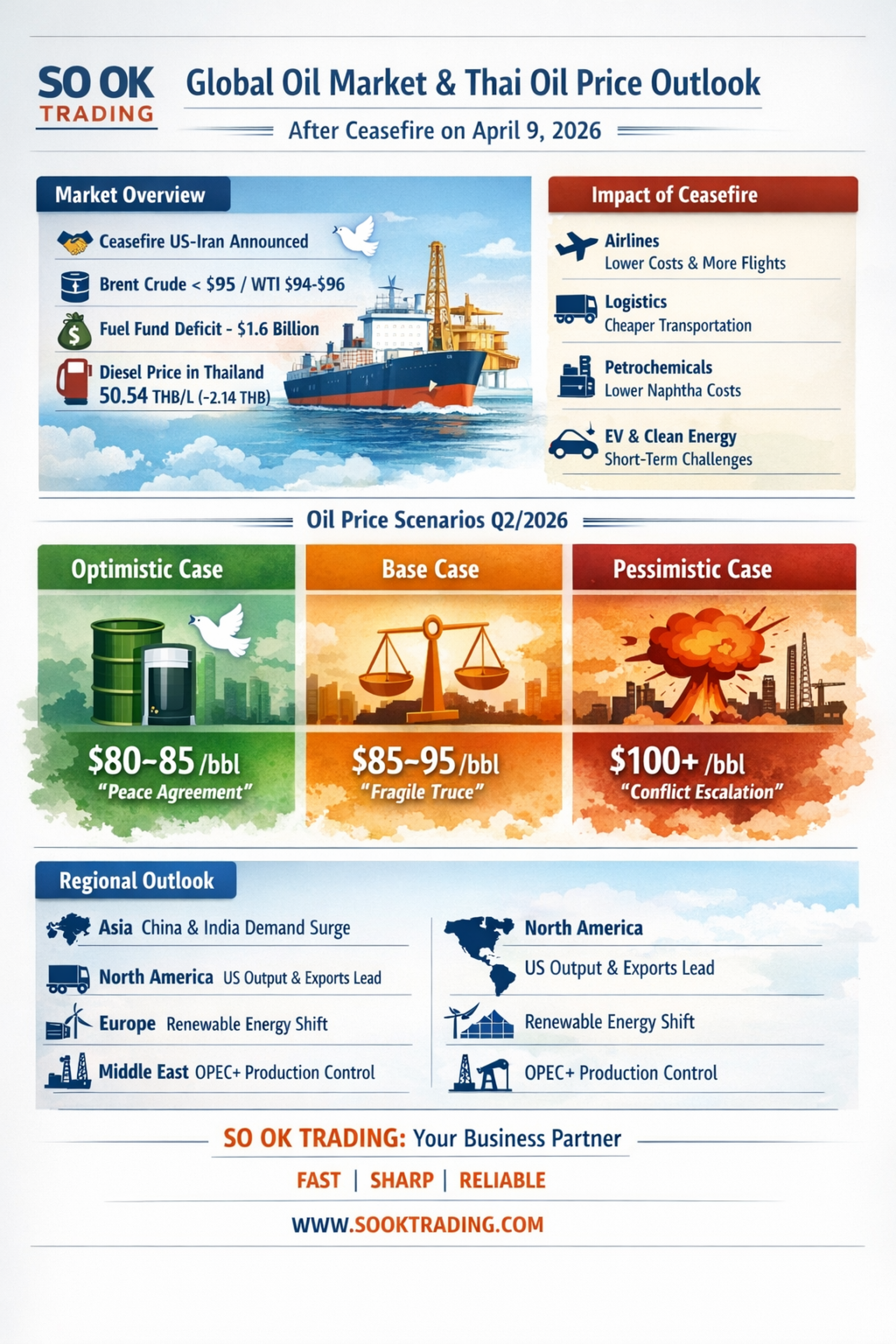
On April 9, 2026, the global energy market reached a critical turning point. Following the temporary ceasefire between the United States and Iran, crude oil prices plunged by 13–16% in a single day. In Thailand, diesel prices were immediately reduced by 2.14 THB per liter, now standing at around 50.54 THB/L, while gasoline and gasohol prices remained unchanged.

 
Key Market Drivers
Ceasefire in the Persian Gulf: Shipping routes through the Strait of Hormuz reopened, easing supply risks
Global Crude Prices: Brent fell below $95/bbl, WTI at $94–96/bbl
Thai Government Policy: The Fuel Fund Committee (กบน.) expanded diesel subsidies to ease living costs
Fuel Fund Deficit: Still over 56 billion THB in deficit, limiting the scope of price reductions
 
Forecasts from Financial Institutions
Goldman Sachs: Brent revised down to $90, WTI to $87
DBS: Brent average forecast at $86.5, potentially dropping to $79.5 in Q3 if stability continues
EIA: Despite lower prices, geopolitical risk premiums remain, leaving room for price rebounds
 
Impact of the Ceasefire on Industries
Airlines: Immediate reduction in jet fuel costs, higher profits, shorter flight routes
Logistics (Thailand): Lower diesel prices reduce transportation costs for consumer goods
Petrochemicals: Naphtha prices drop, lowering production costs for plastics and packaging
EV & Clean Energy: Short-term slowdown in adoption incentives, but strict environmental laws in the US and Europe continue to drive EV production
 
Oil Price Scenarios – Q2/2026 After Ceasefire
Optimistic Case

Ceasefire extends into permanent peace
Oil stabilizes at $80–85/bbl
Retail fuel prices continue to fall, boosting consumption and easing inflation
Base Case

Ceasefire remains fragile, with occasional violations
Oil fluctuates within $85–95/bbl
Pessimistic Case

Conflict reignites in the Persian Gulf
Oil surges above $100/bbl
Inflation spikes, threatening economic stability
 
Demand & Outlook by Region
Asia: China and India remain key demand drivers; partial reliance on Hormuz shipping
South Korea & Japan: Heavily dependent on imports via Hormuz, facing higher risk
North America: US acts as a “stabilizer” with strong production and exports
Europe: Accelerating renewable energy transition, reducing oil demand
Middle East: OPEC+ continues production control to maintain price levels
 
Conclusion
Q2/2026 marks an Inflection Point for the global energy market. If the ceasefire holds, lower oil prices will create golden opportunities for airlines, logistics, and exporters. If conflict resumes, oil prices will surge again, putting pressure on global economies.

 
SO OK TRADING — Your Business Partner FAST | SHARP | RELIABLE www.sooktrading.com


Related Content
“Supply Shock Shakes the World: ADC12 & A6063 — Middle East Supply Vanishes, Premiums Surge, The Critical Variables of Global Industry”
ALUMINUM MARKET UPDATE – April 21, 2026 ADC12 & A6063: The Premium and Scarce Metals Driving Global Industry The aluminum market is entering a turbulent phase. Prices are soaring, supply is tightening, and premiums have reached record highs. With the Middle East supply shock cutting global output by nearly 9%, and LME prices surging to $3,500–$3,626/ton, ADC12 and A6063 have become the most critical — and costly — materials shaping automotive, EV, and construction sectors worldwide. ADC12 powers die-cast components for vehicles and electronics, while A6063 defines the future of low-carbon architecture and EV frames. Both alloys now stand at the center of global manufacturing, reflecting the new reality: scarcity, volatility, and opportunity.
21 Apr 2026
HNY 2026 with a First Analysis on Thai Baht Value
he Thai baht in Q1 2026 is expected to strengthen against the US dollar, driven primarily by a weaker dollar globally, a seasonal tourism boost, and expectations of US Federal Reserve rate cuts. This strength is occurring despite a weak domestic economic outlook and the Bank of Thailand's (BoT) likely continued easing of its policy rate. Exchange Rate Drivers and Forecast External Factors: The primary driver for the strengthening baht is external, mainly the broad weakness of the US dollar as global markets price in expected Fed rate cuts. The baht is also correlated with global gold prices, which have been climbing. Tourism High Season: The period extending into Q1 2026 is the high season for tourism, which typically brings in foreign currency and supports the baht's value. Policy Divergence: The BoT is expected to continue its easing cycle, potentially cutting the policy rate further to 1.00% by Q1 2026 to stimulate the sluggish domestic economy. This divergence from a potentially less aggressive US Fed in Q1 could support the baht in the short term, though some analysts warn the currency could weaken later in 2026. Forecasts: Projections for 2026 generally place the baht in a range of 30.80–33.00 per US dollar. Some models estimate it could trade around 31.06 by the end of Q1. A persistently strong baht below 31 per US$ is seen as a significant risk to the Thai export and tourism sectors. Key Economic Context Weak Growth: Thailand's economy is expected to slow down to a 5-year low growth rate of around 1.6-1.8% in 2026, pressured by US tariffs, global trade tensions, and high household debt. The central bank chief expects an improvement in Q1 2026 after a weak second half of 2025. Political Uncertainty: A general election expected in February 2026 could also introduce volatility, though some historical trends suggest the baht may strengthen following the formation of a new government. Low Inflation: Headline inflation is projected to remain subdued or even negative, providing the central bank with justification for further rate cuts to stimulate demand. In summary, Q1 2026 is characterized by a strong and volatile baht driven by external factors, contrasting sharply with a weak domestic economy and accommodative monetary policy.
1 Jan 2026
Clean Energy Milestones: From Choice to Survival for Thai Industry — Fuel Switching to Net Zero, Unlocking Tax Benefits, Carbon Credits, and ESG with Biomass
Clean Energy Milestones: From “Choice” to “Survival” for Thai Industry Thailand is moving forward into a major energy transition. The clear national targets are Carbon Neutrality by 2050 and Net Zero by 2065. This is not only about reducing greenhouse gas emissions, but also about building new competitiveness for the Thai economy in the global market. Today, “clean fuels” such as RDF-3 and Wood Chips are becoming the core drivers of this transition. Whether replacing coal in cement factories, exporting to Japan and South Korea, or generating new income through Carbon Credits, these fuels are reshaping the energy landscape. Fuel switching is not just about energy — it is about strategic value: - Reducing taxes through BOI incentives - Avoiding the EU’s CBAM (Carbon Border Adjustment Mechanism) - Creating new revenue streams from Carbon Credits - Strengthening ESG and sustainability branding
20 Feb 2026
This website uses cookies for best user experience, to find out more you can go to our Privacy Policy and Cookies Policy
Powered By MakeWebEasy Logo MakeWebEasy