Global Plastic Crisis 2026: Rising Costs as War and Naphtha Shake the Industry
Last updated: 5 Apr 2026
8718 Views
Global Plastic Crisis 2026: How War and Naphtha Shook the Industry
Article by SO OK TRADING | April 5, 2026
Plastic — once considered a basic raw material of everyday life — has now become a “scarce commodity” shaking the world in April 2026. The Middle East conflict and the global naphtha shortage have delivered a heavy blow to the petrochemical industry, driving plastic prices sharply upward and impacting every sector, from food packaging to automotive components.
Roots of the Crisis
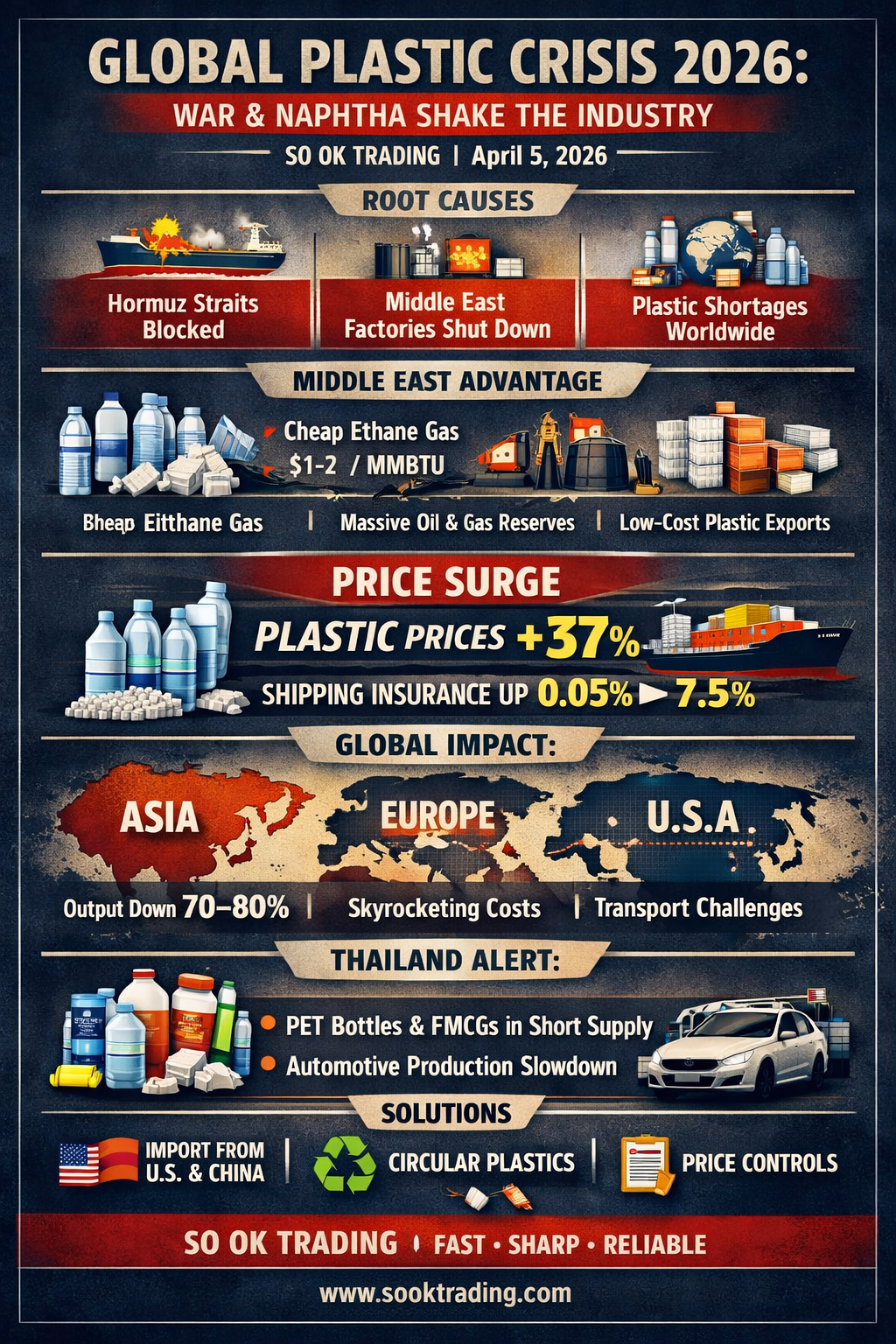
Middle East War: The Hormuz Strait blockade halted over 84% of Polyethylene (PE) export capacity.
Factory Shutdowns: Plants in Iran and neighboring countries ceased operations due to attacks and power shortages.
“Money Can’t Buy It”: Plastic granules disappeared from the market, leaving buyers empty-handed despite soaring prices.
Why the Middle East is the Heart of Plastics
Vast reserves of oil and natural gas
Cheap ethane gas ($1–2/MMBTU) used for plastic production
Heavy investment in midstream industries, making the region the world’s lowest-cost exporter of plastic Yet, once export routes were blocked, shipping and insurance costs skyrocketed, erasing the advantage of low production costs.
Price and Cost Impact
Global plastic prices surged 37–38% in just one month
Shipping insurance jumped from 0.05% to 7.5% of vessel value
Naphtha shortage: Asia and Europe, heavily dependent on naphtha, face costs 5–10 times higher than Middle East ethane-based production
Regional Impact
Asia (Thailand, Japan, South Korea): Petrochemical plants cut output to 70–80%. PET bottles and plastic bags are in severe shortage.
Europe: With Russian imports cut and Middle East supply disrupted, Europe faces the world’s highest plastic prices. Many factories have idled.
United States: Slightly advantaged by ethane use, but still hit by rising transport costs and global volatility.
Thailand’s Situation
Stock Running Out: Experts warn reserves may last only until after Songkran.
Industries Hit Hard:
Food & Beverage Packaging: PET bottles and bags scarce; small producers struggle.
FMCG: Packaging costs rose from 10–15% to nearly 25% of product price; refill packs promoted.
Automotive & Electronics: Engineering-grade plastics short; assembly lines slowed.
Government Measures: “Blue Flag” program to stabilize prices and promote recycled plastics (rPET/rHDPE).
Solutions Moving Forward
Import negotiations with the U.S. and China despite higher transport costs
Circular Plastics: Boosting recycled plastic use to reduce reliance on virgin materials
Price Controls: Ministry of Commerce monitoring to prevent unfair price hikes
Conclusion
This crisis is not just about “rising costs” — it is about “shortages” that are reshaping industries worldwide. Unless the Middle East conflict eases soon, petrochemical recovery may take until the end of 2026, with global production and consumption patterns undergoing dramatic change in the meantime.
SO OK TRADING Your Trusted Business Partner FAST • SHARP • RELIABLE www.sooktrading.com
Article by SO OK TRADING | April 5, 2026
Plastic — once considered a basic raw material of everyday life — has now become a “scarce commodity” shaking the world in April 2026. The Middle East conflict and the global naphtha shortage have delivered a heavy blow to the petrochemical industry, driving plastic prices sharply upward and impacting every sector, from food packaging to automotive components.
Roots of the Crisis
Middle East War: The Hormuz Strait blockade halted over 84% of Polyethylene (PE) export capacity.
Factory Shutdowns: Plants in Iran and neighboring countries ceased operations due to attacks and power shortages.
“Money Can’t Buy It”: Plastic granules disappeared from the market, leaving buyers empty-handed despite soaring prices.
Why the Middle East is the Heart of Plastics
Vast reserves of oil and natural gas
Cheap ethane gas ($1–2/MMBTU) used for plastic production
Heavy investment in midstream industries, making the region the world’s lowest-cost exporter of plastic Yet, once export routes were blocked, shipping and insurance costs skyrocketed, erasing the advantage of low production costs.
Price and Cost Impact
Global plastic prices surged 37–38% in just one month
Shipping insurance jumped from 0.05% to 7.5% of vessel value
Naphtha shortage: Asia and Europe, heavily dependent on naphtha, face costs 5–10 times higher than Middle East ethane-based production
Regional Impact
Asia (Thailand, Japan, South Korea): Petrochemical plants cut output to 70–80%. PET bottles and plastic bags are in severe shortage.
Europe: With Russian imports cut and Middle East supply disrupted, Europe faces the world’s highest plastic prices. Many factories have idled.
United States: Slightly advantaged by ethane use, but still hit by rising transport costs and global volatility.
Thailand’s Situation
Stock Running Out: Experts warn reserves may last only until after Songkran.
Industries Hit Hard:
Food & Beverage Packaging: PET bottles and bags scarce; small producers struggle.
FMCG: Packaging costs rose from 10–15% to nearly 25% of product price; refill packs promoted.
Automotive & Electronics: Engineering-grade plastics short; assembly lines slowed.
Government Measures: “Blue Flag” program to stabilize prices and promote recycled plastics (rPET/rHDPE).
Solutions Moving Forward
Import negotiations with the U.S. and China despite higher transport costs
Circular Plastics: Boosting recycled plastic use to reduce reliance on virgin materials
Price Controls: Ministry of Commerce monitoring to prevent unfair price hikes
Conclusion
This crisis is not just about “rising costs” — it is about “shortages” that are reshaping industries worldwide. Unless the Middle East conflict eases soon, petrochemical recovery may take until the end of 2026, with global production and consumption patterns undergoing dramatic change in the meantime.
SO OK TRADING Your Trusted Business Partner FAST • SHARP • RELIABLE www.sooktrading.com


Related Content

Thailand Packaging Market Outlook 2026–2027
SO OK TRADING Insight | 9 July 2026
Thailand’s Packaging Industry: Moving Forward with Resilience
In 2026, Thailand’s packaging industry stands at a pivotal turning point. Despite pressures from fluctuating raw material costs and intense competition, growth continues to be driven by the recovery of the food and beverage sector (accounting for over 40% of the market), the rapid expansion of e-commerce, and strong exports of finished goods.
While plastic and paper packaging maintain steady growth, metal packaging — aluminum, steel, and tinplate — is undergoing a “transition” toward a new era of Circular Economy and Green Industry, emphasizing recycling and carbon footprint reduction.
9 Jul 2026
Global Non-Ferrous Metals Heat Up!
Aluminum Drops Hard – Copper Holds Firm – Gold, Lead & Tin Plunge
10 Jun 2026
