“Lead Bullion: Powering Batteries, Forging the Green Energy Future — An Article by SO OK TRADING, April 7, 2026”
Lead Bullion & Battery Market: The Metal Power Driving the New Energy World
What is Lead Bullion?
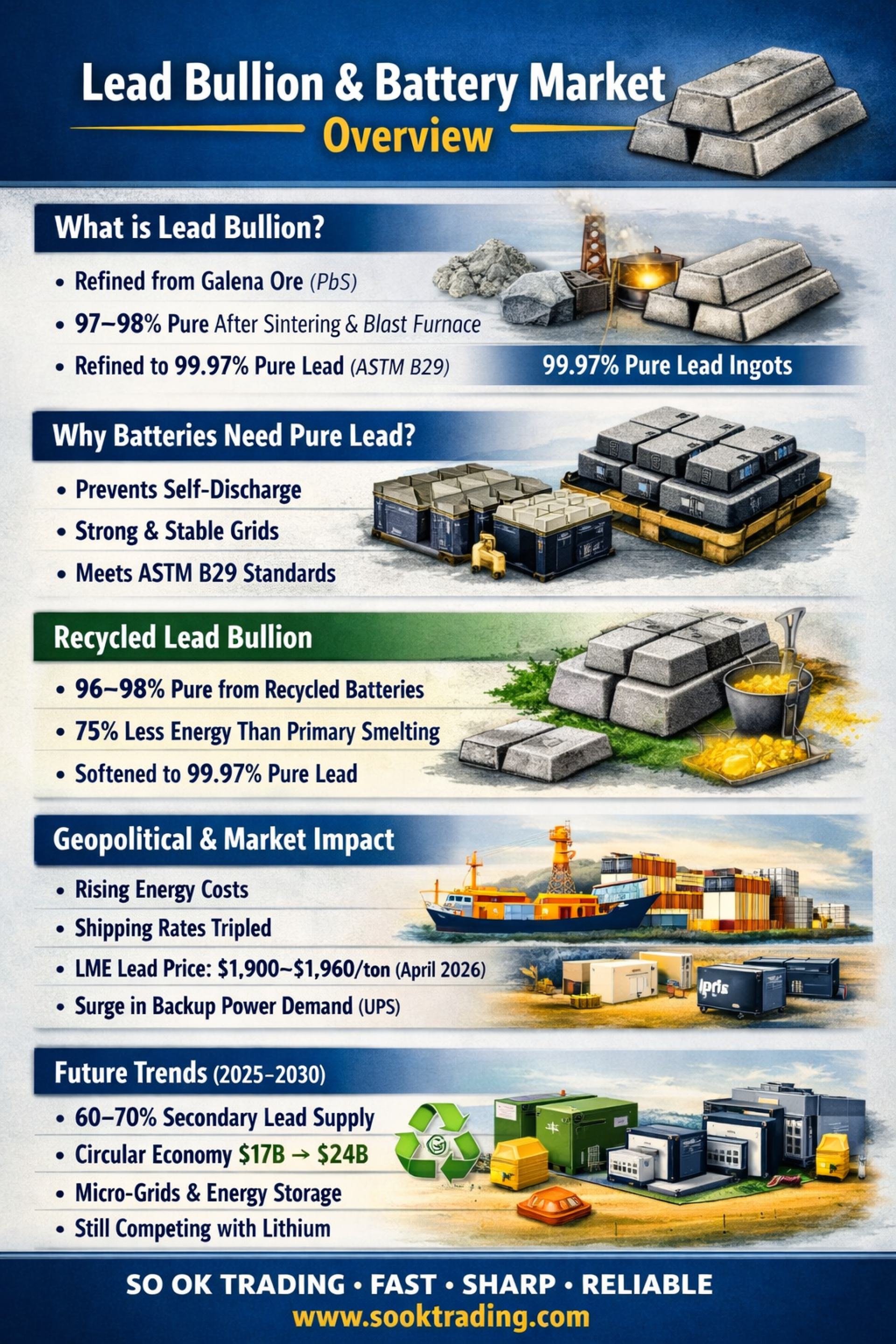
Lead Bullion (crude lead) is produced from Galena ore (PbS) through sintering and blast furnace smelting, with purity around 97–98%. However, it still contains impurities such as silver, copper, antimony, tin, and arsenic. Therefore, it must undergo refining to reach 99.97% pure lead under ASTM B29 standards, before being used in the battery industry.
“Lead Bullion is often cast into large ingots (Ingots or Pigs) for easy transport to refineries.”
⚡ Why Do Batteries Require Pure Lead?
Impurities accelerate degradation: Copper or iron cause rapid self-discharge.
Grid strength: Refined lead is often alloyed with antimony or calcium to ensure strong and stable battery grids.
Strict standards: ASTM B29 strictly limits impurities such as antimony, arsenic, and nickel.
♻️ Lead Bullion from Battery Recycling
Purity 96–98%, but with high antimony content (1.5–4%).
Softening process: Removes antimony, arsenic, and tin to achieve 99.97% soft lead.
Advantages: Uses 75% less energy compared to primary smelting.
Caution: Poor separation may leave high levels of bismuth, which is difficult to remove and affects battery quality.
Geopolitical Factors & Middle East Conflict Impact
Energy prices surge: Refining costs rise immediately.
Freight rates soar: Shipping costs increased 2–3 times after the Strait of Hormuz crisis.
Global market (April 2026): LME lead price at USD 1,900–1,950/ton, with inventories up to 281,000 tons.
Impact on Thailand: Lead prices fell, but electricity and shipping costs rose by 47%.
Opportunity in crisis: UPS battery demand surged in hospitals, data centers, and communication systems.
Future Outlook (2025–2030)
Secondary lead dominates: Expected to account for 60–70% of global demand.
Circular economy growth: Lead-acid battery recycling market projected to grow from USD 17B to USD 24B.
Competition with lithium: EVs rely on lithium, but starter batteries and UPS remain lead-based.
Micro-Grid & ESS: Developing countries favor lead batteries for affordability and easy maintenance.
ESG & clean technology: Smelters must adopt emission-reduction technologies, such as hydrogen instead of coke.
Lead Bullion Summary
Lead prices down, but energy and shipping costs up → Thai manufacturers must manage costs carefully.
Golden opportunity in UPS market → Geopolitical instability drives demand for lead-acid batteries.
Future is recycling → Closed-loop systems will be the key strategy for sustainable battery production.
Recycled Lead = 75% Cost Savings + ESG Compliance + Circular Economy Solutions
SO OK TRADING — FAST • SHARP • RELIABLE We are your trusted business partner, delivering high-quality Lead Bullion and Lead Ingots that meet international standards, supporting the battery industry and renewable energy sectors.
Visit us at: www.sooktrading.com Contact us directly: sooktrading@outlook.com