“Recycled Aluminum: Transforming the Global Economy Towards the Net Zero Era — From Cans to Clean Energy and Circular Economy Innovation” Article by SO OK TRADING | March 25, 2026
“Recycled Aluminum: From Cans to Driving the Net Zero World”
Article by SO OK TRADING | March 25, 2026
Aluminum is shifting its role from a common everyday metal to a strategic resource at the heart of the circular economy and global decarbonization.
Aluminum & Recycled Aluminum: Global Overview (2025–2026)
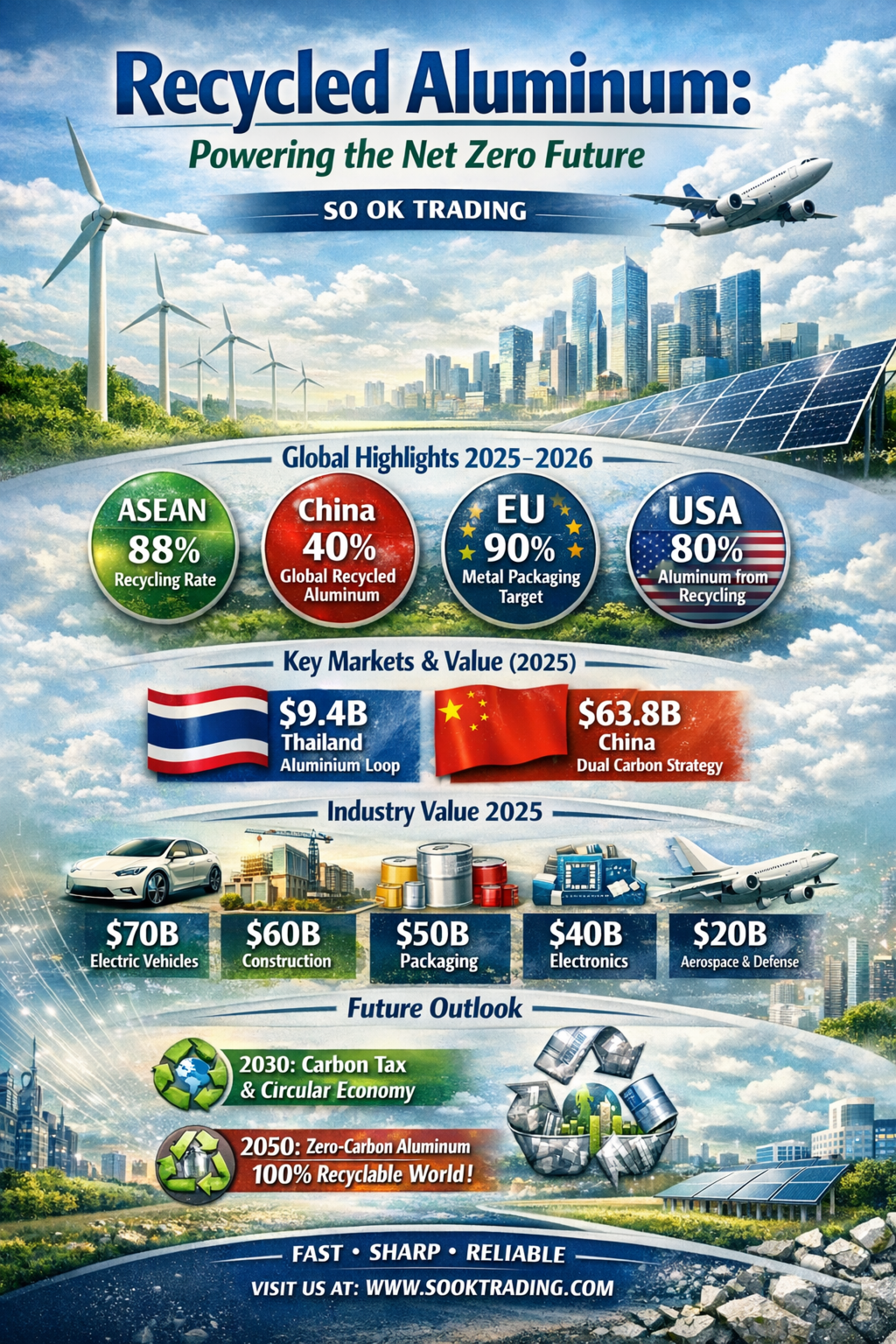
ASEAN: Thailand’s recycling separation rate reaches 88%, with the Aluminium Loop project reclaiming over 1 billion cans. Malaysia and Thailand have significantly increased imports of aluminum scrap from the U.S. to feed regional recycling industries.
China: Accounts for nearly 40% of global secondary aluminum production, transitioning from coal-powered primary aluminum to cleaner scrap. Target: over 15 million tons of recycled aluminum by 2027.
Japan: Boasts a 93% recycling rate and exports advanced metal sorting technology to ASEAN.
South Korea: Known for precise waste data management and ongoing packaging reduction campaigns.
USA: Over 80% of aluminum production comes from recycling, supported by can deposit laws in 10 states.
EU: Aims to collect 90% of metal packaging by 2029, investing in recycling plants powered by solar and hydro energy.
Middle East (GCC): UAE and Saudi Arabia are investing $6 billion in recycling infrastructure to diversify beyond oil.
Africa: Urbanization drives scrap aluminum use in manufacturing, especially in South Africa and Nigeria.
Australia: Collaborates with the International Aluminium Institute to enhance can sorting systems.
Industry Market Value (2025)
Automotive & EV: $70B
Construction: $60B
Packaging: $50B
Electronics: $40B
Aerospace & Defense: $20B
Asia’s Two Pillars: Thailand & China
Thailand: Aluminum market valued at $9.39B in 2025. Focus on recycling and value-added products, supported by EPR laws and the Aluminium Loop model targeting 5 billion cans reclaimed.
China: Market valued at $63.78B in 2025. Produces 42M tons of primary aluminum, capped at 45M tons to control pollution. Driving Dual Carbon and Zero-Waste Cities policies.
⏳ Role of Recycled Aluminum Over Time
Present (2025–2026): A key tool for waste management and cost reduction, widely used in packaging, automotive, and construction.
2030: Central to carbon tax mitigation. Circular economy laws mandate minimum recycled content, while Green Premium markets reward 100% recycled aluminum products with higher prices.
2050: Primary aluminum production drastically reduced. Urban Mining dominates, with nearly all scrap reused. Zero-Carbon Aluminum produced with clean energy (hydrogen, solar). Products designed for 100% recyclability.
Strategic Summary
Recycled aluminum is evolving from a “supplementary material” into a core resource of the global economy by 2050. It will play a vital role across industries from packaging to EVs and aerospace. Nations investing in advanced sorting technology and clean energy will gain strategic advantages in both cost and carbon footprint.
SO OK TRADING — FAST • SHARP • RELIABLE
Visit us at: www.sooktrading.com
For inquiries on REMELT ALUMINUM or ALUMINUM RECYCLING, contact us directly at SOOKTRADING@OUTLOOK.COM