Share

“Recycled Aluminum: Transforming the Global Economy Towards the Net Zero Era — From Cans to Clean Energy and Circular Economy Innovation” Article by SO OK TRADING | March 25, 2026
Last updated: 25 Mar 2026
1596 Views

“Recycled Aluminum: From Cans to Driving the Net Zero World”
Article by SO OK TRADING | March 25, 2026


Aluminum is shifting its role from a common everyday metal to a strategic resource at the heart of the circular economy and global decarbonization.


Aluminum & Recycled Aluminum: Global Overview (2025–2026)

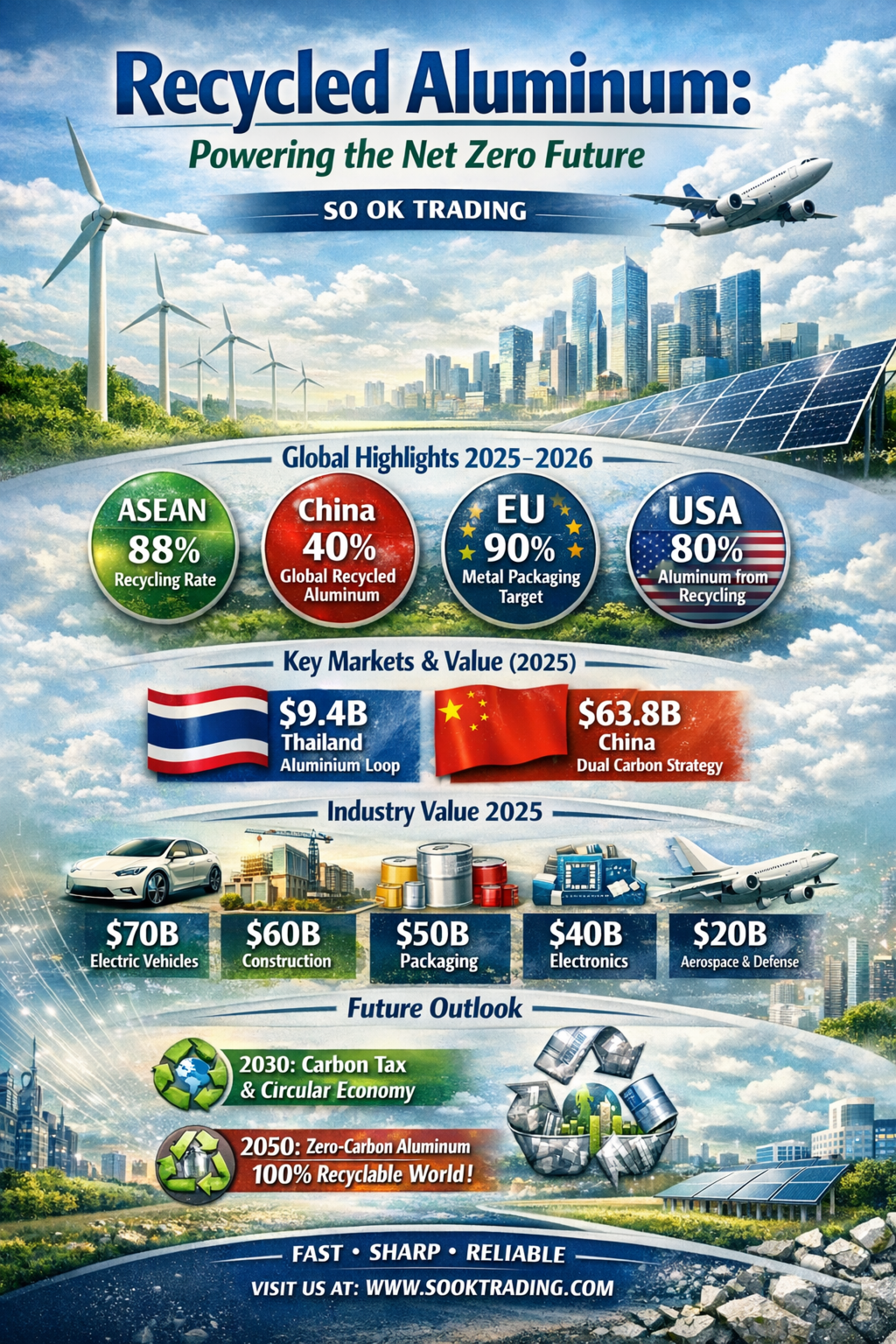
ASEAN: Thailand’s recycling separation rate reaches 88%, with the Aluminium Loop project reclaiming over 1 billion cans. Malaysia and Thailand have significantly increased imports of aluminum scrap from the U.S. to feed regional recycling industries.
China: Accounts for nearly 40% of global secondary aluminum production, transitioning from coal-powered primary aluminum to cleaner scrap. Target: over 15 million tons of recycled aluminum by 2027.
Japan: Boasts a 93% recycling rate and exports advanced metal sorting technology to ASEAN.
South Korea: Known for precise waste data management and ongoing packaging reduction campaigns.
USA: Over 80% of aluminum production comes from recycling, supported by can deposit laws in 10 states.
EU: Aims to collect 90% of metal packaging by 2029, investing in recycling plants powered by solar and hydro energy.
Middle East (GCC): UAE and Saudi Arabia are investing $6 billion in recycling infrastructure to diversify beyond oil.
Africa: Urbanization drives scrap aluminum use in manufacturing, especially in South Africa and Nigeria.
Australia: Collaborates with the International Aluminium Institute to enhance can sorting systems.
 

Industry Market Value (2025)

Automotive & EV: $70B
Construction: $60B
Packaging: $50B
Electronics: $40B
Aerospace & Defense: $20B
 

Asia’s Two Pillars: Thailand & China

Thailand: Aluminum market valued at $9.39B in 2025. Focus on recycling and value-added products, supported by EPR laws and the Aluminium Loop model targeting 5 billion cans reclaimed.
China: Market valued at $63.78B in 2025. Produces 42M tons of primary aluminum, capped at 45M tons to control pollution. Driving Dual Carbon and Zero-Waste Cities policies.
 

⏳ Role of Recycled Aluminum Over Time

Present (2025–2026): A key tool for waste management and cost reduction, widely used in packaging, automotive, and construction.
2030: Central to carbon tax mitigation. Circular economy laws mandate minimum recycled content, while Green Premium markets reward 100% recycled aluminum products with higher prices.
2050: Primary aluminum production drastically reduced. Urban Mining dominates, with nearly all scrap reused. Zero-Carbon Aluminum produced with clean energy (hydrogen, solar). Products designed for 100% recyclability.
 

Strategic Summary

Recycled aluminum is evolving from a “supplementary material” into a core resource of the global economy by 2050. It will play a vital role across industries from packaging to EVs and aerospace. Nations investing in advanced sorting technology and clean energy will gain strategic advantages in both cost and carbon footprint.


SO OK TRADING — FAST • SHARP • RELIABLE
Visit us at: www.sooktrading.com
For inquiries on REMELT ALUMINUM or ALUMINUM RECYCLING, contact us directly at SOOKTRADING@OUTLOOK.COM

Related Content
HNY 2026 with a First Analysis on Thai Baht Value
he Thai baht in Q1 2026 is expected to strengthen against the US dollar, driven primarily by a weaker dollar globally, a seasonal tourism boost, and expectations of US Federal Reserve rate cuts. This strength is occurring despite a weak domestic economic outlook and the Bank of Thailand's (BoT) likely continued easing of its policy rate. Exchange Rate Drivers and Forecast External Factors: The primary driver for the strengthening baht is external, mainly the broad weakness of the US dollar as global markets price in expected Fed rate cuts. The baht is also correlated with global gold prices, which have been climbing. Tourism High Season: The period extending into Q1 2026 is the high season for tourism, which typically brings in foreign currency and supports the baht's value. Policy Divergence: The BoT is expected to continue its easing cycle, potentially cutting the policy rate further to 1.00% by Q1 2026 to stimulate the sluggish domestic economy. This divergence from a potentially less aggressive US Fed in Q1 could support the baht in the short term, though some analysts warn the currency could weaken later in 2026. Forecasts: Projections for 2026 generally place the baht in a range of 30.80–33.00 per US dollar. Some models estimate it could trade around 31.06 by the end of Q1. A persistently strong baht below 31 per US$ is seen as a significant risk to the Thai export and tourism sectors. Key Economic Context Weak Growth: Thailand's economy is expected to slow down to a 5-year low growth rate of around 1.6-1.8% in 2026, pressured by US tariffs, global trade tensions, and high household debt. The central bank chief expects an improvement in Q1 2026 after a weak second half of 2025. Political Uncertainty: A general election expected in February 2026 could also introduce volatility, though some historical trends suggest the baht may strengthen following the formation of a new government. Low Inflation: Headline inflation is projected to remain subdued or even negative, providing the central bank with justification for further rate cuts to stimulate demand. In summary, Q1 2026 is characterized by a strong and volatile baht driven by external factors, contrasting sharply with a weak domestic economy and accommodative monetary policy.
1 Jan 2026
Aluminum Recycling the Circle and How it work
Aluminium is the most abundant metal in the earth’s crust. Approximately 75% of aluminium ever produced is still in use today as it can be recycled endlessly without compromising any of its unique properties or quality. Aluminium’s lifecycle provides significant benefits through recycling, saving 95% of the energy it would take to make new aluminium metal. More information on recycling may be found here. Recycling aluminium has five steps: Step 1: Collecting Scrap There are two categories of aluminium scrap: New Scrap New Scrap is surplus material that arises during the manufacture and fabrication of aluminium products, up to the point where they are sold to the final consumer. For example, off cuts of aluminium sheet or extrusions are considered new scrap. Sometimes, this new scrap can be safely recycled by aluminium smelters as its composition is known. Old Scrap Old Scrap is material that has been used by the consumer and subsequently discarded. For example, used beverage cans, window frames, electrical cabling and car cylinder heads are all considered old scrap. Aluminium smelters are unable to safely accept this old scrap as its composition is usually unknown and it can be contaminated. Scrap aluminium is also collected from the community – from households, scrap merchants, local and regional authorities, etc. Step 2: Sorting Scrap The scrap is then sorted – grouping all coated (painted or lacquered) aluminium together, and grouping all uncoated aluminium together. Paper, plastic and other non-aluminium recycling needs to be removed. Step 3: Crushing The sorted aluminium is then crushed into bales – by compacting the aluminium scrap, it reduces freight, storage and handling costs Step 4: Remelting Uncoated scrap is loaded directly into a large furnace called a remelter, where it is heated at high temperatures and turned into molten form. If the scrap aluminium is coated, it is processed through a gas fired rotary furnace to remove any coating and then transferred to the remelter. Step 5: Casting The molten aluminium is cast at a temperature of just over 700°C to form ingots
13 Nov 2025
“Baht Weak, Dollar Strong – The Shaken Global Financial Game”: SO OK TRADING: 15 MAY 2026
This May, the “Global Financial Game” heats up once again — the US dollar surges strong while the Thai baht continues to weaken, moving within the 32.30–32.65 THB/USD range. Strong US economic growth, soaring oil prices, and falling gold have drained the baht’s momentum. For businesses and investors, this is the time to “Think Fast, Adapt Quickly” to navigate global market volatility. SO OK TRADING FAST • SHARP • RELIABLE
15 May 2026
This website uses cookies for best user experience, to find out more you can go to our Privacy Policy and Cookies Policy
Powered By MakeWebEasy Logo MakeWebEasy