“Global Sugar Industry 2024/25: From Sweetness to ‘Oil on Land’ — Transforming into Aviation Fuel and Bio-Economy in the Net Zero Era”
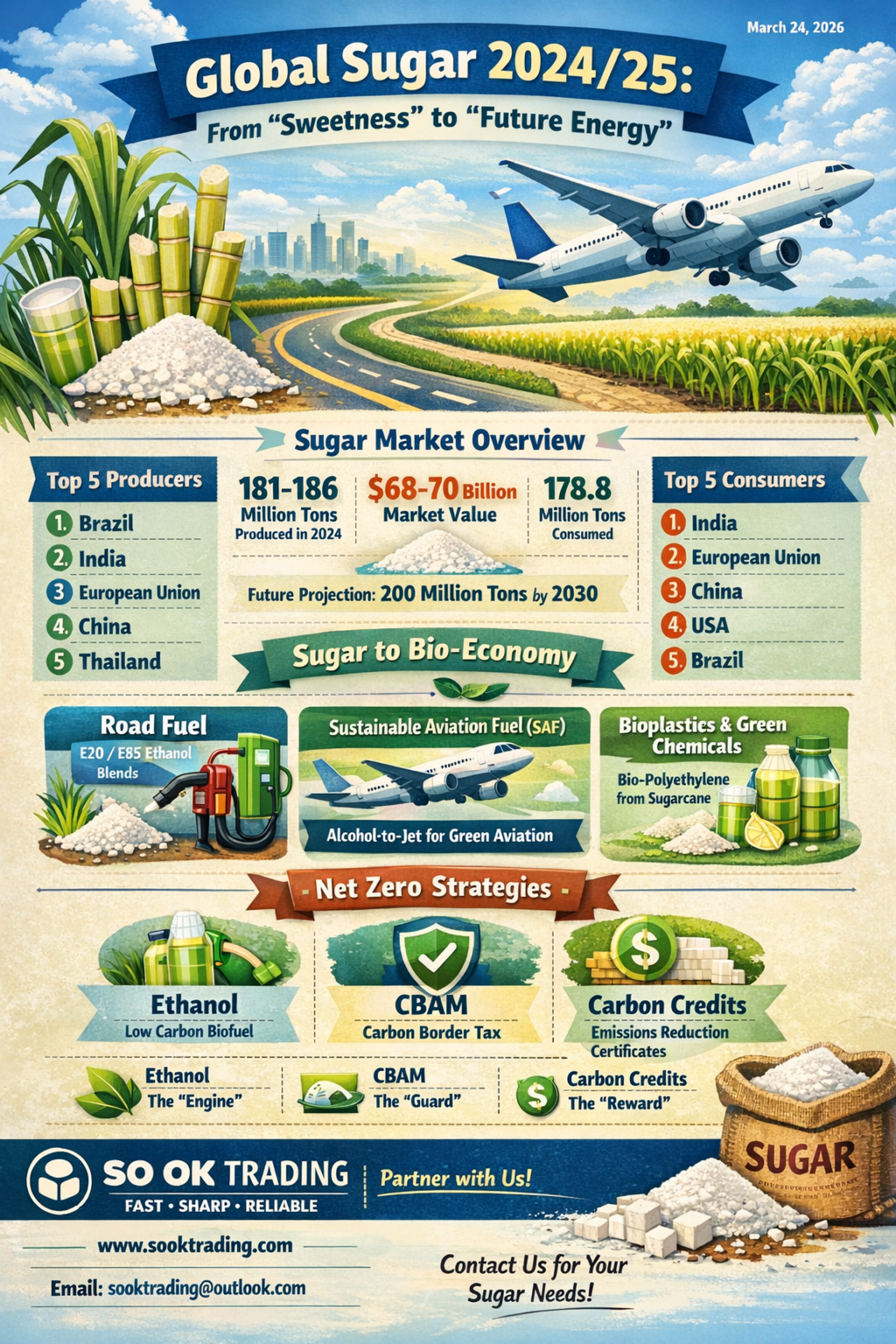
Global Sugar Industry 2024/25: From Sweetness to Future Energy
Article by SO OK TRADING March 24, 2026
The sugar industry is undergoing a major transformation. Once seen merely as a flavoring ingredient for food and beverages, sugar is now evolving into a biofuel and a green raw material directly tied to the world’s Net Zero ambitions.
Global Sugar Market Overview
Production (2024): 181–186 million tons
Market Value: USD 68–70 billion
Consumption: 178.8 million tons (driven by food, beverage, and bakery industries)
Average Prices: Raw sugar USD 448.6/ton; White sugar USD 577.8/ton
Projection: Output expected to reach 200 million tons by 2030
Top 5 Sugar Producers (as of end-2025)
Brazil — 44–47 million tons annually; world’s largest exporter with flexibility to switch between sugar and ethanol.
India — 33–35 million tons; second-largest producer, with exports restricted to stabilize domestic prices.
European Union (EU) — 16 million tons; beet-based production facing environmental regulation challenges.
China — 11 million tons; insufficient for domestic demand, heavily reliant on imports from Brazil and Thailand.
Thailand — 10–14 million tons; fifth-largest producer but second–third largest exporter globally, especially in raw sugar.
Top 5 Sugar Consumers (as of end-2025)
India — 28–32 million tons; largest consumer due to population size and sweet-based culture.
European Union (EU) — 16–17 million tons; strong demand in food and bakery industries, though health trends are reducing sugar intake.
China — 15–16 million tons; major net importer as consumption outpaces production.
United States — 11–12 million tons; highest per capita consumption, with import quotas in place.
Brazil — 9–10 million tons; large domestic demand driven by population and food industry.
From Sugar to Ethanol: The Bio-Economy Transition
Sugarcane is no longer just about sweetness — it is becoming a biorefinery powerhouse:
Road Fuel: Thailand and India promote ethanol-blended fuels (E20/E85). India targets E20 by 2025, diverting 5–6 million tons of sugar from global markets.
Aviation Fuel (SAF): Brazil and India are pioneering Alcohol-to-Jet technologies. SAF commands premium prices and is emerging as the “star” of clean energy.
Bioplastics & Green Chemicals: Ethanol is a feedstock for bio-polyethylene. Global brands like Coca-Cola and LEGO are adopting plant-based packaging.
Ethanol, CBAM, and Carbon Credits: Three Tools for Net Zero
Though distinct, these mechanisms complement each other toward the same goal:
Ethanol: Low-carbon biofuel replacing fossil fuels.
CBAM (Carbon Border Adjustment Mechanism): EU’s carbon tariff penalizing high-emission products.
Carbon Credits: Certificates for verified emission reductions, tradable for revenue.
In simple terms:
Ethanol = The Engine
CBAM = The Guard
Carbon Credits = The Reward
Strategic Outlook
Rising oil prices → More ethanol production, sugar shortages, and price spikes.
Stricter climate policies → Sugarcane ethanol becomes a premium product for aviation and green chemicals.
Thailand → Positioned to become ASEAN’s Bio-Hub, leveraging its sugarcane production and export strength.
✨ The sugar industry is shifting from a volatile commodity to a high-value Bio-Economy, linked to clean energy, bioplastics, and Net Zero policies.
SO OK TRADING: Your Business Partner
SO OK TRADING — FAST • SHARP • RELIABLE
Visit us: www.sooktrading.com
Inquiries: sooktrading@outlook.com
We provide high-quality sugar for industrial and commercial use, with competitive pricing and export-ready services.


 – The Treasure of the AI & EV Era: Market News, Price Movements, and Investment Strategies by SOOK TRADING"")
