“The Negotiation Table That Shook the World: Islamabad Talks 2026 — A Turning Point for the Global Economy, Where Politics Becomes the Game of Economics”
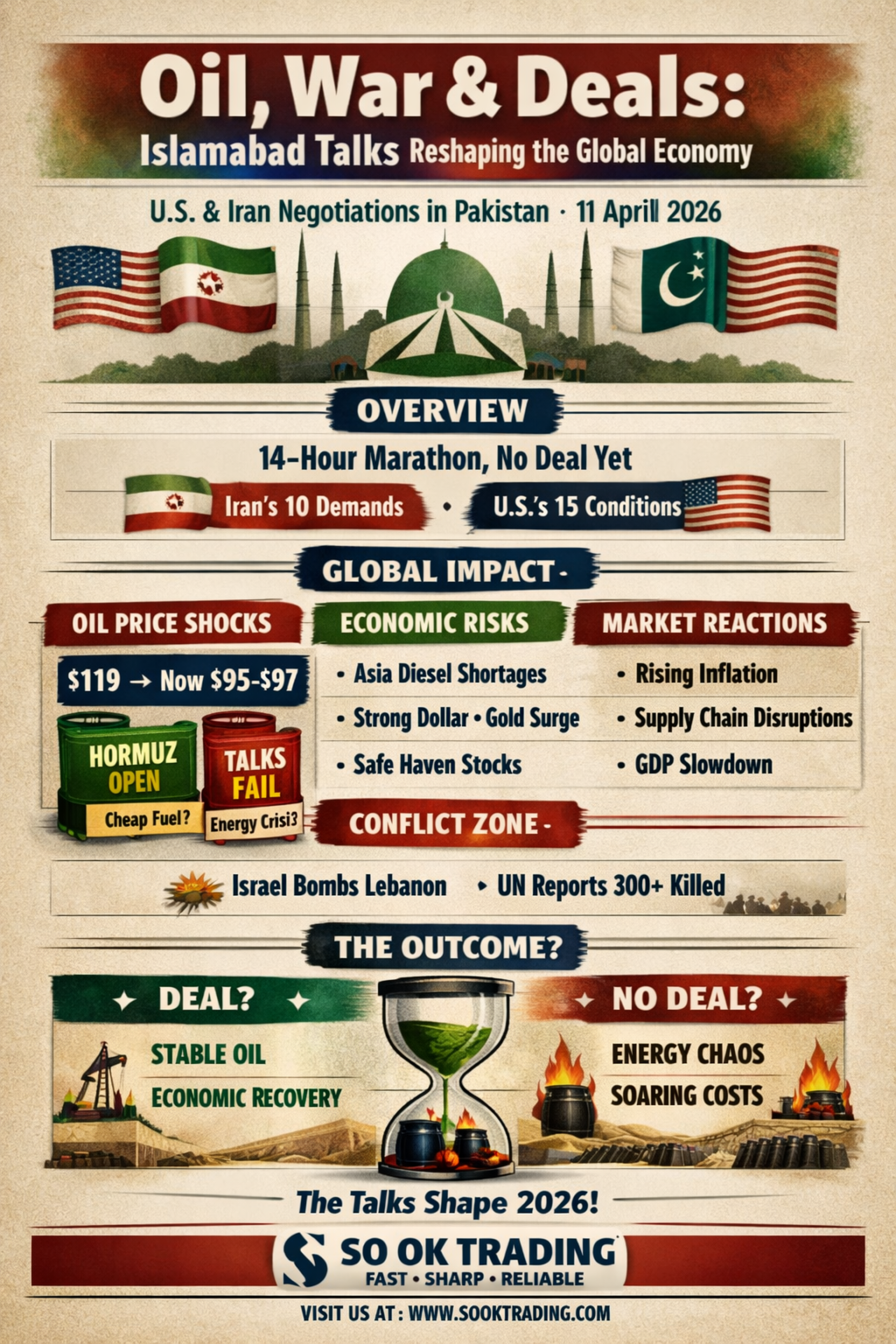
Oil, War & Deals: Islamabad Talks Reshaping the Global Economy
The U.S.–Iran Negotiations in Pakistan — A Turning Point for the Global Economy in 2026 By SO OK TRADING | April 11, 2026
Overview of the Negotiations
The Islamabad Talks between the United States and Iran, held in Pakistan’s capital on April 11–12, 2026, marked the first direct negotiations in years after escalating conflicts. Pakistan acted as host and mediator.
14-hour marathon discussions stretched past midnight, yet no agreement was reached.
Key proposals:
Iran’s 10 demands: control of the Strait of Hormuz, nuclear rights, lifting sanctions, U.S. troop withdrawal.
U.S. response with 15 conditions: ban on nuclear weapons, open sea routes, missile restrictions.
⛽ Global Economic Impact
Oil Prices
Before talks: surged to $119 per barrel.
After temporary ceasefire: dropped to $95–97.
If Hormuz remains open: could stabilize at $80.
If talks collapse: prices may soar beyond $150.
Thailand & Regional Economy
Thailand announced a fuel price cut of up to 6 baht during Songkran.
Prolonged negotiations risk diesel shortages, forcing new import markets.
Global Financial Markets
Dollar likely strengthens if U.S. military pressure continues.
If tensions ease, the dollar weakens while gold rises.
Energy stocks act as safe havens, but excessive oil prices could slow global manufacturing.
⚔️ Battlefield Tensions
Lebanon crisis: Israel continues strikes on Hezbollah despite a two-week ceasefire.
Israel absent from talks: PM Netanyahu insists on continuing war under “Operation Eternal Darkness.”
UN condemnation: Over 300 killed in a single day, with 1.2 million displaced.
Global Reactions
United Nations: opposes attacks on Lebanon.
Europe: France and Spain demand immediate ceasefire.
Middle East: Turkey and Egypt accuse Israel of “deliberately destroying peace.”
ICC: issues arrest warrant for Netanyahu, citing use of starvation as a weapon.
Future Economic Outlook
Energy: Successful talks → stable oil prices; failure → global energy crisis.
Logistics & Transport: Rising costs force businesses to adjust pricing strategies.
Agriculture & Food: Hormuz closure → global fertilizer shortage, threatening food security.
Industrial Raw Materials: Shortages in petrochemicals (e.g., naphtha) disrupt packaging and related industries.
Inflation: Rising worldwide, with GDP growth slowing across nations.
Conclusion
The Islamabad Talks are more than negotiations — they are a defining moment for the global economy in 2026.
If successful → oil prices stabilize, markets recover, consumers breathe easier.
If failed → energy crisis, soaring inflation, and major business adjustments worldwide.
SO OK TRADING Your Business Partner FAST • SHARP • RELIABLE VISIT US AT: WWW.SOOKTRADING.COM