Global Currency Wars: Dollar Surges—Baht Retreats, Yet Thailand Holds Its Balance. From Hormuz to Bangkok, the Dollar Strengthens Worldwide While the Baht Weakens Temporarily but Remains in Equilibrium
Last updated: 21 Mar 2026
2915 Views
Here’s the full English version of your article, polished for clarity and impact while keeping the analytical and professional tone intact:
Global Currency Wars: Dollar Strengthens—Baht Weakens, Yet Thailand Holds Its Balance
Market Analysis | March 21, 2026 | By SO OK TRADING
Introduction
March 2026 has become a month closely watched by global financial markets as the U.S. dollar surged significantly. Meanwhile, the Thai baht weakened to 32.85–32.90 per dollar in less than a month, down from 31.14 at the beginning of March. This movement reflects the combined pressures of Middle East conflict, U.S. monetary policy, and Thailand’s structural economic vulnerabilities.
Key Drivers Behind Dollar Strength and Baht Weakness
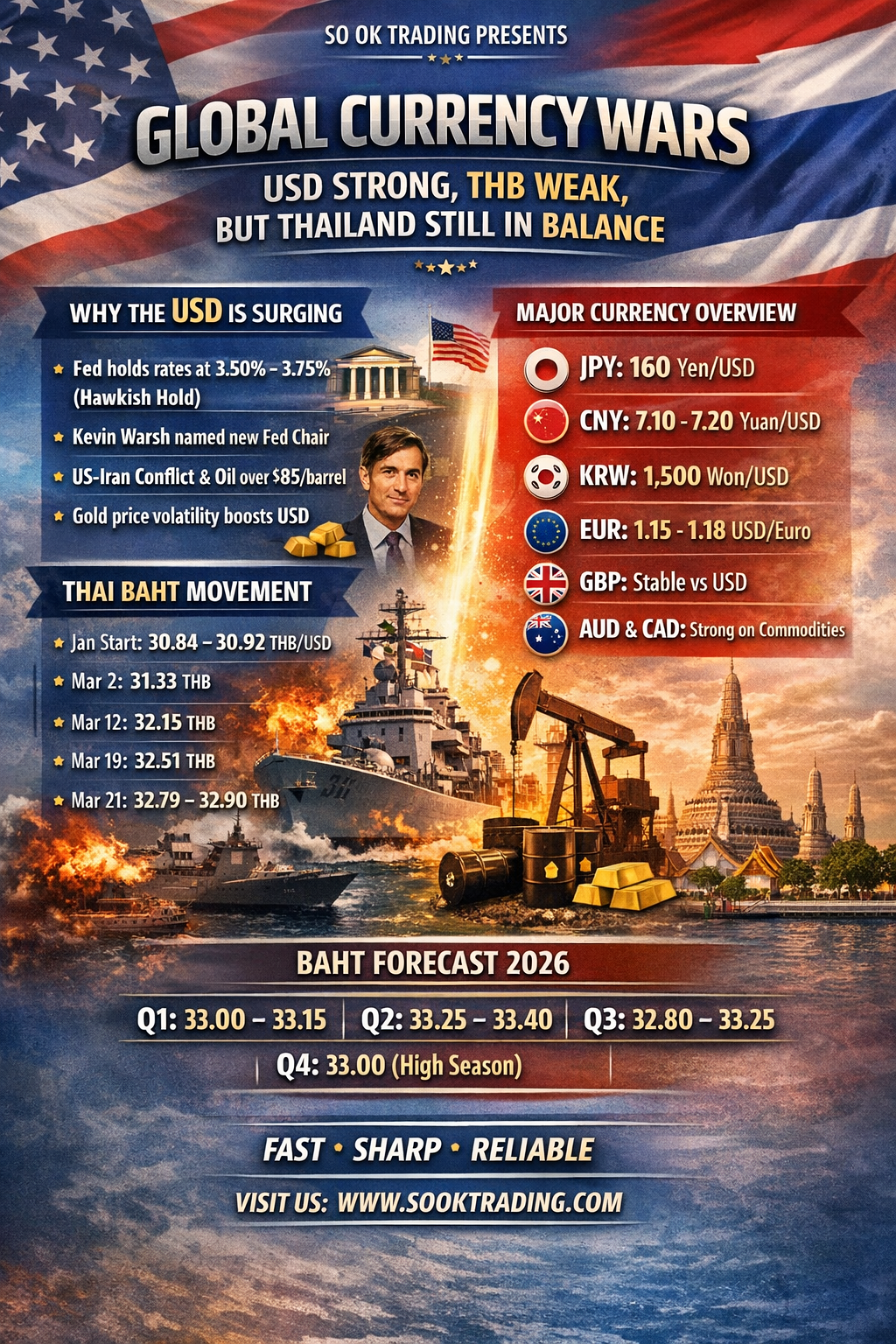
Federal Reserve Policy: Rates held at 3.50%–3.75% with a hawkish stance, signaling slower-than-expected rate cuts.
Leadership Change: Appointment of Kevin Warsh as the new Fed Chair raised expectations of continued monetary tightening.
U.S.–Iran Conflict: Escalation in the Middle East, including attacks on warships and energy facilities in the Strait of Hormuz, boosted demand for the dollar as a safe haven.
Oil Prices: Crude oil surged above $85 per barrel, reigniting inflation concerns and attracting capital into U.S. Treasuries.
Gold Volatility: Sharp swings in gold prices increased demand for dollar settlements, adding pressure on the baht.
Thai Baht Performance (Year-to-Date)
Late January: 30.84 – 30.92
March 2: 31.33
March 12: 32.15
March 19: 32.51
March 21: 32.79 – 32.92
Capital outflows and safe-haven dollar buying were the main drivers. The Bank of Thailand is expected to intervene if the baht weakens too rapidly.
Global Currency Overview
JPY (Japanese Yen): Near 160 per dollar, with speculation of Bank of Japan intervention.
CNY (Chinese Yuan): Managed within 7.10–7.20 per dollar by PBoC to support exports.
KRW (Korean Won): Weakened to 1,500 per dollar amid risk-off sentiment and tech stock sell-offs.
SGD (Singapore Dollar): More resilient due to MAS’s inflation-control policies.
AUD (Australian Dollar): Supported by commodity prices and prolonged high interest rates, showing rebound potential.
EUR (Euro): Trading within 1.15–1.18 per dollar, supported by ECB’s cautious stance on rate cuts.
GBP (British Pound): Stable, buoyed by signs of economic recovery in the UK.
CAD (Canadian Dollar): Strengthened by high oil prices, outperforming Asian currencies.
CHF (Swiss Franc): Safe-haven currency, though overshadowed by stronger dollar demand.
Thai Baht Quarterly Forecast (as of March 21, 2026)
Q1 (Current): Supported by tourism and gold demand but pressured by war; expected to close at 33.00–33.15.
Q2 (Apr–Jun): Seasonal weakness from dividend payments and higher dollar demand; 33.25–33.40.
Q3 (Jul–Sep): Potential rebound to 32.80–33.25 as U.S. rates enter a clear downtrend and the dollar index weakens.
Q4 (Oct–Dec): Continued strength, averaging 33.00, supported by tourism high season and foreign capital inflows.
Q1/2026 Strategic Summary
Importers: Gradually purchase USD near 32.80.
Exporters: Lock in profits with forward contracts at 32.90–33.00.
Investors/Travelers: Exchange gradually; avoid rushing decisions amid volatility.
✨ This analysis highlights that while the dollar is strengthening due to war and monetary policy, the baht’s weakness is temporary. A rebound is likely in the second half of the year. Strategic planning and close monitoring of global developments remain essential for businesses and investors.
SO OK TRADING: Your Business Partner
FAST • SHARP • RELIABLE
www.sooktrading.com
sooktrading@outlook.com
Global Currency Wars: Dollar Strengthens—Baht Weakens, Yet Thailand Holds Its Balance
Market Analysis | March 21, 2026 | By SO OK TRADING
Introduction
March 2026 has become a month closely watched by global financial markets as the U.S. dollar surged significantly. Meanwhile, the Thai baht weakened to 32.85–32.90 per dollar in less than a month, down from 31.14 at the beginning of March. This movement reflects the combined pressures of Middle East conflict, U.S. monetary policy, and Thailand’s structural economic vulnerabilities.
Key Drivers Behind Dollar Strength and Baht Weakness
Federal Reserve Policy: Rates held at 3.50%–3.75% with a hawkish stance, signaling slower-than-expected rate cuts.
Leadership Change: Appointment of Kevin Warsh as the new Fed Chair raised expectations of continued monetary tightening.
U.S.–Iran Conflict: Escalation in the Middle East, including attacks on warships and energy facilities in the Strait of Hormuz, boosted demand for the dollar as a safe haven.
Oil Prices: Crude oil surged above $85 per barrel, reigniting inflation concerns and attracting capital into U.S. Treasuries.
Gold Volatility: Sharp swings in gold prices increased demand for dollar settlements, adding pressure on the baht.
Thai Baht Performance (Year-to-Date)
Late January: 30.84 – 30.92
March 2: 31.33
March 12: 32.15
March 19: 32.51
March 21: 32.79 – 32.92
Capital outflows and safe-haven dollar buying were the main drivers. The Bank of Thailand is expected to intervene if the baht weakens too rapidly.
Global Currency Overview
JPY (Japanese Yen): Near 160 per dollar, with speculation of Bank of Japan intervention.
CNY (Chinese Yuan): Managed within 7.10–7.20 per dollar by PBoC to support exports.
KRW (Korean Won): Weakened to 1,500 per dollar amid risk-off sentiment and tech stock sell-offs.
SGD (Singapore Dollar): More resilient due to MAS’s inflation-control policies.
AUD (Australian Dollar): Supported by commodity prices and prolonged high interest rates, showing rebound potential.
EUR (Euro): Trading within 1.15–1.18 per dollar, supported by ECB’s cautious stance on rate cuts.
GBP (British Pound): Stable, buoyed by signs of economic recovery in the UK.
CAD (Canadian Dollar): Strengthened by high oil prices, outperforming Asian currencies.
CHF (Swiss Franc): Safe-haven currency, though overshadowed by stronger dollar demand.
Thai Baht Quarterly Forecast (as of March 21, 2026)
Q1 (Current): Supported by tourism and gold demand but pressured by war; expected to close at 33.00–33.15.
Q2 (Apr–Jun): Seasonal weakness from dividend payments and higher dollar demand; 33.25–33.40.
Q3 (Jul–Sep): Potential rebound to 32.80–33.25 as U.S. rates enter a clear downtrend and the dollar index weakens.
Q4 (Oct–Dec): Continued strength, averaging 33.00, supported by tourism high season and foreign capital inflows.
Q1/2026 Strategic Summary
Importers: Gradually purchase USD near 32.80.
Exporters: Lock in profits with forward contracts at 32.90–33.00.
Investors/Travelers: Exchange gradually; avoid rushing decisions amid volatility.
✨ This analysis highlights that while the dollar is strengthening due to war and monetary policy, the baht’s weakness is temporary. A rebound is likely in the second half of the year. Strategic planning and close monitoring of global developments remain essential for businesses and investors.
SO OK TRADING: Your Business Partner
FAST • SHARP • RELIABLE
www.sooktrading.com
sooktrading@outlook.com



Related Content
Aluminum Coil for Beverage and Food Packaging: Global Outlook 2027
By SO OK TRADING | 16 September 2026
✨ Introduction
The year 2027 marks a turning point for the global aluminum coil market for beverage and food packaging. While China continues to dominate as the largest producer and exporter, mounting pressures from Carbon Border Adjustment Mechanisms (CBAM), rising demand for recycled content, and expanding production capacity from competitors such as Thailand, India, Japan, Turkey, and Europe are reshaping the industry landscape like never before.
Global buyers are now seeking new alternatives that balance cost, quality, and sustainability. ASEAN producers, particularly UACJ Thailand, stand out with their AFTA tariff advantages and Japanese-level manufacturing standards.
The aluminum packaging market is no longer just about “price.” It has evolved into a matter of sourcing strategy, requiring careful consideration of conversion costs, regional premiums (MJP / Rotterdam), and the growing trend of Green Aluminum, which is rapidly becoming the new global standard.
As a trusted business partner from Thailand, SO OK TRADING provides in-depth insights and global market outlooks to help companies and brands plan their procurement strategies effectively and stay ahead in the new era of the aluminum industry.
SO OK TRADING — FAST • SHARP • RELIABLE
Your true partner in the aluminum packaging industry from Thailand
16 Sept 2026

⚙️ Copper Supercycle 2026 – The Future Metal
Copper is rapidly becoming “the strategic metal of the AI era.”
Prices remain hot, reaching $13,500–14,000/MT.
Demand driven by AI, EVs, and clean energy continues to surge worldwide.
SO OK TRADING analyzes the global copper market outlook
and offers the “Buy on Dip” strategy for forward‑thinking businesses.
28 May 2026