Share

“Aluminum: The Industrial Metal of the EV and Clean Energy Era — From Door Frames to Car Batteries, Unlocking Thailand’s Green Aluminum Opportunities in a Low-Carbon Economy” Article by SO OK TRADING · March 19, 2026
Last updated: 19 Mar 2026
994 Views

“Aluminum: The Industrial Metal of the Future”

From Ordinary Material to the Heart of EVs and the Green Industry

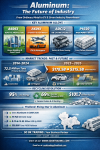
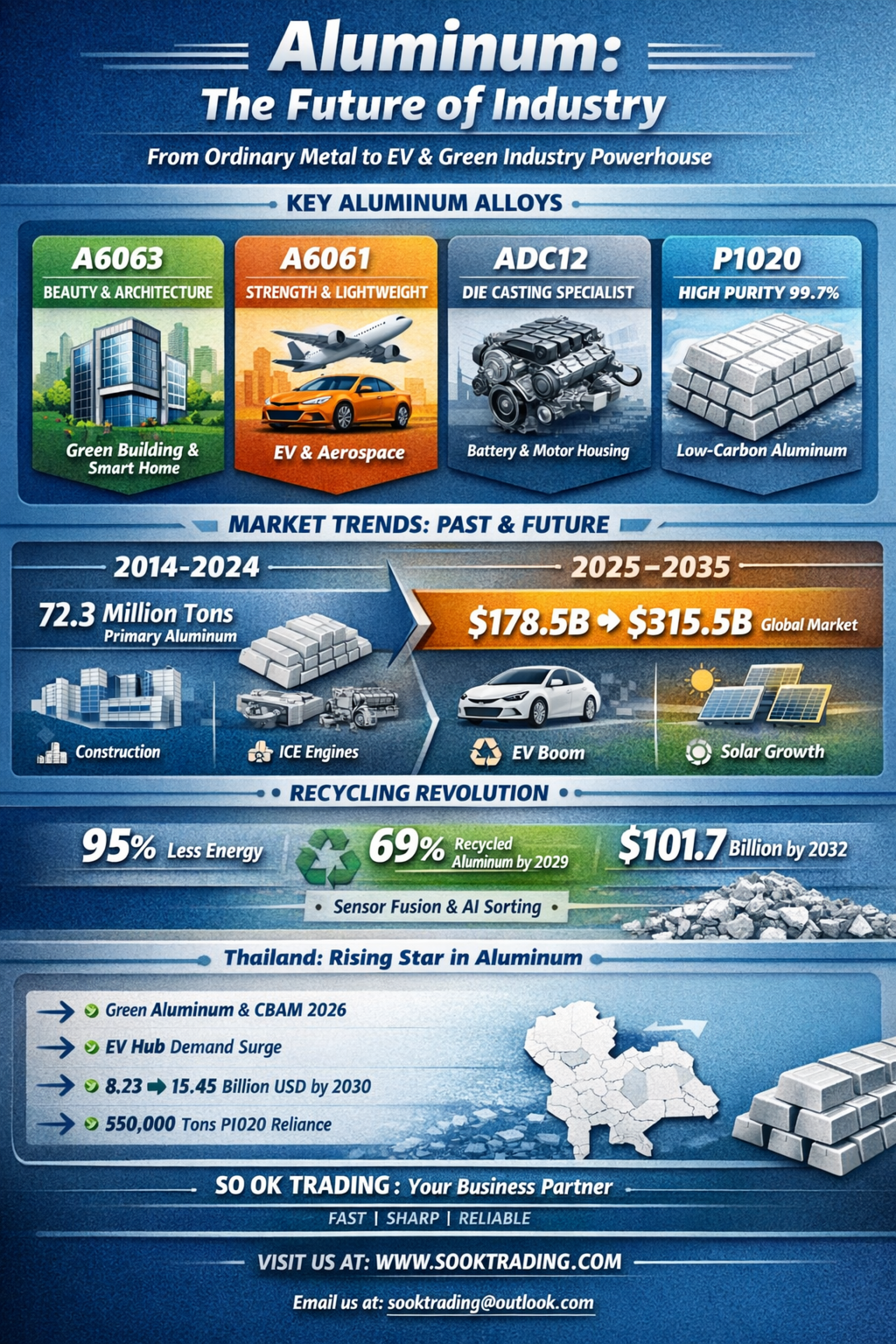
Aluminum is no longer just a common industrial metal — it is becoming the lifeblood of the modern global economy, both in Thailand and worldwide. Four key grades are driving this transformation: A6063, A6061, ADC12, and P1020.

Discover the 4 Key Aluminum Grades

A6063 – Smooth & Elegant
A star in architecture, used for door and window frames and façades.
Global trends are pushing toward Green Buildings and Smart Homes.

A6061 – Strong, Light & Durable
Widely used in Thailand for EV structures and machinery.
Internationally popular in Aerospace and Solar Cell applications.

ADC12 – Complex Die Casting
Transitioning from ICE engine parts to EV battery housings and motor housings.
The new trend: Gigacasting — casting large auto parts in a single piece.

P1020 – 99.7% Pure Ingot
Imported into Thailand for specialized alloy production.
Globally shifting toward Low-Carbon Aluminum produced with clean energy.


Market Outlook: Past 10 Years & Next 10 Years

2014–2024:

A6063 dominated construction.
ADC12 grew with internal combustion engines.
P1020 remained stable as a raw material.
Global primary aluminum production reached 72.3 million tons.
2025–2035:

Global aluminum market projected to grow from $178.5B → $315.5B (CAGR ~5.9%).
Demand for A6061 & ADC12 surges from EVs and Aerospace.
A6063 expands into Green Building and Solar Infrastructure.
P1020 shifts focus from “quantity” to “origin” — Low-Carbon Aluminum becomes the standard.
 

♻️ Recycling: From Option to Obligation

Recycling uses 95% less energy than primary production.
By 2029, recycled aluminum will account for 69% of global use.
Recycling market expected to reach $101.7B by 2032.
Thailand invests in Sensor Fusion + AI to sort high-quality aluminum scrap.
 

Thailand: From General Producer → High-Value Base

Green Aluminum & Net Zero: CBAM fully enforced in 2026 — exporters must report carbon emissions.
EV Hub: Demand for A6061 and ADC12 rising sharply.
Thai Market Growth: From $8.23B → $15.45B by 2030 (CAGR ~10.46%).
Challenges: Chinese dumping and reliance on importing over 550,000 tons/year of P1020.
 

Thailand’s Aluminum Industry Entering a New Golden Era

The measure is no longer “volume” but sustainability and environmental value.

Major opportunities: EVs, Solar Cells, Smart Electronics
New technologies: Closed-loop Recycling, Gigacasting
New regulations: ESG and Carbon Tax
Aluminum is the industrial metal of the future — shaping the global economy, with Thailand playing a vital role on the world stage.


SO OK TRADING: Your Trusted Business Partner
FAST | SHARP | RELIABLE

Visit us at: www.sooktrading.com
Email: sooktrading@outlook.com


This English version is ready for LinkedIn, Facebook, WeChat, or website publication.
Would you like me to also refine a short headline-style version (8–10 words) in English for social media feeds, so it grabs attention instantly?


Related Content
“Recycled Aluminum: From Scrap to Global Standard – Circular Economy Reshaping Industry with Aluminum Remelt – Remelt Revolution: Transforming the Metal Industry for Net Zero”
Recycled Aluminum: From Scrap to the New Global Standard As industries worldwide accelerate toward Net Zero and embrace the Circular Economy, Aluminum Remelt Ingots are no longer just an “alternative material.” They are becoming the main driver that every nation relies on for sustainability and economic competitiveness. With outstanding properties—lightweight, strong, corrosion-resistant, and excellent thermal and electrical conductivity—remelt ingots are now essential across diverse industries: automotive, construction, electronics, and packaging, all of which demand high-quality, eco-friendly materials. Most importantly, recycling aluminum consumes up to 95% less energy than producing primary aluminum, dramatically reducing both costs and carbon footprints. At the same time, global demand continues to rise, especially for ADC12, which is highly sought after in China, Japan, and Thailand, along with A356 and AC4B for automotive and high-strength applications. Global Shifts in 2025–2026 - China: Expanding production capacity to support electric vehicle (EV) manufacturing and construction, with stricter import standards for scrap aluminum. - United States: The world’s highest remelt usage (81%), driven by energy efficiency and carbon reduction, reinforced by strict tariffs under Section 232 (raised to 50%). - Japan: Fully dependent on imports and recycling, leveraging advanced sorting technologies and increasing the use of green aluminum in high-end automotive manufacturing. - Thailand: Rising as ASEAN’s scrap hub, exporting heavily to China and the U.S., with an aluminum can recycling rate of 86% and new circular economy initiatives such as the Aluminium Loop. From Scrap → To the Hero of Tomorrow Aluminum Remelt Ingots are rapidly evolving into the new global standard across industries. For those in the metals and manufacturing sectors, now is the time to adapt and seize opportunities in the global market.
21 Feb 2026
“Rare Earth: The Vitamins of Modern Global Industry : SO OK TRADING and Rare Earth Business Opportunities”
Rare Earth Elements (REEs): The Vitamins of Modern Industry From strategic resources to global business opportunities, Rare Earths are the key drivers of clean energy and advanced technologies—from EVs and batteries to defense systems and medical innovation.
16 Jan 2026
Analyzing the Global Economy at a Turning Point: From War to Adaptation — Rising Energy Costs, Surging Production Expenses, Yet Business Opportunities Remain Article by SO OK TRADING  March 31, 2026
Global Turning Point: Rising Energy Costs, Economic Volatility, Yet Business Opportunities Ahead ✨ Analysis by SO OK TRADING On March 31, 2026, the Middle East conflict shook the global economy. Oil and gas prices surged to multi‑year highs, driving production costs across industries — from plastics and fertilizers to food and metals. Stock markets worldwide faced heavy volatility, while gold remained a “safe haven” asset with heightened risk. Yet amid this uncertainty, new opportunities emerge for businesses ready to adapt — whether through embracing the Circular Economy, investing in renewable energy, or accelerating recycling and low‑carbon technologies. SO OK TRADING sees this as a pivotal moment: - Companies shifting toward sustainability will gain an edge. - Investors seeking opportunities in crisis will find new pathways in Green Energy and alternative supply chains. - Consumers will increasingly turn to eco‑friendly, cost‑efficient products.
31 Mar 2026
This website uses cookies for best user experience, to find out more you can go to our Privacy Policy and Cookies Policy
Powered By MakeWebEasy Logo MakeWebEasy