Share

“Oil Prices Break the Ceiling: Thailand Shaken, Global Economy at Risk — Oil Shock 2026 When Living Costs Skyrocket and the World Stumbles” Article by SO OK TRADING | March 18, 2026
Last updated: 18 Mar 2026
7234 Views

Oil Price Crisis 2026: Thailand Hit Hard, Global Economy at Risk
️ Article by SO OK TRADING | March 18, 2026

The surge in oil and natural gas (LNG) prices driven by Middle East tensions is not just an economic headline — it is a shockwave shaking Thai households and destabilizing the global economy.

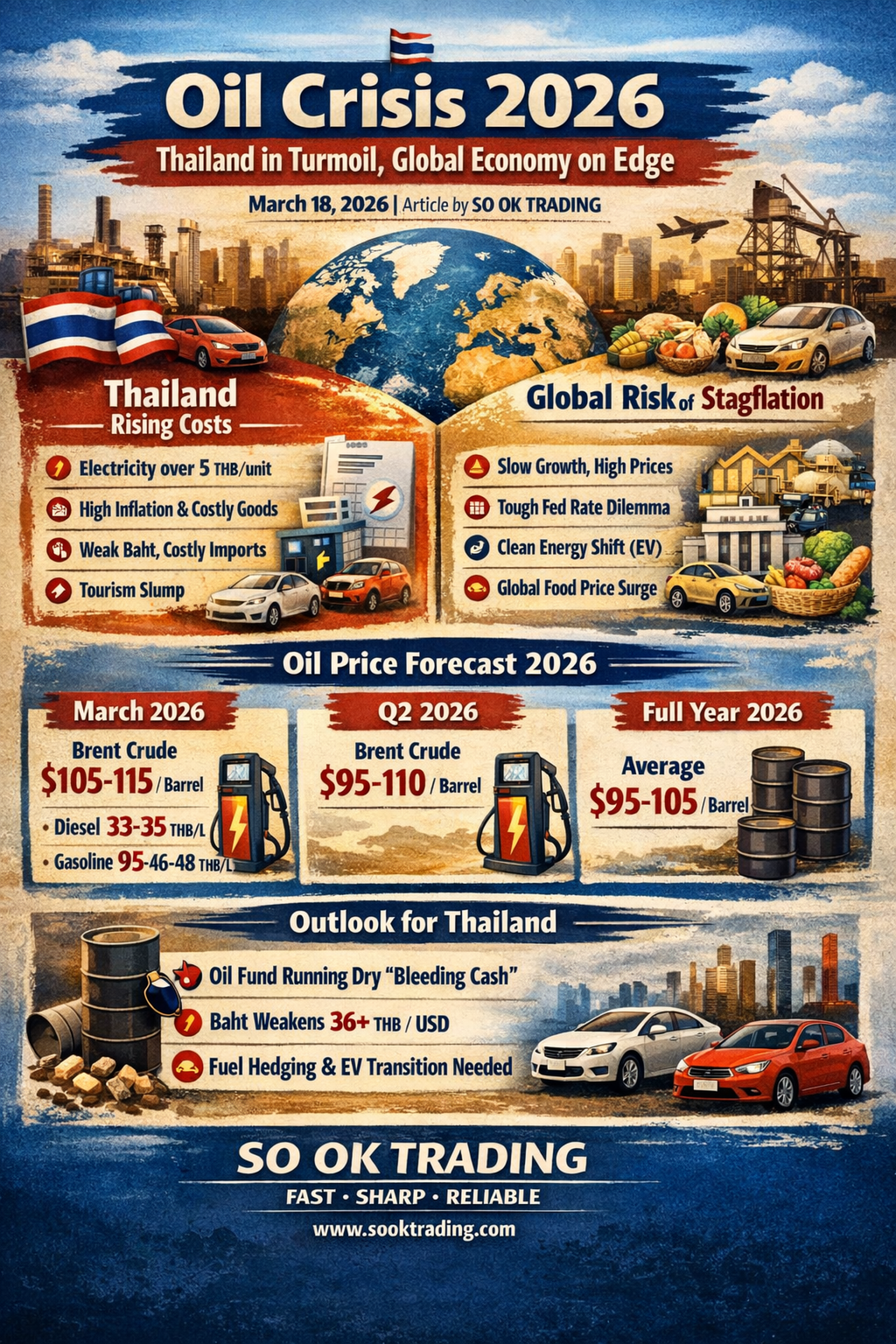
Thailand: Rising Living Costs
As a net energy importer, Thailand is hit harder than many nations.

Electricity Costs: Over 60% of Thailand’s power relies on natural gas. With global gas prices soaring, FT adjustments will push electricity bills beyond 5 THB/unit, directly impacting households and businesses.
Transport Inflation: Diesel prices drive up logistics costs, fueling cost-push inflation and squeezing consumer purchasing power.
Weak Baht: Higher energy import bills weaken the currency, making oil imports even more expensive — a vicious cycle.
Tourism Slowdown: Rising fuel surcharges increase airfare, discouraging foreign tourists and hurting Thailand’s service sector.
Global: Risk of Stagflation
The impact extends far beyond Thailand.

Slow Growth, High Prices: Oil drains consumer wallets while production costs rise, pushing the world toward stagflation.
Central Bank Dilemma: Institutions like the Fed face tough choices between raising rates to fight inflation or cutting them to support slowing economies.
Clean Energy Transition: Europe and China accelerate investments in renewables and EVs to reduce reliance on Middle Eastern oil.
Food Price Surge: Natural gas-based fertilizer costs rise, driving global food inflation and risking hunger crises in poorer nations.


⛽ Oil Price Forecast 2026

March 2026: Brent crude expected at $105–115/barrel. In Thailand, diesel likely capped at 33–35 THB/liter, gasoline 95 at 46–48 THB/liter (if floated).
Q2 2026 (Apr–Jun): Brent crude averages $95–110/barrel. OPEC+ reserves may ease prices slightly, but summer demand in the US and Europe will keep them high.
Full Year 2026:
H1: $100–120/barrel
H2: $85–95/barrel (if tensions ease)
Annual average: $95–105/barrel — the highest in years.
Thailand’s Energy Outlook

The Oil Fund risks running dry, forcing diesel prices to reflect market rates later in the year.
The baht may weaken beyond 33 THB/USD, making pump prices in Thailand harder to reduce compared to global benchmarks.
Businesses should adopt Fuel Hedging and accelerate EV Fleet transitions, as cheap oil is unlikely to return this year.
✨ Conclusion: 2026 is
A year when Thailand faces its highest living costs in years, while the world risks stagflation and accelerates the clean energy transition.


SO OK TRADING — Your Strategic Business Partner
FAST • SHARP • RELIABLE
www.sooktrading.com


Related Content
Copper Usage and Trend of it use and price
Copper's excellent electrical/thermal conductivity, corrosion resistance, and antimicrobial properties make it vital for electrical wiring, plumbing (pipes, fittings), and electronics; it's also crucial in construction (roofing, gutters), transportation (EVs, radiators), machinery (motors, pumps), and has uses in medicine (hospital surfaces), art, and agriculture (fungicides). Its role is growing with the energy transition (solar, wind, EV infrastructure). Key Applications by Industry Electrical & Electronics: Wires, cables, circuit boards, motors, transformers, switches, connectors (essential for data centers, AI, EVs). Construction: Plumbing (pipes), roofing, gutters, downspouts, architectural details, door handles (due to antimicrobial nature). Transportation: Vehicle wiring, motors, radiators, braking systems, marine hardware (anti-fouling). Industrial Machinery: Heat exchangers, pumps, valves, bearings, industrial piping. Medical: Hospital surfaces, doorknobs, equipment (reduces bacteria). Consumer Goods: Cookware, jewelry, musical instruments, tools, decorative items. Agriculture: Copper sulfate used as fungicide and algaecide. Why Copper is Used High Conductivity: Best for transferring electricity and heat efficiently. Corrosion Resistance: Resists weathering and soil corrosion, ideal for water/plumbing. Malleability & Ductility: Easy to shape and draw into wires. Antimicrobial: Kills microbes, reducing infection spread. Durability & Recyclability: Long-lasting and highly sustainable
21 Dec 2025
HNY 2026 with a First Analysis on Thai Baht Value
he Thai baht in Q1 2026 is expected to strengthen against the US dollar, driven primarily by a weaker dollar globally, a seasonal tourism boost, and expectations of US Federal Reserve rate cuts. This strength is occurring despite a weak domestic economic outlook and the Bank of Thailand's (BoT) likely continued easing of its policy rate. Exchange Rate Drivers and Forecast External Factors: The primary driver for the strengthening baht is external, mainly the broad weakness of the US dollar as global markets price in expected Fed rate cuts. The baht is also correlated with global gold prices, which have been climbing. Tourism High Season: The period extending into Q1 2026 is the high season for tourism, which typically brings in foreign currency and supports the baht's value. Policy Divergence: The BoT is expected to continue its easing cycle, potentially cutting the policy rate further to 1.00% by Q1 2026 to stimulate the sluggish domestic economy. This divergence from a potentially less aggressive US Fed in Q1 could support the baht in the short term, though some analysts warn the currency could weaken later in 2026. Forecasts: Projections for 2026 generally place the baht in a range of 30.80–33.00 per US dollar. Some models estimate it could trade around 31.06 by the end of Q1. A persistently strong baht below 31 per US$ is seen as a significant risk to the Thai export and tourism sectors. Key Economic Context Weak Growth: Thailand's economy is expected to slow down to a 5-year low growth rate of around 1.6-1.8% in 2026, pressured by US tariffs, global trade tensions, and high household debt. The central bank chief expects an improvement in Q1 2026 after a weak second half of 2025. Political Uncertainty: A general election expected in February 2026 could also introduce volatility, though some historical trends suggest the baht may strengthen following the formation of a new government. Low Inflation: Headline inflation is projected to remain subdued or even negative, providing the central bank with justification for further rate cuts to stimulate demand. In summary, Q1 2026 is characterized by a strong and volatile baht driven by external factors, contrasting sharply with a weak domestic economy and accommodative monetary policy.
1 Jan 2026
This website uses cookies for best user experience, to find out more you can go to our Privacy Policy and Cookies Policy
Powered By MakeWebEasy Logo MakeWebEasy