Share

“Recycled Lead Ingot: From Scrap Batteries to Clean Energy — The Pillar of Circular Economy and the Power of a Sustainable Future” Article by SO OK TRADING – March 14, 2026
Last updated: 14 Mar 2026
971 Views

♻️ Recycled Lead Ingot: The Circular Metal the World Still Relies On
Although often seen as an “old metal,” Lead Ingot, especially when recycled, is becoming the backbone of the circular economy. It enables sustainable resource use, reduces dependence on new mining, and continues to serve critical industries worldwide.

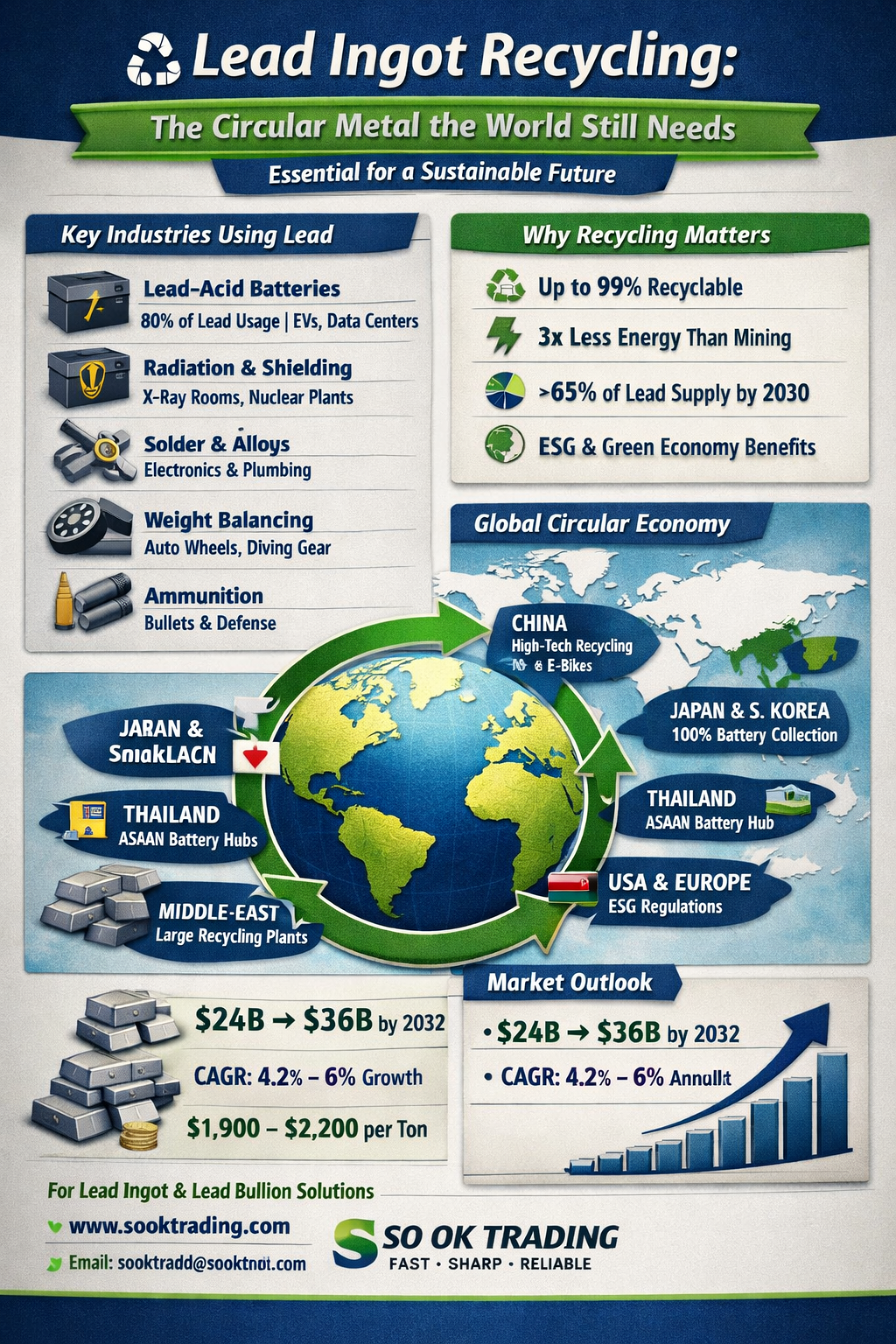
Key Industries Using Lead Ingot

Lead-Acid Batteries: Over 80% of global lead usage; essential for cars, EV auxiliary 12V batteries, UPS systems, and data centers.
Radiation & Sound Shielding: High density makes lead ideal for X-ray rooms, nuclear plants, and acoustic insulation.
Solder & Alloys: Widely used in electronics and plumbing, with strong demand in developing markets.
Weight Balancing: Automotive wheels, diving gear, and fishing sinkers.
Defense & Ammunition: Easy to mold, low melting point; remains stable despite environmental concerns.
Why Recycling is the Future

Nearly 100% recyclable: Old batteries can be reused at 95–99%.
3x less energy compared to mining.
By 2030, over 65% of global lead supply will come from recycling.
Meets ESG & Green Economy standards: “Green Lead” is increasingly adopted worldwide.
Circular Economy by Region

China: Shutting down illegal smelters, investing in high-standard recycling; demand driven by 5G and e-bikes.
Japan & South Korea: Nearly 100% battery collection; recycled lead used in hybrid cars and data centers.
Thailand: ASEAN automotive battery hub; LME + premium pricing; recycled lead now used in solar factory systems.
USA & EU: ESG laws mandate recycled materials in new batteries; reducing mining reliance.
Middle East: Investing in large recycling plants to cut imports and manage hazardous waste.
Africa: Major exporter of scrap batteries, though recycling standards remain inconsistent.
Market Outlook

Global lead market projected to grow from $24B (2024) to $36–38B (2032).
CAGR: 4.2% – 6%.
Price range: $1,900–$2,200 per ton, driven by real demand rather than speculation.
Positive factor: Stricter pollution controls in China could tighten supply and push prices upward.
 

Recycled Lead Ingot is not just another metal — it is the pillar of the circular economy, ensuring sustainable resource use, lowering energy costs, and supporting industries from automotive to data centers and healthcare.

SO OK TRADING: Your Trusted Business Partner
FAST • SHARP • RELIABLE

Visit us: www.sooktrading.com
Email: sooktrading@outlook.com


Related Content
“War Shakes the Global Packaging Industry: Supply Chain Disruption, Plastic Shortage & Aluminum Squeeze – From Crisis to New Business Opportunities” Article by SO OK TRADING | March 26, 2026
“War Reshapes the Packaging Industry – Plastic Stumbles, Aluminum Faces Shortages” The Middle East conflict has severely disrupted global supply chains, striking hardest at petrochemicals and packaging. Plastic packaging is in critical shortage, while aluminum has been pulled in as the substitute material—only to face its own supply squeeze. Both stockpiling and new production are under pressure, especially in food and beverage packaging. This article by SO OK TRADING dives deep into the cascading impacts of war on the packaging industry, and highlights strategies and opportunities to pivot toward recycled packaging and innovative solutions in 2026.
26 Mar 2026
ALUMINUM PRICE TREND 2026
An analysis of the aluminum market in 2026 indicates a likely continued market deficit and upward price pressure, driven by constrained supply and resilient demand from green energy sectors. However, significant volatility is expected due to policy uncertainties and the potential for new Indonesian supply to eventually balance the market. Key Drivers and Projections for 2026 Supply Side Analysis Capacity Constraints: China's primary aluminum output is approaching its self-imposed 45 million-tonne capacity cap, limiting global supply growth. Power Challenges: Smelters outside of China face intense competition for power from energy-intensive sectors like AI data centers, which are willing to pay higher prices for long-term contracts. This has kept significant capacity offline in Europe and the US. Production Disruptions: Outages and potential shutdowns at existing smelters in Iceland and Mozambique further tighten the market. Scrap Supply Pressure: The EU's planned implementation of the Carbon Border Adjustment Mechanism (CBAM) and potential scrap export tariffs in spring 2026 are expected to impact global scrap flows, creating regional shortages and price volatility. New Capacity: Indonesia is a key source of new supply, with several projects in the pipeline. However, analysts suggest the pace of the ramp-up may be slower than expected due to infrastructure and policy challenges, meaning it is unlikely to fully offset near-term tightness. Demand Side Analysis Green Transition Demand: Demand from "green" sectors such as solar panels, new energy vehicles, and energy transition infrastructure remains strong, providing fundamental support for the market. Substitution Effect: Aluminum's wide price discount relative to copper has encouraged substitution in electrical applications, acting as a tailwind for demand and prices. Construction and Automotive: The construction and automotive industries continue to be major consumers, with growing demand for lightweight, low-carbon aluminum products. Price Forecasts and Volatility The market is expected to remain in a deficit in 2026, with estimates ranging from 200,000 to 600,000 tonnes. This structural tightness is leading most analysts to forecast sustained or rising prices. Bullish Views: Analysts at Bank of America project prices of $3,000/tonne as early as 2026. J.P. Morgan also expects prices to approach $3,000/tonne in Q1 2026. ING forecasts an average price of $2,900/tonne for the year. Bearish/Conservative Views: Goldman Sachs is an outlier, forecasting prices to decline to $2,350/tonne by Q4 2026, anticipating a market surplus later in the year. SMM forecasts a "high first, then lower" pattern, with prices finding equilibrium in the $2,700–$2,800/tonne range by year-end. Premiums: Regional premiums, particularly the US Midwest premium, are expected to remain high and volatile due to tariffs and regional supply dynamics, creating a disconnect from the LME benchmark price. In essence, 2026 is projected to be a year of high volatility where participants need to focus on scenario readiness rather than relying on a single price forecast, as geopolitical and energy policies significantly influence regional supply and costs
31 Dec 2025
“Copper Price Outlook – March 2026: Copper Surges! A New Opportunity for Thai Producers in the Global Market and the Power of Copper Amid War and the Transition to Clean Energy”
Copper Surges into the New Era of Electrification and Clean Energy In March 2026, copper prices continue to soar, driven by severe supply shortages and surging demand from EVs, clean energy projects, and AI data centers — all unfolding amid escalating geopolitical tensions between the USA and Iran.
2 Mar 2026
This website uses cookies for best user experience, to find out more you can go to our Privacy Policy and Cookies Policy
Powered By MakeWebEasy Logo MakeWebEasy