Share

“War Shakes the Global Packaging Industry: Supply Chain Disruption, Plastic Shortage & Aluminum Squeeze – From Crisis to New Business Opportunities” Article by SO OK TRADING | March 26, 2026
Last updated: 26 Mar 2026
178 Views

ได้เลยครับ Mongkol — ผมช่วยแปลบทความนี้เป็นภาษาอังกฤษให้ครบถ้วนและยังคงโทนทางการตลาดที่ทรงพลังดังนี้ครับ:

 “War Reshapes the Packaging Industry – Plastic Stumbles, Aluminum Faces Shortages”
The Middle East conflict has triggered a petrochemical crisis that continues to ripple into the global packaging industry. Supply chain disruption is no longer distant—it is becoming a reality that must be closely monitored.
Article by SO OK TRADING | March 26, 2026


⚔️ War and Its Impact on Plastic

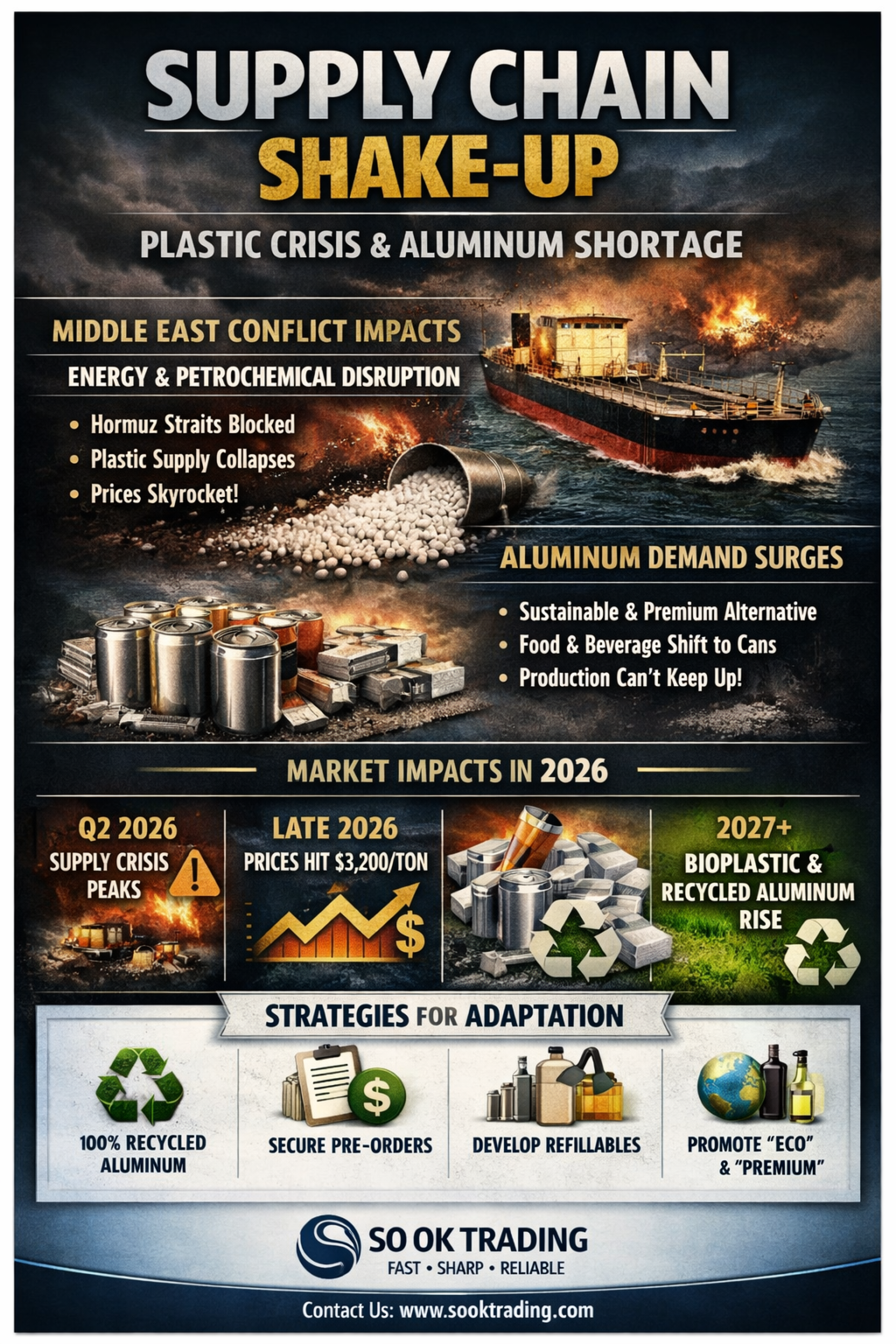
Hormuz Strait Blocked: Oil and petrochemical shipments halted, forcing many factories to suspend plastic resin production.
Rapid Stock Decline: In Thailand and Southeast Asia, plastic resin stockpiles are only sufficient until April–May 2026.
“Money Can’t Buy It”: Even with buyers willing to pay, supply cannot reach the market, creating a severe packaging plastic shortage.
 

Aluminum Packaging as the Alternative

100% Recyclable: Fully reusable, meeting ESG and Net Zero requirements.
Premium Image: Aluminum cans and packaging are perceived as more eco-friendly and upscale than plastic bottles.
Demand Surge: Food, beverage, and cosmetics industries are rapidly shifting to aluminum.
 

Aluminum Packaging Shortage Emerges

Transport Disruptions: Aluminum shipments from the Middle East face the same bottlenecks as plastics.
Production Capacity Shortfall: Middle Eastern smelters partially offline, reducing supply.
High Energy Costs: Aluminum smelting consumes vast electricity; European and Asian plants cut output.
Price Spike: Aluminum prices hit $3,200 per ton, the highest in years, burdening packaging producers.
 

Market Outlook 2026

Q2 2026: Peak supply crunch—both plastic and aluminum in shortage simultaneously.
Late 2026: Some stabilization, but prices remain higher than the previous year.
2027+: Market enters a “new balance” with recycled aluminum and bioplastics taking permanent market share.
 

Opportunities for Producers and Users

Shift to Green Packaging: Use recycled aluminum to differentiate and mitigate cost risks.
Secure Forward Contracts: Lock in prices and supply to hedge against volatility.
Develop Refillable Packaging: Enhance sustainability and reduce reliance on virgin materials.
Positive Consumer Communication: Turn crisis into opportunity by promoting “Eco-Friendly” and “Premium” packaging with NEO (Natural Plastic) or 100% recycled aluminum.
 

✨ Conclusion

This war has not eliminated plastic, but transport and energy costs have become major obstacles, pushing industries toward aluminum. Yet as demand outpaces supply, aluminum itself faces shortages.

This is a golden opportunity to pivot toward recycled packaging and innovation. In a world where supply chain disruption is the new normal, sustainable and circular materials will be the key to survival for the packaging industry.

 
SO OK TRADING: Your Trusted Business Partner
FAST • SHARP • RELIABLE
www.sooktrading.com


Related Content
Aluminium Cans 2026: The New Symbol of Green Business — Sustainability Drives Growth
Thailand is entering a new era where aluminium cans are no longer just packaging — they have become symbols of sustainability, innovation, and circular growth. In 2025, the metal packaging industry is projected to generate over 18 billion THB, with aluminium accounting for 74.22% and aluminium cans leading at 58.48%. Many producers are switching from plastic to aluminium to meet ESG goals and to build a modern, eco-friendly brand image. If you are looking for Aluminium Coil, Ingot, or Remelt for sustainable packaging or industrial applications that demand international quality standards, please contact SO OK TRADING today.
20 Feb 2026
SILVER PRICE TREND AND IT CONTINUE UPWARD ON VALUE FOR YEAR 2026
SILVER PRICE 2026 EVALUATION : The Bank of America believe silver will average around $56 in 2026, but could climb to a peak of $65. Robert Kiyosaki believes $75 can be reached, while analysts at CNBC even suggested $100 is achievable following a breakout above $50. Anyhow according to China Policy (start on 1 JAN 2026) on restrict SILVER to export this might create a shortage on Industry which use silver as raw material such as SEMI-CONDUCTER, ARMY HI-TECH WEAPON, SOLAR CELL, EV Car, This will be the pressure on SILVER PRICE To Increae from 72 USD/ONZE to more than 80 USD/ONZ within Early 2026
2 Jan 2026
Aluminum Recycling the Circle and How it work
Aluminium is the most abundant metal in the earth’s crust. Approximately 75% of aluminium ever produced is still in use today as it can be recycled endlessly without compromising any of its unique properties or quality. Aluminium’s lifecycle provides significant benefits through recycling, saving 95% of the energy it would take to make new aluminium metal. More information on recycling may be found here. Recycling aluminium has five steps: Step 1: Collecting Scrap There are two categories of aluminium scrap: New Scrap New Scrap is surplus material that arises during the manufacture and fabrication of aluminium products, up to the point where they are sold to the final consumer. For example, off cuts of aluminium sheet or extrusions are considered new scrap. Sometimes, this new scrap can be safely recycled by aluminium smelters as its composition is known. Old Scrap Old Scrap is material that has been used by the consumer and subsequently discarded. For example, used beverage cans, window frames, electrical cabling and car cylinder heads are all considered old scrap. Aluminium smelters are unable to safely accept this old scrap as its composition is usually unknown and it can be contaminated. Scrap aluminium is also collected from the community – from households, scrap merchants, local and regional authorities, etc. Step 2: Sorting Scrap The scrap is then sorted – grouping all coated (painted or lacquered) aluminium together, and grouping all uncoated aluminium together. Paper, plastic and other non-aluminium recycling needs to be removed. Step 3: Crushing The sorted aluminium is then crushed into bales – by compacting the aluminium scrap, it reduces freight, storage and handling costs Step 4: Remelting Uncoated scrap is loaded directly into a large furnace called a remelter, where it is heated at high temperatures and turned into molten form. If the scrap aluminium is coated, it is processed through a gas fired rotary furnace to remove any coating and then transferred to the remelter. Step 5: Casting The molten aluminium is cast at a temperature of just over 700°C to form ingots
13 Nov 2025
This website uses cookies for best user experience, to find out more you can go to our Privacy Policy and Cookies Policy
Compare product
0/4
Remove all
Compare
Powered By MakeWebEasy Logo MakeWebEasy