Share

“Aluminum Billet: From Solid Metal to the Force Driving the Structures of Tomorrow” Article by SO OK TRADING March 14, 2026
Last updated: 14 Mar 2026
1510 Views

Aluminum Billet: From Solid Metal to the Force Driving the Structures of Tomorrow

Article by SO OK TRADING March 14, 2026

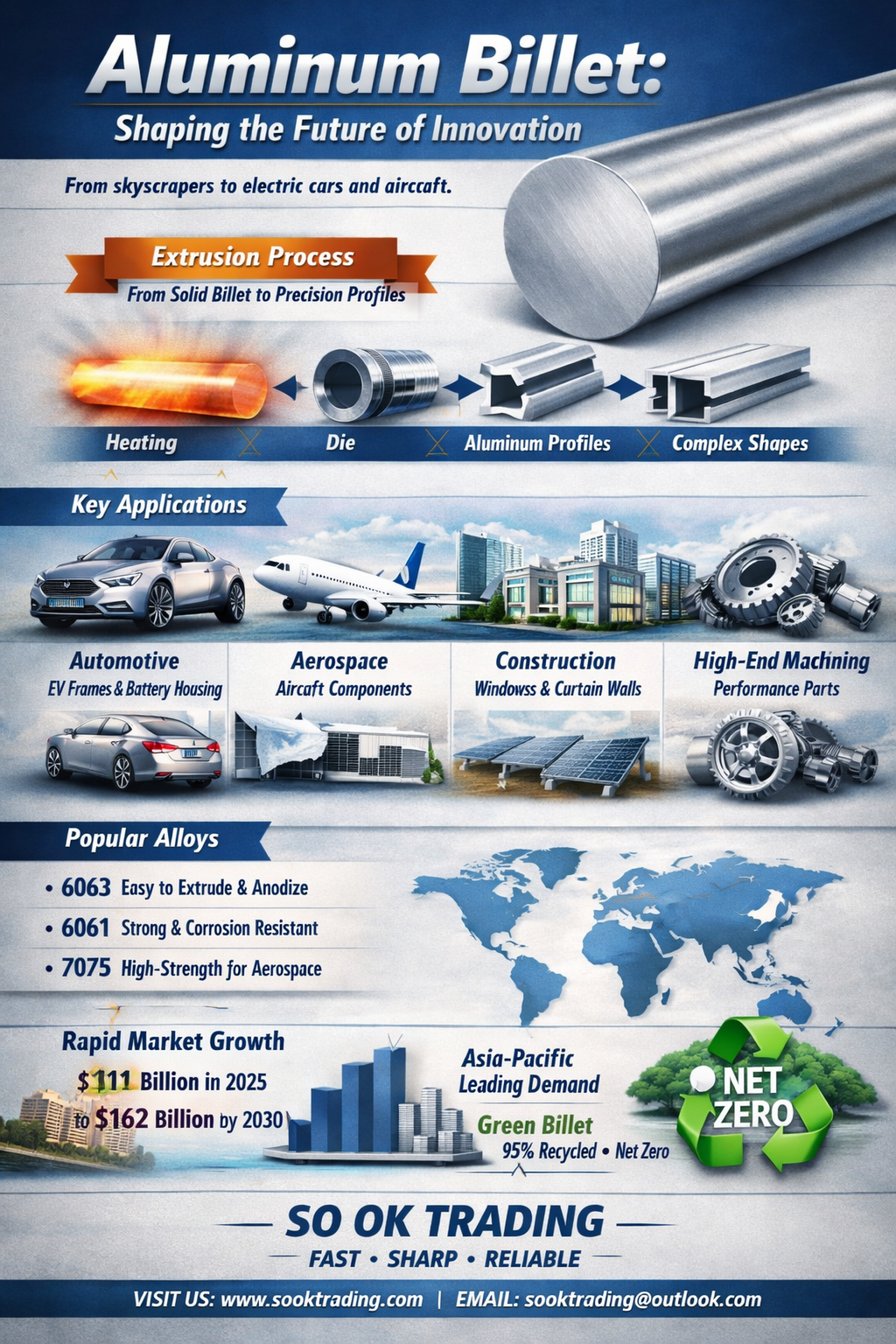
At first glance, aluminum billets may look like simple solid rods. In reality, they are the “origin of innovation” that surrounds us every day. From skyscrapers and electric vehicles to airplanes, everything begins with Aluminum Billet.

Extrusion Process: Transforming Metal into Profiles

Billets are heated to the right temperature and then pressed through specially designed dies. The result is aluminum profiles with complex cross-sections — window frames, machine structures, or EV components. This process is the key that turns billets into usable materials for modern life.

Wide Applications Across Industries

Automotive: Strong yet lightweight components such as EV body frames, battery housings, and suspension parts.
Aerospace: Aircraft structural parts requiring maximum strength and consistency.
Construction: Window frames, curtain walls, high-rise structures, and decorative finishes.
Industrial & Engineering: Heat sinks for electronics, machinery frames, air-conditioning pipes, and solar panel mounts.
High-End CNC Machining: Entire billets are precision-machined into racing engine blocks, premium alloy wheels, drone parts, and luxury accessories.
Popular Alloy Grades and Properties

6063: Easy to extrude, smooth finish, excellent for anodizing — ideal for windows and decorative applications.
6061: Strong and corrosion-resistant, widely used in automotive structures and load-bearing engineering.
7075: Steel-like strength, favored in aerospace, racing, and high-performance sports equipment.
Market Growth and Trends

The Aluminum Billet market continues to expand. Valued at USD 111 billion in 2025, it is projected to reach USD 162 billion by 2030, with an average annual growth rate of over 8%.

Asia-Pacific is the largest consumer, with China using more than 45 million tons of aluminum annually.
North America and Europe focus on EV and aerospace applications.
Green Billet is in high demand — produced from recycled scrap, saving up to 95% of energy, and aligning with global Net Zero goals.
Why Billets Are in Demand

Strong yet lightweight — ideal for EVs and aircraft.
Easy to weld and highly corrosion-resistant.
Can be anodized for beautiful, versatile finishes.
Environmentally friendly when produced through sustainable processes.
 

Aluminum Billet is not just a piece of metal — it is the “foundation of future structures” all around us. From the homes we live in, to the cars we drive, to the planes that carry us across the skies, billets are everywhere. And in the future, the world will increasingly demand billets that are clean and sustainable.

SO OK TRADING: Your Trusted Business Partner
FAST • SHARP • RELIABLE

Visit us: www.sooktrading.com
Contact us: sooktrading@outlook.com


Would you like me to also craft a short, punchy caption version of this in English for LinkedIn or Facebook posts, so you can deploy it instantly on social media?

Related Content
“Recycled Aluminum: From Scrap to Global Standard – Circular Economy Reshaping Industry with Aluminum Remelt – Remelt Revolution: Transforming the Metal Industry for Net Zero”
Recycled Aluminum: From Scrap to the New Global Standard As industries worldwide accelerate toward Net Zero and embrace the Circular Economy, Aluminum Remelt Ingots are no longer just an “alternative material.” They are becoming the main driver that every nation relies on for sustainability and economic competitiveness. With outstanding properties—lightweight, strong, corrosion-resistant, and excellent thermal and electrical conductivity—remelt ingots are now essential across diverse industries: automotive, construction, electronics, and packaging, all of which demand high-quality, eco-friendly materials. Most importantly, recycling aluminum consumes up to 95% less energy than producing primary aluminum, dramatically reducing both costs and carbon footprints. At the same time, global demand continues to rise, especially for ADC12, which is highly sought after in China, Japan, and Thailand, along with A356 and AC4B for automotive and high-strength applications. Global Shifts in 2025–2026 - China: Expanding production capacity to support electric vehicle (EV) manufacturing and construction, with stricter import standards for scrap aluminum. - United States: The world’s highest remelt usage (81%), driven by energy efficiency and carbon reduction, reinforced by strict tariffs under Section 232 (raised to 50%). - Japan: Fully dependent on imports and recycling, leveraging advanced sorting technologies and increasing the use of green aluminum in high-end automotive manufacturing. - Thailand: Rising as ASEAN’s scrap hub, exporting heavily to China and the U.S., with an aluminum can recycling rate of 86% and new circular economy initiatives such as the Aluminium Loop. From Scrap → To the Hero of Tomorrow Aluminum Remelt Ingots are rapidly evolving into the new global standard across industries. For those in the metals and manufacturing sectors, now is the time to adapt and seize opportunities in the global market.
21 Feb 2026
Copper Surge! April 2026 — Middle East Conflict, Trade Policies, and Technology Drive Global Copper Prices to the Boiling Point   Article by SO OK TRADING
Copper Surge! April 2026 Global copper prices have skyrocketed to $13,300/ton (+6.4%) in just one week, driven by Middle East conflict – trade policies – and China’s sulfuric acid export restrictions. The global copper market is now in a phase of “strong rally but high volatility.” Investors worldwide are rushing to buy as a hedge against supply shortages. Meanwhile, leading financial institutions — J.P. Morgan, Goldman Sachs, Citigroup, and Deutsche Bank — forecast that prices could test $14,000/ton if tensions persist.
15 Apr 2026
SO OK INSIGHT: Global Oil Prices Plunge – When Geopolitics Reshapes the Industrial World   (27 May 2026)
SO OK INSIGHT: Global Oil Prices Plunge – Geopolitical Easing Reshapes the Energy World (27 May 2026) Article Global crude oil prices have dropped to their lowest level in five weeks. Brent crude fell below $100 per barrel, while WTI settled at $92.78 per barrel. The decline follows progress in peace talks between the United States and Iran, raising hopes for reopening the Strait of Hormuz and easing supply concerns. This adjustment reflects more than just market volatility — it highlights a geopolitical shift that directly impacts global commodities, from naphtha and petrochemicals to fertilizers and alternative energy sources. For Thailand, this situation could become a golden opportunity. Lower oil prices reduce energy costs and pave the way for economic recovery in the second half of 2026. SO OK TRADING FAST • SHARP • RELIABLE
27 May 2026
This website uses cookies for best user experience, to find out more you can go to our Privacy Policy and Cookies Policy
Powered By MakeWebEasy Logo MakeWebEasy