Share

“Aluminum Billet: From Solid Metal to the Force Driving the Structures of Tomorrow” Article by SO OK TRADING March 14, 2026
Last updated: 14 Mar 2026
397 Views

Aluminum Billet: From Solid Metal to the Force Driving the Structures of Tomorrow

Article by SO OK TRADING March 14, 2026

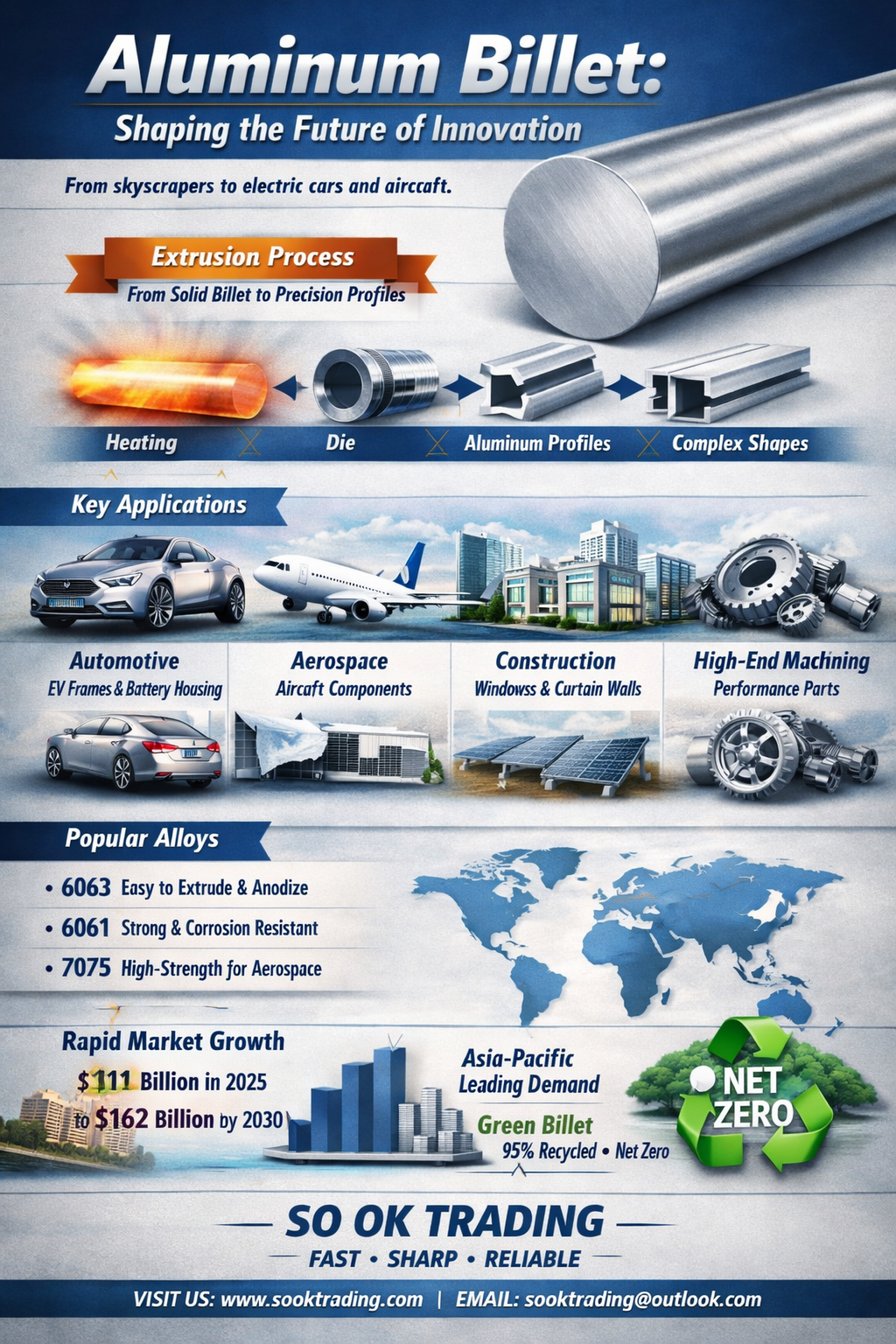
At first glance, aluminum billets may look like simple solid rods. In reality, they are the “origin of innovation” that surrounds us every day. From skyscrapers and electric vehicles to airplanes, everything begins with Aluminum Billet.

Extrusion Process: Transforming Metal into Profiles

Billets are heated to the right temperature and then pressed through specially designed dies. The result is aluminum profiles with complex cross-sections — window frames, machine structures, or EV components. This process is the key that turns billets into usable materials for modern life.

Wide Applications Across Industries

Automotive: Strong yet lightweight components such as EV body frames, battery housings, and suspension parts.
Aerospace: Aircraft structural parts requiring maximum strength and consistency.
Construction: Window frames, curtain walls, high-rise structures, and decorative finishes.
Industrial & Engineering: Heat sinks for electronics, machinery frames, air-conditioning pipes, and solar panel mounts.
High-End CNC Machining: Entire billets are precision-machined into racing engine blocks, premium alloy wheels, drone parts, and luxury accessories.
Popular Alloy Grades and Properties

6063: Easy to extrude, smooth finish, excellent for anodizing — ideal for windows and decorative applications.
6061: Strong and corrosion-resistant, widely used in automotive structures and load-bearing engineering.
7075: Steel-like strength, favored in aerospace, racing, and high-performance sports equipment.
Market Growth and Trends

The Aluminum Billet market continues to expand. Valued at USD 111 billion in 2025, it is projected to reach USD 162 billion by 2030, with an average annual growth rate of over 8%.

Asia-Pacific is the largest consumer, with China using more than 45 million tons of aluminum annually.
North America and Europe focus on EV and aerospace applications.
Green Billet is in high demand — produced from recycled scrap, saving up to 95% of energy, and aligning with global Net Zero goals.
Why Billets Are in Demand

Strong yet lightweight — ideal for EVs and aircraft.
Easy to weld and highly corrosion-resistant.
Can be anodized for beautiful, versatile finishes.
Environmentally friendly when produced through sustainable processes.
 

Aluminum Billet is not just a piece of metal — it is the “foundation of future structures” all around us. From the homes we live in, to the cars we drive, to the planes that carry us across the skies, billets are everywhere. And in the future, the world will increasingly demand billets that are clean and sustainable.

SO OK TRADING: Your Trusted Business Partner
FAST • SHARP • RELIABLE

Visit us: www.sooktrading.com
Contact us: sooktrading@outlook.com


Would you like me to also craft a short, punchy caption version of this in English for LinkedIn or Facebook posts, so you can deploy it instantly on social media?

Related Content
Steel Industry Outlook 2026: Gradual Recovery with Rising Price Potential BY SOOK TRADING
Steel Industry Outlook 2026: Gradual Recovery with Rising Price Potential The year 2026 marks a turning point for the global steel industry. After hitting its lowest point in 2025, the market is entering a “new equilibrium,” with demand gradually recovering and prices showing signs of stable upward movement. Global steel demand is forecast to grow 1.3%, reaching 1,773 million tons. India will be the main driver, with growth of 9% fueled by infrastructure investments in roads, railways, and energy. The United States and Europe are also expected to recover steadily, supported by interest rate cuts, clean energy projects, and the automotive sector—1.8% growth in the US and 3.2% in the EU. China, while still facing a slowdown in real estate, will see demand decline ease to -1%, supported by infrastructure projects and steel exports. Meanwhile, Southeast Asia and the Middle East are expected to contribute to diversified demand growth through infrastructure and energy investments. On the pricing side, steel bars (Rebar) are expected to average 16,000–17,000 THB/ton (450–530 USD/MT). Iron ore costs are projected at 83–95 USD/ton, with new supply from Guinea and Australia helping to stabilize input costs. Although trade barriers in the US and EU may keep domestic prices above global levels, the market is moving toward a more stable balance. In Thailand, steel demand is expected to grow modestly, driven by construction and automotive industries, with a base of 16.2 million tons in 2025. However, cheap Chinese steel could account for up to 50% of the market, putting pressure on local producers. Thai businesses must adapt by developing value-added specialty products, enhancing quality standards, and targeting premium and niche export markets such as ASEAN, the Middle East, and Africa. SO OK Trading: Partnering Thai Steel with Global Markets SO OK Trading supports Thai steel producers with comprehensive solutions: - Market Connectivity: Linking Thai producers with buyers in China and East Asia through an extensive partner network and integrated rail–sea–road logistics. - Market Analysis & Pricing Strategy: Providing insights into steel and iron ore price trends, with index-linked pricing recommendations to reduce volatility. - Stable Contracts & Compliance: Assisting in contract structuring, export documentation, standards, and certifications to ensure reliable trade. - Customer Development: Delivering tailored technical and commercial proposals to meet the needs of Chinese buyers seeking specialty steel. SO OK Trading is more than an exporter—it is a trusted business partner, helping Thai steel enterprises compete with stability and sustainability in the global steel market.
15 Jan 2026
SOOK ขอเสนอการข้อมูลการใช้งานสายไฟฟ้า ทองแดง และ อลูมิเนียม รวมทั้งสายไฟรถ EV เกร็ดความรู้
เกร็ดความรู้เรื่องสายไฟ โดยมากสายไฟที่พูดถึงนั้นเป็นสายไฟที่ทำจาก ทองแดง (Copper) และ อะลูมิเนียม (Aluminum) โดยมีคุณสมบัติที่แตกต่างกัน เช่น สายทองแดงนำไฟฟ้าได้ดีกว่า มีความทนทานและอายุการใช้งานยาวนานกว่า แต่น้ำหนักมากและมีราคาสูงกว่า ในขณะที่สายอะลูมิเนียมมีน้ำหนักเบาและราคาถูกกว่า แต่ต้องใช้ขนาดใหญ่กว่าทองแดงสำหรับกระแสไฟเท่ากัน และมีความปลอดภัยในจุดต่อมากกว่า สายไฟทองแดง (Copper) คุณสมบัติ: การนำไฟฟ้า: สูงมาก ความปลอดภัย: เสถียรกว่าและร้อนน้อยกว่า ความทนทาน: ไม่เกิดสนิมและอายุการใช้งานยาวนาน การใช้งาน: นิยมใช้ในอาคารและใต้ดิน เนื่องจากสามารถนำมาทำเป็นเส้นลวดขนาดเล็กได้ง่าย ข้อจำกัด: น้ำหนักมากและราคาสูงกว่า สายไฟอะลูมิเนียม (Aluminum) คุณสมบัติ: น้ำหนัก: เบากว่าทองแดงประมาณ 30-50% ราคา: ถูกกว่าทองแดง การนำไฟฟ้า: นำไฟฟ้าได้ดี แต่ต้องใช้ขนาดสายใหญ่กว่าทองแดงสำหรับกระแสไฟเท่ากัน การใช้งาน: นิยมใช้กับสายส่งไฟฟ้าแรงดันสูงที่ต้องแขวนลอยในอากาศ หรือในงานที่ต้องการความยืดหยุ่นและทนความร้อนได้สูง ข้อจำกัด: มีโอกาสเกิดสนิม (ออกไซด์) และความปลอดภัยที่จุดต่อต้องควบคุมให้แน่นหนา สรุป ทองแดง เหมาะสำหรับงานภายในอาคารที่ต้องการความปลอดภัยและความเสถียรสูง อะลูมิเนียม เหมาะสำหรับงานที่ต้องการประหยัดต้นทุนและน้ำหนัก เช่น สายส่งไฟฟ้าแรงดันสูง
3 Dec 2025
This website uses cookies for best user experience, to find out more you can go to our Privacy Policy and Cookies Policy
Compare product
0/4
Remove all
Compare
Powered By MakeWebEasy Logo MakeWebEasy