“Middle East Conflict Shakes Global Agriculture: Thailand Pivots, Builds New Pathways, and Seizes Golden Opportunities in East Asia” — March 11, 2026: Article by SO OK TRADING
“Middle East Conflict: Global Agriculture Shaken, Thailand Must Pivot to East Asia”
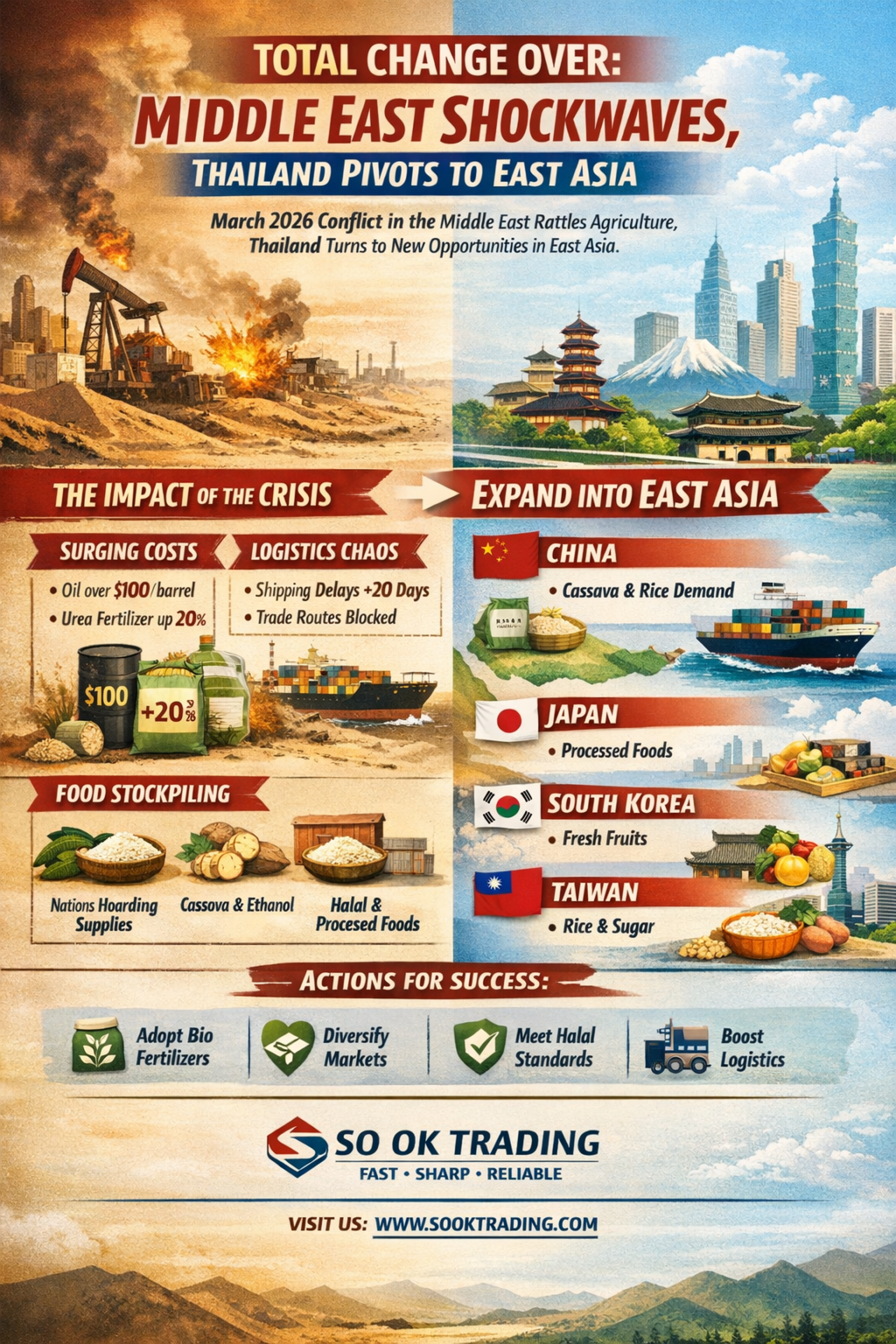
The unrest in the Middle East (March 2026) has not only affected the region itself but has sent shockwaves through the global food system and Thai agriculture. We are now in an era of soaring costs, disrupted logistics, and accelerated food stockpiling — yet within this crisis lies new opportunity, especially in expanding into the fast-growing East Asian market.
Rising Production and Agricultural Costs
Oil prices have surged past $100 per barrel, driving up transport and machinery fuel costs.
Urea fertilizer shortages have pushed prices up more than 20% within days of the conflict. Thailand, which imports over 90% of its fertilizer, faces heavy pressure.
Overall costs for Thai farmers have risen 10–15%, especially for rice and cassava, which are fertilizer-intensive crops.
Logistics Disruptions — Direct Impact of the Middle East War
Shipping routes through the Persian Gulf are closed, forcing detours around the Cape of Good Hope, adding 15–20 days to transit times.
Freight rates for agricultural goods from the U.S. and Brazil to Northeast Asia have risen by more than $5 per ton.
Container shortages have stalled exports of processed and frozen foods to the Middle East.
Thai Agriculture: Pressure and Opportunity
Rice: Supported by Arab nations’ food stockpiling, but a strong baht weakens competitiveness.
Cassava: Remains strong due to demand for ethanol and animal feed.
Sugar: Oversupply in the global market, but higher transport costs may push up end prices.
Processed & Halal Foods: Strong demand in the Middle East, but logistics remain a barrier.
Middle East Market: High Potential, High Risk
Imports account for 80–90% of food consumption.
High-demand products: Jasmine rice, halal processed foods, fresh and dried fruits.
Key markets: Saudi Arabia (largest), UAE (distribution hub), Iraq (major rice importer).
Obstacles: Longer shipping routes, strict halal and food safety standards.
East Asia: A Market to Watch
As the Middle East grows riskier, East Asia emerges as a promising alternative market.
China: Strong demand for cassava and rice for animal feed and ethanol industries.
Japan: Rising imports of cassava pellets and processed foods, especially for feed and ready-to-eat sectors.
South Korea: Growing market for fresh fruits such as mangoes and durians.
Taiwan: Increasing demand for rice and sugar in food and beverage industries.
✅ Preparing Farmers, Businesses, and Policymakers
Farmers: Conserve fertilizer or shift to bio-fertilizers to reduce reliance on urea/chemical inputs.
Businesses: Diversify markets into China, Japan, South Korea, and ASEAN to reduce dependence on the Middle East.
Exporters: Strengthen compliance with halal and SPS/TBT standards.
Government: Support logistics negotiations and expand new markets in East Asia.
Conclusion
The Middle East conflict has placed immense pressure on global agriculture. Yet Thailand has an opportunity: by pivoting away from dependence on the Middle East and expanding into East Asia — where demand is high and stability greater — this crisis can become a turning point for Thai agricultural exports on the global stage.
SO OK TRADING: Your Business Partner
FAST • SHARP • RELIABLE
VISIT US AT: WWW.SOOKTRADING.COM