Share

“2026: The Year of Transition to a Green Economy and Smart Agriculture — Green Energy is Survival, Agriculture is Prosperity. Thailand is ready to conquer global markets with Wood Pellets, Cassava, and Durian, the rising stars the world demands.”
Last updated: 3 Mar 2026
595 Views

Thailand’s Rising Industries in 2026: “Green” is Survival, “Agriculture” is Prosperity

Green means clean energy, eco-friendly power.
Agriculture’s standout products include cassava and sugarcane for biofuels, and premium fruits such as durian for export.

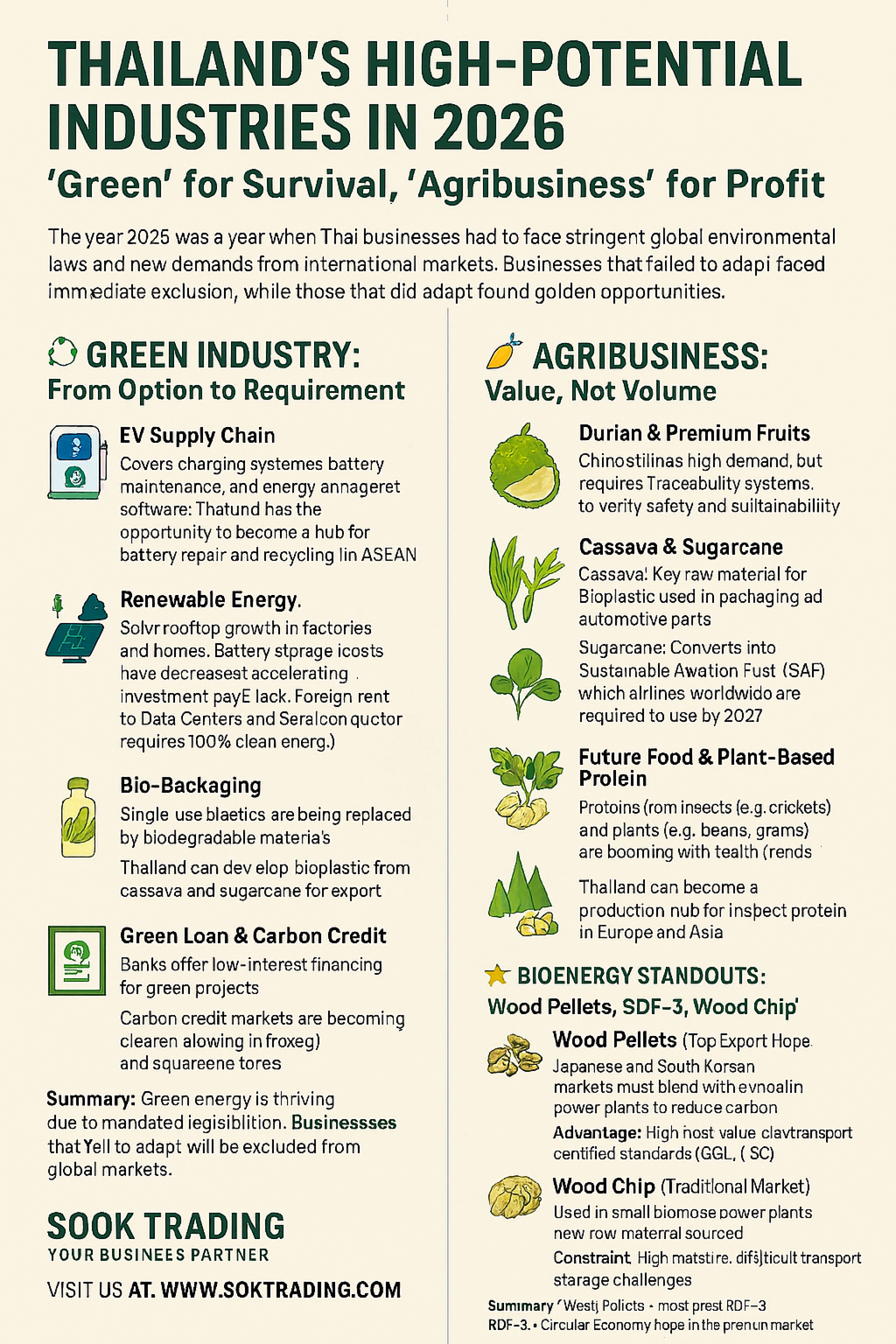
In 2026, Thai businesses must face strict global environmental regulations and new demands from international markets.
Those who fail to adapt will be excluded immediately, while those who succeed will find golden opportunities for both industry and business.


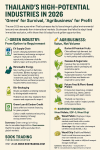
♻️ Green Industry: From Option to Requirement

EV Supply Chain: Charging systems, battery maintenance, energy management software. Thailand has the chance to become ASEAN’s hub for battery repair and recycling.
Renewable Energy: Solar rooftops booming in factories and households. Battery storage costs falling, speeding up ROI. Foreign investment in data centers and semiconductors requires 100% clean energy.
Bio-Packaging: Single-use plastics are being replaced by biodegradable materials. Thailand can develop bioplastics from cassava and sugarcane for export.
Green Loan & Carbon Credit: Banks offer low-interest loans for green projects. Carbon credit markets are becoming clearer, allowing afforestation and clean energy to be directly monetized.
Summary: Green energy is thriving because of legal mandates. Businesses that fail to adapt will be shut out of global markets.


Agribusiness: Value, Not Volume

Premium Fruits (Durian, etc.): Strong demand from China, but traceability systems are required to ensure safety and sustainability.
Cassava & Sugarcane: Cassava is a key raw material for bioplastics; sugarcane is processed into Sustainable Aviation Fuel (SAF), which airlines worldwide must adopt by 2027.
Future Food & Plant-Based Protein: Insect protein (e.g., crickets) and plant-based protein (beans, grains) are booming with health trends. Thailand can become a hub for insect protein production for Europe and Asia.
Herbs & Functional Food: Turmeric, ginger, centella are in high demand for supplements and cosmetics worldwide.
Fast-Growing Trees (Eucalyptus, Acacia): Used for wood pellets and carbon credit sales.
 

Biomass Fuel Stars: Wood Pellets, RDF-3, Wood Chip

Wood Pellets (Top Export Hope): Japan and South Korea require co-firing with coal to reduce carbon emissions. High heat value, easy transport, certified standards. Thailand’s government supports fast-growing tree plantations.
RDF-3 (Domestic Market): Waste-derived fuel used in cement plants and waste-to-energy facilities. Supports circular economy, reduces coal dependency. Limitations: inconsistent quality and incomplete waste sorting in Thailand.
Wood Chip (Traditional Market): Used in small biomass power plants near raw material sources. High moisture, transport and storage challenges. Gradually losing ground to wood pellets in premium markets.
Summary:

Wood Pellets = Export star
RDF-3 = Domestic circular economy hope
Wood Chip = Still viable but declining
 

Strategic Conclusion for 2026

Green Industry = Survival → Businesses that fail to adapt will be excluded from global markets.
Bio-Agriculture = Prosperity → Thai agriculture must shift from “selling raw produce” to “industrial raw materials.”
Wood Pellets, RDF-3, Wood Chip = Indicators of transition to a circular economy.
Cassava & Sugarcane = Core of bio-refinery, elevating Thai agriculture to global markets.
✨ 2026 is not about who produces more, but who produces in line with global trends and sustainable standards.

SO OK TRADING: Your Business Partner VISIT US AT: WWW.SOOKTRADING.COM

Related Content
ALUMINUM PRICE TREND 2026
An analysis of the aluminum market in 2026 indicates a likely continued market deficit and upward price pressure, driven by constrained supply and resilient demand from green energy sectors. However, significant volatility is expected due to policy uncertainties and the potential for new Indonesian supply to eventually balance the market. Key Drivers and Projections for 2026 Supply Side Analysis Capacity Constraints: China's primary aluminum output is approaching its self-imposed 45 million-tonne capacity cap, limiting global supply growth. Power Challenges: Smelters outside of China face intense competition for power from energy-intensive sectors like AI data centers, which are willing to pay higher prices for long-term contracts. This has kept significant capacity offline in Europe and the US. Production Disruptions: Outages and potential shutdowns at existing smelters in Iceland and Mozambique further tighten the market. Scrap Supply Pressure: The EU's planned implementation of the Carbon Border Adjustment Mechanism (CBAM) and potential scrap export tariffs in spring 2026 are expected to impact global scrap flows, creating regional shortages and price volatility. New Capacity: Indonesia is a key source of new supply, with several projects in the pipeline. However, analysts suggest the pace of the ramp-up may be slower than expected due to infrastructure and policy challenges, meaning it is unlikely to fully offset near-term tightness. Demand Side Analysis Green Transition Demand: Demand from "green" sectors such as solar panels, new energy vehicles, and energy transition infrastructure remains strong, providing fundamental support for the market. Substitution Effect: Aluminum's wide price discount relative to copper has encouraged substitution in electrical applications, acting as a tailwind for demand and prices. Construction and Automotive: The construction and automotive industries continue to be major consumers, with growing demand for lightweight, low-carbon aluminum products. Price Forecasts and Volatility The market is expected to remain in a deficit in 2026, with estimates ranging from 200,000 to 600,000 tonnes. This structural tightness is leading most analysts to forecast sustained or rising prices. Bullish Views: Analysts at Bank of America project prices of $3,000/tonne as early as 2026. J.P. Morgan also expects prices to approach $3,000/tonne in Q1 2026. ING forecasts an average price of $2,900/tonne for the year. Bearish/Conservative Views: Goldman Sachs is an outlier, forecasting prices to decline to $2,350/tonne by Q4 2026, anticipating a market surplus later in the year. SMM forecasts a "high first, then lower" pattern, with prices finding equilibrium in the $2,700–$2,800/tonne range by year-end. Premiums: Regional premiums, particularly the US Midwest premium, are expected to remain high and volatile due to tariffs and regional supply dynamics, creating a disconnect from the LME benchmark price. In essence, 2026 is projected to be a year of high volatility where participants need to focus on scenario readiness rather than relying on a single price forecast, as geopolitical and energy policies significantly influence regional supply and costs
31 Dec 2025
"USA–Israel–Iran War Pushes Oil Prices Higher, Metals Shock Global Markets: March – Q2/2026 Market Analysis by SO OK TRADING” March 16, 2026
LME on Fire! Commodities Surge Amid Global Energy Crisis Global Metals & Energy Market Analysis – March to Q2/2026 by SO OK TRADING The closure of the Strait of Hormuz and escalating conflicts in the Middle East have pushed oil prices beyond $110 per barrel, triggering one of the most volatile rallies in recent years. Industrial and precious metals are soaring, with copper and aluminum hitting record highs driven by demand from AI and clean energy sectors.
16 Mar 2026
This website uses cookies for best user experience, to find out more you can go to our Privacy Policy and Cookies Policy
Compare product
0/4
Remove all
Compare
Powered By MakeWebEasy Logo MakeWebEasy