Share

“Copper Price Outlook – March 2026: Copper Surges! A New Opportunity for Thai Producers in the Global Market and the Power of Copper Amid War and the Transition to Clean Energy”
Last updated: 2 Mar 2026
4320 Views

Copper Surges into the New Era of Electrification and Clean Energy

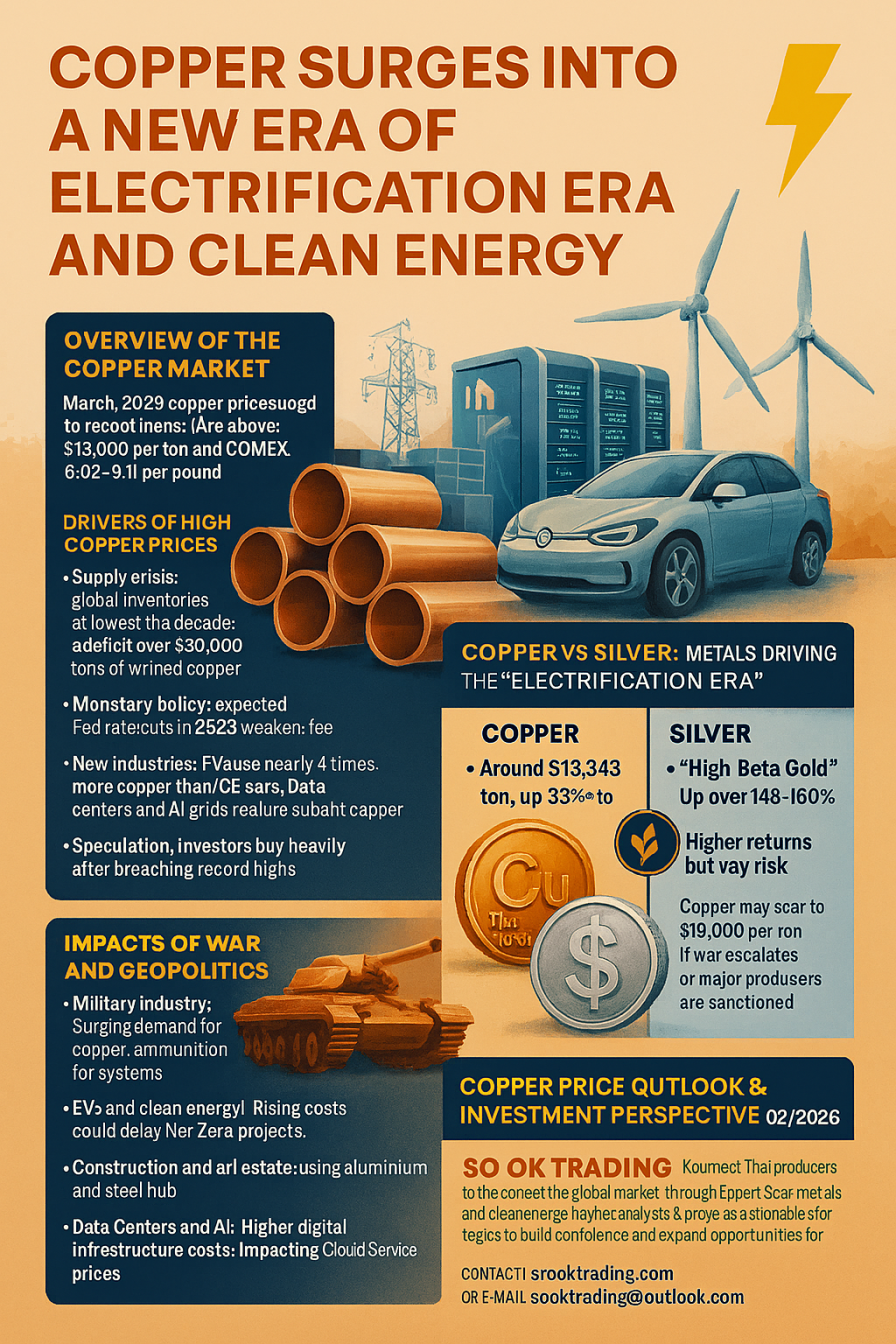
March 2026 Market Overview
Copper is rapidly becoming the “New Oil” of the modern world. Prices continue to soar to record highs, with LME trading above $13,000 per ton and COMEX at $6.02–6.11 per pound, marking a 31–33% increase year-on-year. The surge is fueled by the most severe supply shortage in years, alongside relentless demand from EVs, clean energy projects, and AI data centers.

Q2/2026 Outlook

Goldman Sachs and Citigroup forecast copper prices could climb to $15,000 per ton if the USA–Iran war escalates and sanctions hit major producers.
JP Morgan estimates an average price of $12,075 per ton for the year.
Some industries are exploring aluminum substitution, though efficiency limitations remain.
Key Drivers Behind Copper’s Rise

Supply Crisis: Global inventories at their lowest in a decade, with a deficit of over 330,000 tons of refined copper.
Monetary Policy: Anticipated Fed rate cuts in 2026 weaken the dollar, boosting commodity prices.
New Industries: EVs consume nearly 4x more copper than combustion cars; AI data centers and power grids require massive copper inputs.
Speculation: Investors buying aggressively after prices broke historic highs.
⚔️ Impact of War and Geopolitics

Defense Industry: Surging copper demand for ammunition and military communication systems.
EV & Clean Energy: Rising costs may delay Net Zero projects.
Construction & Real Estate: Inflation in building materials halts projects.
Data Centers & AI: Higher infrastructure costs push up cloud service prices.
SO OK TRADING
We are the bridge connecting Thai producers with the global market. Beyond tracking copper trends, we transform insights into actionable strategies that build trust and expand opportunities worldwide.

Products Available

Copper Cathode
Copper Scrap
Contact Us
www.sooktrading.com
sooktrading@outlook.com


Related Content
Aluminum Scrap & UBC Scrap: White Gold in Recycling and the Circular Economy Industry Outlook – Thailand’s Aluminum Sector By SO OK TRADING
Thailand’s aluminum scrap market is entering an exciting new era. What was once considered “waste” has now become a strategic resource powering sustainability, circular economy models, and global technology industries. In particular, UBC (Used Beverage Can) scrap is emerging as a cornerstone of the circular economy, enabling closed-loop recycling and reducing carbon footprints. By 2026, Thailand is set to strengthen its role as a regional hub for aluminum recycling, transforming scrap from a low-value byproduct into “White Gold” for both domestic and international markets.
15 Feb 2026
“Aluminum Boom! Global Prices Surge as LME Breaks $3,600 – Japan Premium Hits Decade High, 2026 Becomes Thailand’s Golden Year for Recycling”
Aluminum Boom! LME Surges – Premium Hits Decade High In May 2026, the global aluminum market remains “the hottest in years.” Prices broke past $3,600 per ton, driven by supply disruptions in the Middle East and soaring demand from the EV and clean energy industries.
12 May 2026
Aluminum Recycling the Circle and How it work
Aluminium is the most abundant metal in the earth’s crust. Approximately 75% of aluminium ever produced is still in use today as it can be recycled endlessly without compromising any of its unique properties or quality. Aluminium’s lifecycle provides significant benefits through recycling, saving 95% of the energy it would take to make new aluminium metal. More information on recycling may be found here. Recycling aluminium has five steps: Step 1: Collecting Scrap There are two categories of aluminium scrap: New Scrap New Scrap is surplus material that arises during the manufacture and fabrication of aluminium products, up to the point where they are sold to the final consumer. For example, off cuts of aluminium sheet or extrusions are considered new scrap. Sometimes, this new scrap can be safely recycled by aluminium smelters as its composition is known. Old Scrap Old Scrap is material that has been used by the consumer and subsequently discarded. For example, used beverage cans, window frames, electrical cabling and car cylinder heads are all considered old scrap. Aluminium smelters are unable to safely accept this old scrap as its composition is usually unknown and it can be contaminated. Scrap aluminium is also collected from the community – from households, scrap merchants, local and regional authorities, etc. Step 2: Sorting Scrap The scrap is then sorted – grouping all coated (painted or lacquered) aluminium together, and grouping all uncoated aluminium together. Paper, plastic and other non-aluminium recycling needs to be removed. Step 3: Crushing The sorted aluminium is then crushed into bales – by compacting the aluminium scrap, it reduces freight, storage and handling costs Step 4: Remelting Uncoated scrap is loaded directly into a large furnace called a remelter, where it is heated at high temperatures and turned into molten form. If the scrap aluminium is coated, it is processed through a gas fired rotary furnace to remove any coating and then transferred to the remelter. Step 5: Casting The molten aluminium is cast at a temperature of just over 700°C to form ingots
13 Nov 2025
This website uses cookies for best user experience, to find out more you can go to our Privacy Policy and Cookies Policy
Powered By MakeWebEasy Logo MakeWebEasy