“Tin: From Ordinary Metal to Strategic Resource — The Glue Connecting AI and Clean Energy of the Future”
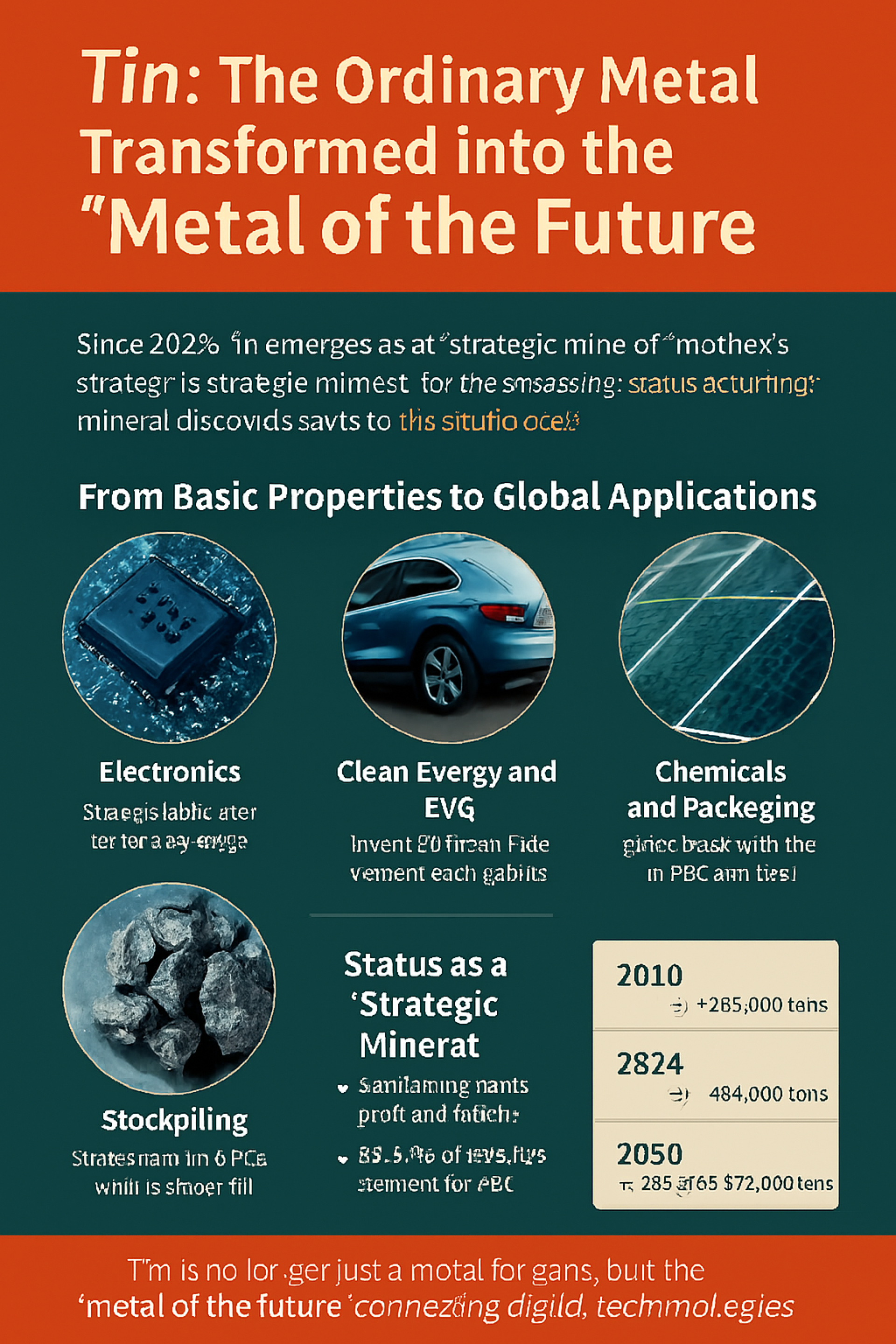
✨ Tin: The Ordinary Metal Becoming the “Metal of the Future” ✨
Once, tin (Sn) was seen merely as a coating for food cans.
But in 2026, the world has begun to recognize it as a strategic mineral reshaping the digital economy and clean energy transition.
From Basic Properties to Global Applications
Tin stands out with its softness, malleability, low melting point, and resistance to corrosion.
These qualities make it indispensable — from food packaging coatings to the solder that holds electronic circuits together.
Today, global tin usage falls into three major categories:
Electronics (50%): Tin is the “glue” connecting circuits in smartphones, AI chips, and 5G devices.
Clean Energy & EVs: Electric vehicles use 2–3 times more tin than combustion cars, in batteries and solar panels.
Chemicals & Packaging: Still vital in PVC, toothpaste, glass, and food-safe coatings.
Price Surge and Market Drivers
By February 2026, tin prices soared to $53,698 per ton (~1.9 million THB) — a 65% jump from last year.
The surge is driven by booming demand in semiconductors and EVs, alongside supply constraints from Indonesia and Myanmar.
Tin in the Age of AI
Tin has become the “glue” of the digital world:
Advanced Packaging: AI chips and GPUs require ultra-dense tin solder connections.
Data Centers: Expanding server and network infrastructure for AI drives massive tin demand.
Next-Generation Battery Innovation
Tin is moving beyond solder into battery technology:
Lithium-Ion + Silicon Anodes: Adding just 2% tin boosts capacity and charging speed.
Sodium-Ion Batteries: Tin helps solve low energy density, cutting costs for clean energy storage.
Solar Ribbon: Tin connectors in solar cells are expected to double in demand by 2030.
Strategic Mineral Status
Stockpiling: Global powers are building strategic reserves of tin.
Recycling: E-waste recycling could meet 20–25% of market demand.
Growth Trajectory
2010: ~350,000 tons
2024: 495,000 tons (driven by 5G and EVs)
2030: 420,000–572,000 tons (forecast)
2040: 700,000+ tons (AI & clean energy boom)
Reserves and Challenges
Current proven reserves: 4.3–4.9 million tons
China (15%): Largest reserves and top consumer
Indonesia (17%): World’s most important offshore deposits
Myanmar: High-grade ores declining
Brazil & Australia: Potential for new mines
Key players by 2040: China, Indonesia, Africa (Congo/Nigeria), Europe, Australia.
The challenge is not lack of reserves, but production difficulty. Easy-to-mine ores are depleting, leaving lower-grade deposits that require higher costs and advanced technology.
Conclusion
Tin is no longer just a basic metal.
It is now a strategic resource — the glue connecting AI, EVs, and clean energy — and will shape the global economy over the next two decades.