Share

India’s Golden Opportunity in Copper & Aluminium (2026–2030): Recycling and Innovation Driving the Non-Ferrous Metals Revolution
Last updated: 26 Feb 2026
867 Views

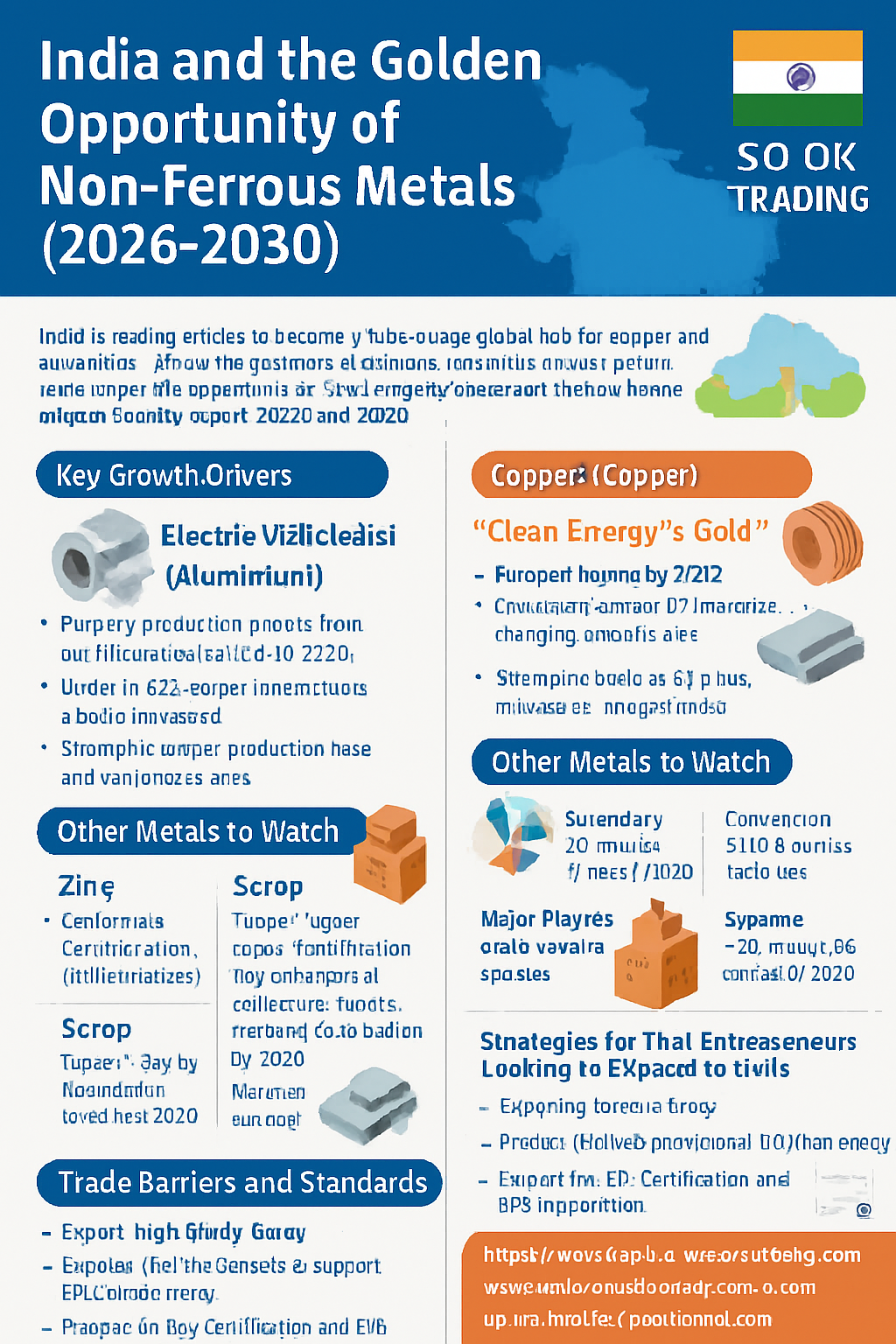
India and the Golden Opportunity of Non-Ferrous Metals (2026–2030)

Article by SO OK TRADING

India is moving decisively toward becoming the “global hub for copper and aluminium.” Government policies, infrastructure investments, and the promotion of a circular economy are the key drivers behind this transformation. The non-ferrous metals market is expected to grow rapidly between 2026 and 2030.

Key Growth Drivers

Electric Vehicles (EVs) → Aluminium usage per vehicle increases by 25–30%, while copper is essential for motors and batteries
Renewable Energy → Target of 500 GW power generation by 2030 requires massive copper and aluminium demand
Infrastructure & Smart Cities → High-rise buildings, metro systems, bridges, data centers, and 5G networks
Circular Economy → Extended Producer Responsibility (EPR) regulations enforced from 2026
Spotlight Metals

Aluminium: “Champion in Volume”
Primary production to rise from 4.2 million tons (2025) → 7.0 million tons (2030)
Applications: EVs, transmission lines, food packaging
Strength: Large production base and cost competitiveness
Copper: “The Gold of the Clean Energy Era”
Demand expected to double by 2030
Applications: EV motors, batteries, charging stations, 5G, data centers
Strength: India remains a net importer → supply gap creates opportunities for exporters
Other Metals to Watch
Zinc → Stable growth in galvanization for infrastructure
Scrap Metal → Recycling market set to boom due to EPR and tax incentives
Major Players in India

Hindalco Industries → Giant in aluminium and copper
Vedanta Limited → Dominates aluminium, reviving copper smelting operations
Hindustan Copper Limited (HCL) → State-owned enterprise with full copper mining rights
Recycling Market Opportunities

Secondary aluminium production uses 95% less energy than new mining
Market remains fragmented → opportunity for foreign investors with advanced sorting technology
Recycling revenue projected to reach USD 4.8 billion by 2030
Trade Barriers & Standards

BIS Standard → Imported products must be certified before sale
EPR Regulation (2026) → New products must include 5–10% recycled metal
Simplified Trend Summary

Aluminium → Highest growth in volume, driven by EVs, construction, packaging
Copper → Fastest growth in value, driven by clean energy, EVs, 5G
Zinc → Stable growth in infrastructure
Scrap Metal → Recycling boom from circular economy policies
Strategies for Thai Businesses Expanding into India

Focus on exporting high-purity scrap
Develop finished products supporting EVs and clean energy
Prepare for BIS certification and EPR compliance
 

SO OK TRADING: Your Bridge to India

SO OK TRADING is ready to serve as the bridge between Thai businesses and the Indian market. With expertise in non-ferrous metals and the ability to source high-quality raw materials, we help Thai companies enter India’s booming market with confidence.

For aluminium, copper, or other non-ferrous products, contact us today:
www.sooktrading.com
sooktrading@outlook.com


Related Content
Gold Breaks $5,000 – A Golden Opportunity for Investors: Market Summary and Outlook BY SO OK TRADING
old Breaks $5,000 – What’s Next for Investors? Gold just shattered the $5,000/oz barrier for the first time in history, and Thai gold prices are surging toward 80,000 THB. Volatility is high, but the long-term trend is clear: gold is back as the star asset of 2026. At SO OK TRADING, we see this as more than a market move—it’s a signal. A shield for wealth. A rare opportunity for Thai investors to lock in stability and growth amid global uncertainty.
4 Feb 2026
ALUMINUM PRICE TREND 2026
An analysis of the aluminum market in 2026 indicates a likely continued market deficit and upward price pressure, driven by constrained supply and resilient demand from green energy sectors. However, significant volatility is expected due to policy uncertainties and the potential for new Indonesian supply to eventually balance the market. Key Drivers and Projections for 2026 Supply Side Analysis Capacity Constraints: China's primary aluminum output is approaching its self-imposed 45 million-tonne capacity cap, limiting global supply growth. Power Challenges: Smelters outside of China face intense competition for power from energy-intensive sectors like AI data centers, which are willing to pay higher prices for long-term contracts. This has kept significant capacity offline in Europe and the US. Production Disruptions: Outages and potential shutdowns at existing smelters in Iceland and Mozambique further tighten the market. Scrap Supply Pressure: The EU's planned implementation of the Carbon Border Adjustment Mechanism (CBAM) and potential scrap export tariffs in spring 2026 are expected to impact global scrap flows, creating regional shortages and price volatility. New Capacity: Indonesia is a key source of new supply, with several projects in the pipeline. However, analysts suggest the pace of the ramp-up may be slower than expected due to infrastructure and policy challenges, meaning it is unlikely to fully offset near-term tightness. Demand Side Analysis Green Transition Demand: Demand from "green" sectors such as solar panels, new energy vehicles, and energy transition infrastructure remains strong, providing fundamental support for the market. Substitution Effect: Aluminum's wide price discount relative to copper has encouraged substitution in electrical applications, acting as a tailwind for demand and prices. Construction and Automotive: The construction and automotive industries continue to be major consumers, with growing demand for lightweight, low-carbon aluminum products. Price Forecasts and Volatility The market is expected to remain in a deficit in 2026, with estimates ranging from 200,000 to 600,000 tonnes. This structural tightness is leading most analysts to forecast sustained or rising prices. Bullish Views: Analysts at Bank of America project prices of $3,000/tonne as early as 2026. J.P. Morgan also expects prices to approach $3,000/tonne in Q1 2026. ING forecasts an average price of $2,900/tonne for the year. Bearish/Conservative Views: Goldman Sachs is an outlier, forecasting prices to decline to $2,350/tonne by Q4 2026, anticipating a market surplus later in the year. SMM forecasts a "high first, then lower" pattern, with prices finding equilibrium in the $2,700–$2,800/tonne range by year-end. Premiums: Regional premiums, particularly the US Midwest premium, are expected to remain high and volatile due to tariffs and regional supply dynamics, creating a disconnect from the LME benchmark price. In essence, 2026 is projected to be a year of high volatility where participants need to focus on scenario readiness rather than relying on a single price forecast, as geopolitical and energy policies significantly influence regional supply and costs
31 Dec 2025
“Copper Price Outlook – March 2026: Copper Surges! A New Opportunity for Thai Producers in the Global Market and the Power of Copper Amid War and the Transition to Clean Energy”
Copper Surges into the New Era of Electrification and Clean Energy In March 2026, copper prices continue to soar, driven by severe supply shortages and surging demand from EVs, clean energy projects, and AI data centers — all unfolding amid escalating geopolitical tensions between the USA and Iran.
2 Mar 2026
This website uses cookies for best user experience, to find out more you can go to our Privacy Policy and Cookies Policy
Powered By MakeWebEasy Logo MakeWebEasy