“Copper Cathode — The Heart Driving Clean Energy and Global Innovation In-depth Analysis of Price Trends and Short-Term Market Outlook”
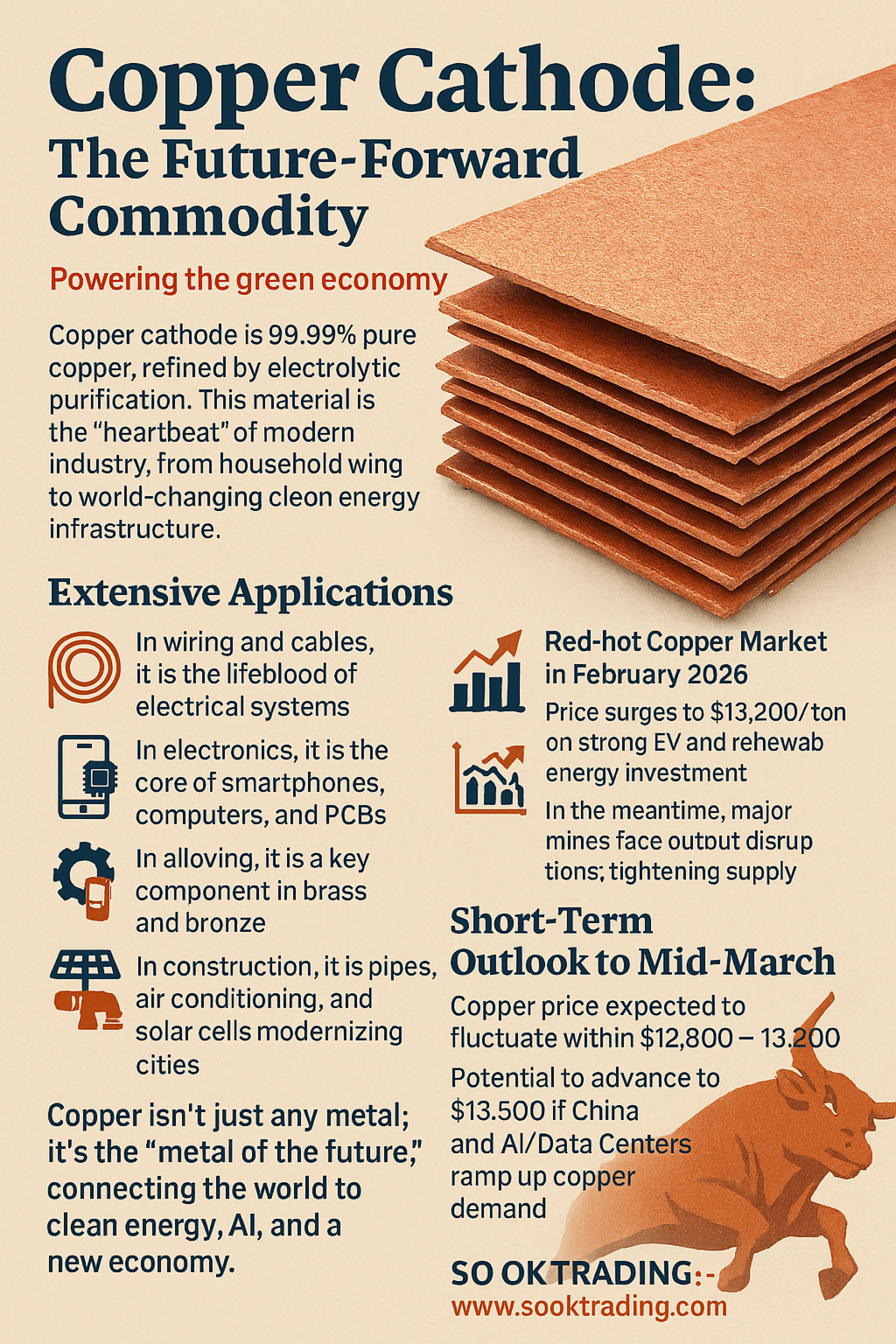
Copper Cathode: The Future Raw Material Driving the Green Economy
Copper cathode (Copper Cathode) is 99.99% pure copper refined through electrolytic purification. This material is not just an ordinary metal — it is the “heartbeat” of modern industry. From household wiring to clean energy infrastructure that is transforming the world, copper cathode is the starting point of it all.
Wide-Ranging Applications
Copper is the metal that connects the world:
In wires and cables, it is the lifeblood of electrical systems.
In electronics, it is the core of smartphones, computers, and PCBs.
In alloy production, it is a key component of brass and bronze.
In construction, it is used in pipes, air conditioning systems, and solar panels, modernizing cities.
Copper Market: February 2026 Heat
Copper prices on the LME surged to $13,200 per ton, marking the highest level of the year. Driving factors include demand from electric vehicles (EVs) — which use 3–4 times more copper than gasoline cars — and global investment in renewable energy infrastructure.
Meanwhile, supply remains tight. Major mines in Chile and Peru face production issues and strikes, limiting global supply. LME stocks stand at just 235,150 tons, accelerating price volatility.
Short-Term Outlook (Until Mid-March)
Copper prices are expected to move within the $12,800–13,200 range, with potential to test $13,500 if demand from China and AI/Data Centers rises simultaneously.
China, which consumes nearly half of the world’s copper, is resuming full-scale factory operations after the Lunar New Year, actively stocking copper for appliances and vehicles. At the same time, expanding AI data centers worldwide require massive amounts of copper for cooling systems and wiring, creating significant new demand.
Key Drivers and Risks
Drivers:
Supply Deficit: Market deficit projected at ~330,000 tons in 2026.
EVs & Green Energy: EVs use 3–4 times more copper than gasoline cars; renewable energy infrastructure continues to expand.
New Industry Demand: AI and data centers are emerging as powerful demand drivers.
Risks:
A strong US dollar could pressure commodity prices.
Uncertainty in US–China trade policy may trigger profit-taking.
First Half of 2026 Outlook
Analysts expect copper prices to reach $13,500–14,000 per ton by mid-year. Q2 will be a seasonal high driven by construction and air conditioning demand, while LME stocks are projected to fall to critical levels.
If the global economy slows sharply, prices could correct to $11,500–12,000. But under normal conditions, prices are expected to hold above $13,000, gradually rising with inflation and higher production costs.
Conclusion
Copper is not just any metal — it is the “metal of the future”, connecting the world to clean energy, AI, and the new economy. Prices at $13,200–13,500 represent a key resistance level; if broken, copper could surge toward $14,000 per ton.
➡ Market Analysis by SO OK TRADING
SO OK TRADING: Your Trusted Partner
In a volatile copper market with intense global competition, having a partner who truly understands the market is essential. SO OK TRADING is not only an expert in international trade but also has deep experience in minerals and raw materials.
If you are seeking raw materials such as copper, aluminum, lead, tin, and more, you can contact us directly:
www.sooktrading.com
sooktrading@outlook.com