Share

“The World After Lunar New Year: Strong Dollar, Rare Earth Shortages, and the Rise of AI” “From Tariff War to Resource War: The World of 2026 Will Never Be the Same” “Trump 2.0 Reshapes the Globe: When the Economy Turns Into a Battlefield"
Last updated: 19 Feb 2026
2072 Views

Global Economy in the Trump 2.0 Era: From Trade War to Resource War

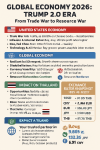
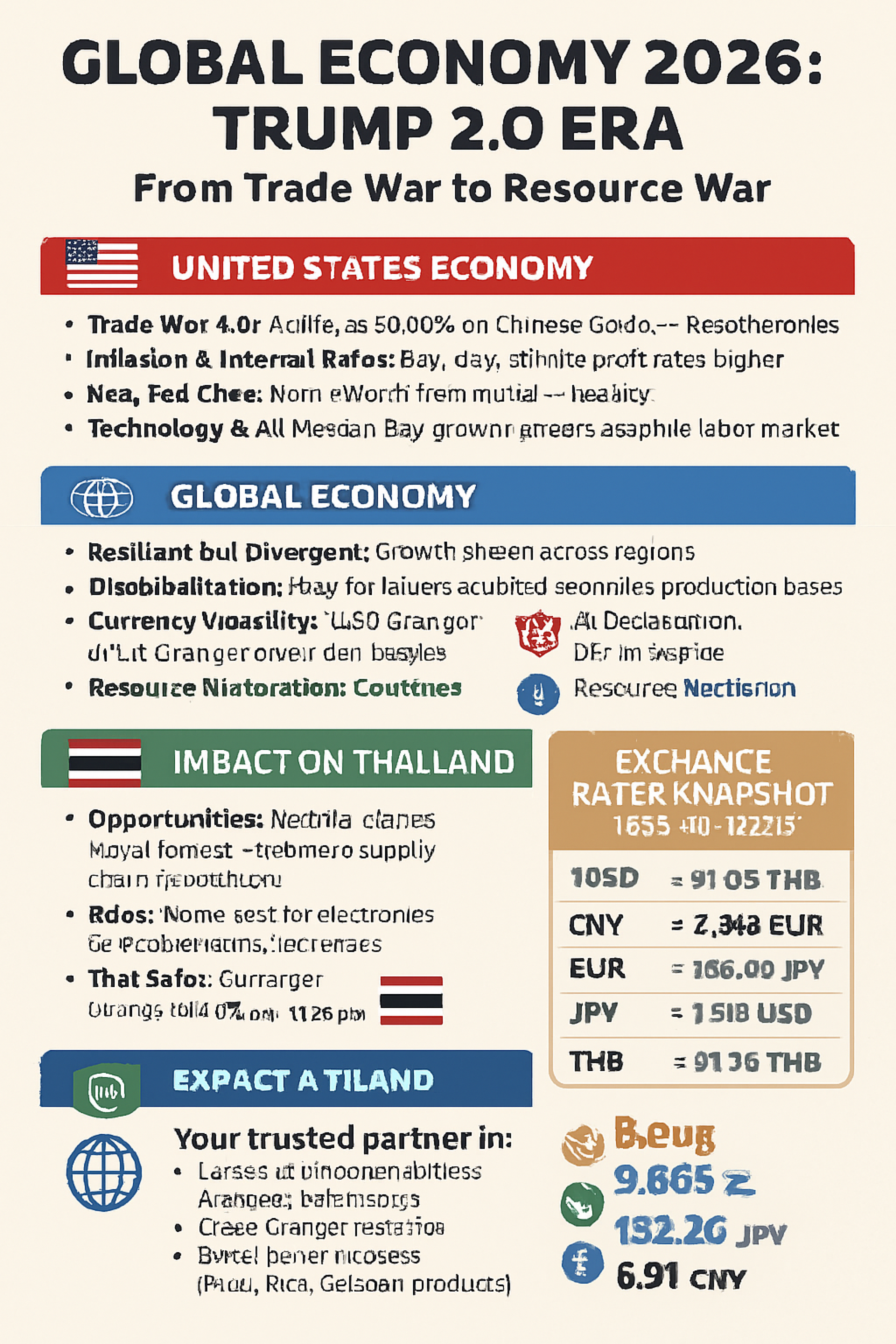
2026 is not just a year of transition—it marks the beginning of a new era of economic and resource conflict. Under President Donald Trump’s “America First” policy, the world is undergoing a profound transformation in trade, finance, and geopolitics.


U.S. Economy: Tariffs + New Fed Chair

Trade War 2.0: Tariffs up to 60% on Chinese goods → factories reshored, global import costs rising.
Inflation & Interest Rates: Domestic tax cuts + tariffs fuel inflation → Fed keeps interest rates higher for longer.
Fed Leadership Change: Kevin Warsh nominated; markets watch closely whether he remains “hawkish” or shifts to easing.
Labor Market & Technology: Hiring slows, but AI and advanced tech remain the main drivers of stock markets.
 

Global Economy: Resilient but Divergent

Global Trade Slowdown: Supply chains disrupted → countries accelerate relocation of production bases.
Currency Volatility: USD stronger short‑term, weaker mid‑term → EUR recovery potential, JPY under pressure, THB strengthening.
Geopolitical Tensions: Conflicts with China and oil producers push energy prices higher.
AI Investment Boom: Massive investments in AI across the U.S. and Europe help prevent a global recession.
 

⚔️ Resource Wars: Rare Earths, Battery Metals & Chips

Rare Earths: China controls 80% of supply, begins restricting exports.
Battery Metals: Lithium, cobalt, nickel → South America’s “Lithium Triangle” and Congo become diplomatic battlegrounds.
Semiconductor War: U.S. blocks China’s access to advanced chip technology → China stockpiles high‑tech raw materials.
Resource Nationalism: Countries hoard resources → commodity prices swing violently.
 

Impact on Thailand: Opportunities & Risks

Opportunities: Thailand could become a “midstream supply chain” hub if it maintains neutrality and attracts investment in mineral processing.
Risks: Rising raw material costs for electronics and automotive industries.
Currency: Thai Baht strengthens (31.00–31.50 per USD).
 

Exchange Rate Summary (Feb 2026)

USD: 1 USD ≈ 31.09 THB 0.845 EUR 153.26 JPY 6.91 CNY
CNY: 1 USD ≈ 6.91 CNY
EUR: 1 EUR ≈ 1.18 USD
JPY: 1 USD ≈ 153.26 JPY
THB: 1 USD ≈ 31.09 THB
 

Overall Summary

U.S. Economy: “America First” → high tariffs + Fed leadership change.
Global Economy: Entering a “survival of the fittest” era, with AI as the growth engine.
Currencies: USD strong short‑term, Thai Baht strengthening steadily.
Resource Wars: China dominates rare earths, U.S. seeks new sources → commodity prices highly volatile.
 

If you are interested in non‑ferrous commodities (copper, aluminum), clean energy resources, or agricultural exports (fruit, rice, cassava products),
SO OK TRADING is your trusted partner in global markets.

For more details:
www.sooktrading.com
sooktrading@outlook.com


Related Content
“Bio Mass Revolution: Wood Pellets Driving Clean Energy and Transforming Asia’s Industrial Future”
Bio Mass Wood Pellet: Clean Energy of the Future SO OK TRADING : 8 JUNE 2026 The world is accelerating toward Carbon Neutrality and reducing greenhouse gas emissions. In this transition, Wood Pellets (compressed biomass fuel) have evolved from being an “alternative fuel” to becoming a vital primary energy source across industries, power plants, and households. From industrial steam boilers and co-firing in power plants to residential heating in Europe and North America, Wood Pellets are emerging as the backbone of the new clean energy era. In Thailand, the market is still in its early stage but holds enormous potential. With abundant agricultural resources and production capacity, Thailand is well-positioned to become a key exporter — especially to Japan, where demand for high-quality Wood Pellets is rapidly increasing, supported by long-term contracts and strict sustainability standards. While South Korea’s market is slowing down, Japan has become the “new pillar” of Asia’s Wood Pellet industry, offering significant opportunities for Thai producers to expand and upgrade to international standards. The future of clean energy has already begun — and Wood Pellets are one of the essential keys driving the world toward sustainability
8 Jun 2026
REES Rare Earth Element, แร่หายาก คือ อะไรใช้งาน อะไร เกร็ดความรู้ รวมรวมโดย SO OK TRADING
แร่หายาก (Rare Earth Elements: REEs) คือกลุ่มธาตุโลหะ 17 ชนิดที่มีความสำคัญต่อเทคโนโลยีสมัยใหม่ (เช่น รถไฟฟ้า กังหันลม สมาร์ทโฟน) แม้ชื่อจะบอกว่า "หายาก" แต่จริงๆ แล้วมีอยู่ในโลก แต่กระจายตัวไม่เข้มข้นและแยกสกัดยาก ทำให้มีต้นทุนสูง และมักพบรวมกับแร่ธาตุอื่น ๆ เช่น แร่ดีบุก ทังสเตน และพบได้ในหลายประเทศ โดยเฉพาะจีนที่ครองตลาดใหญ่. แร่หายากคืออะไร? กลุ่มธาตุ 17 ชนิด: ประกอบด้วยธาตุในกลุ่มแลนทาไนด์ (Lanthanides) 15 ธาตุ + สแกนเดียม (Sc) และ อิตเทรียม (Y). ธาตุสำคัญ: ซีเรียม (Ce), นีโอไดเมียม (Nd), ยูโรเปียม (Eu), เทอร์เบียม (Tb). ทำไมถึงสำคัญ? ส่วนประกอบเทคโนโลยี: ใช้ทำแม่เหล็กกำลังสูง (รถยนต์ไฟฟ้า), สารเรืองแสง (LED), ตัวเร่งปฏิกิริยา (ลดมลพิษ), ไฟเบอร์ออปติก, เครื่อง MRI. พบได้ที่ไหน? กระจายทั่วโลก: แต่แหล่งที่พบมากและแปรรูปได้ง่ายมีไม่กี่แห่ง (เช่น จีน, เวียดนาม, บราซิล). ในไทย: พบกระจายทางภาคตะวันตก (เชียงราย, แม่ฮ่องสอน, กาญจนบุรี) มักปนกับแร่ดีบุกและทังสเตน. ความท้าทายในการทำเหมือง: ต้นทุนสูง และกระบวนการสกัดซับซ้อน ต้องใช้เทคโนโลยีสูง. ก่อให้เกิดมลพิษทางสิ่งแวดล้อมหากจัดการไม่ดี. ---------------
14 Dec 2025
“Recycled Copper: Thailand’s Green Economic Power — From Scrap to Billion-Dollar Opportunities on the Global Stage, with SO OK TRADING’s Market Outlook 2026–2035”
Copper — The Strategic Metal of the Clean Energy Era As the world accelerates its transition to renewable energy, electric vehicles, and digital technologies, copper has become the beating heart of the new global economy. From production and power transmission to the data centers driving AI worldwide, copper plays an indispensable role. Thailand is no exception — the copper recycling industry is growing rapidly, entering a Structural Uptrend with an average growth rate of 7.6% per year, and rising to become one of the Top 10 copper scrap exporters globally. ♻️ From Scrap to Global Business Opportunities Recycled copper not only reduces costs but also cuts carbon emissions by up to 85% compared to primary smelting. This directly supports global ESG and Net Zero standards. Thai smelters and businesses are adapting quickly, investing in clean technologies such as automatic wire stripping machines and advanced sorting systems like LIBS and Hyperspectral Imaging, to enhance purity and commercial value. ⚙️ The Global Market Enters a Supercycle Between 2026 and 2035, global copper prices are expected to surge, driven by demand from EVs, AI, data centers, and clean energy infrastructure. By 2035, prices are projected to exceed $15,000 per ton, fueled by supply shortages and massive investments in power grids worldwide.
31 Jul 2026
This website uses cookies for best user experience, to find out more you can go to our Privacy Policy and Cookies Policy
Powered By MakeWebEasy Logo MakeWebEasy