Share

China 2026: Rebalancing the World, Reshaping the Economic Game — Thailand Must Be Ready (Article by SO OK TRADING)
Last updated: 14 Feb 2026
833 Views

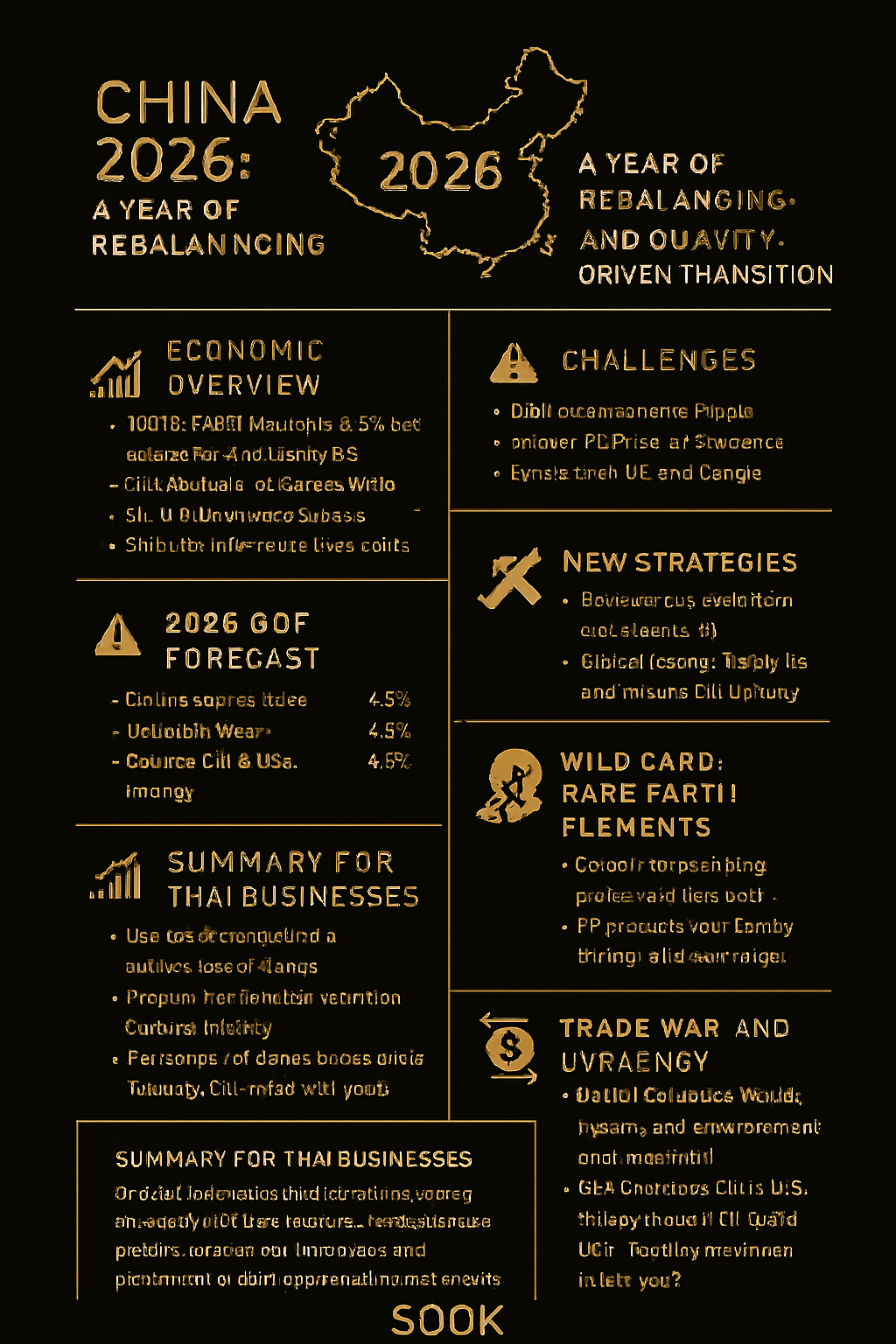
China 2026: A Year of Rebalancing and Quality-driven Transition

In 2026, China’s economy is moving into a new era of quality-driven growth. After achieving its 5% growth target in 2025, the country continues to face pressure from weak domestic consumption and foreign tariff measures.

Economic Overview

GDP 2025: Grew 5.0% overall, but slowed to 4.5% in Q4
Deflation: Producer Price Index (PPI) has declined for 40 consecutive months, reflecting sluggish domestic demand
Exports: The main growth engine, with a trade surplus reaching USD 1.19 trillion despite trade tensions with the U.S.
Stimulus Measures: The People’s Bank of China (PBoC) cut interest rates and subsidized loans to boost consumption
 

⚠️ Ongoing Challenges

Fragile real estate sector affecting household wealth
Intense EV price wars squeezing corporate profits
Tariff pressures from the U.S. and Europe
 

GDP Forecast for 2026

Chinese Government: May set a target below 5% for the first time in years
IMF: 4.5%
Goldman Sachs: 4.8% (optimistic outlook due to strong exports)
Reuters Poll & UBS: Average forecast of 4.5%
 

️ China’s New Strategies

Investment in semiconductors, clean energy, and AI
Focus on exporting high-margin products
Stimulating consumption in tourism and entertainment services
 

Impact on Thailand (Three Key Areas)

Tourism: Chinese tourists shifting from large group tours to FIT (Free Independent Travelers) → Opportunities for wellness hotels and restaurants leveraging digital marketing on Chinese platforms
Products & Manufacturing: Influx of cheap Chinese goods into Thailand → Pressure on Thai SMEs, but consumers benefit from lower prices
Investment: Export-related Thai stocks may fluctuate; Chinese equity funds should focus on high-tech and green energy sectors


Related Content
HNY 2026 with a First Analysis on Thai Baht Value
he Thai baht in Q1 2026 is expected to strengthen against the US dollar, driven primarily by a weaker dollar globally, a seasonal tourism boost, and expectations of US Federal Reserve rate cuts. This strength is occurring despite a weak domestic economic outlook and the Bank of Thailand's (BoT) likely continued easing of its policy rate. Exchange Rate Drivers and Forecast External Factors: The primary driver for the strengthening baht is external, mainly the broad weakness of the US dollar as global markets price in expected Fed rate cuts. The baht is also correlated with global gold prices, which have been climbing. Tourism High Season: The period extending into Q1 2026 is the high season for tourism, which typically brings in foreign currency and supports the baht's value. Policy Divergence: The BoT is expected to continue its easing cycle, potentially cutting the policy rate further to 1.00% by Q1 2026 to stimulate the sluggish domestic economy. This divergence from a potentially less aggressive US Fed in Q1 could support the baht in the short term, though some analysts warn the currency could weaken later in 2026. Forecasts: Projections for 2026 generally place the baht in a range of 30.80–33.00 per US dollar. Some models estimate it could trade around 31.06 by the end of Q1. A persistently strong baht below 31 per US$ is seen as a significant risk to the Thai export and tourism sectors. Key Economic Context Weak Growth: Thailand's economy is expected to slow down to a 5-year low growth rate of around 1.6-1.8% in 2026, pressured by US tariffs, global trade tensions, and high household debt. The central bank chief expects an improvement in Q1 2026 after a weak second half of 2025. Political Uncertainty: A general election expected in February 2026 could also introduce volatility, though some historical trends suggest the baht may strengthen following the formation of a new government. Low Inflation: Headline inflation is projected to remain subdued or even negative, providing the central bank with justification for further rate cuts to stimulate demand. In summary, Q1 2026 is characterized by a strong and volatile baht driven by external factors, contrasting sharply with a weak domestic economy and accommodative monetary policy.
1 Jan 2026
Trump 2.0: The Tariff Game Isn’t Over The Supreme Court halts global tariffs — but Trump strikes back instantly! Old tariffs are gone, new ones arrive: a fresh 10% global tariff kicks in on February 24, 2026. How much will this hit our wallets? Stay tuned
February 20, 2026 – The day “Global Tariffs” were halted by the U.S. Supreme Court But the game isn’t over… President Donald Trump strikes back with a brand-new 10% global tariff! Dollar weakens Gold surges Stock markets rebound Currencies swing worldwide Precious metals return as Safe Haven The full article by SO OK TRADING analyzes the impact on the global economy, currencies, equities, and safe-haven assets — plus strategies to navigate the coming era of High Volatility. Check out the English Infographic summary Interested in agricultural products, industrial goods, or clean energy fuels? Contact us directly: www.sooktrading.com sooktrading@outlook.com
21 Feb 2026
War • Oil • Dollar: Deep Dive into Thai Baht & Stock Market Q1 2026 and April Outlook in a High-Volatility Era Article by SO OK TRADING  April 1, 2026
Currency & Thai Stock Market: Q1 2026 Recap & April Outlook SO OK TRADING April 1, 2026 The Middle East conflict, a stronger U.S. dollar, and surging oil prices — in Q1 2026, both the Thai Baht and the Thai Stock Market faced heavy external pressures.
1 Apr 2026
This website uses cookies for best user experience, to find out more you can go to our Privacy Policy and Cookies Policy
Powered By MakeWebEasy Logo MakeWebEasy