Share

"Extraordinary Silver (Ag) – The Treasure of the AI & EV Era: Market News, Price Movements, and Investment Strategies by SOOK TRADING"
Last updated: 13 Feb 2026
1412 Views

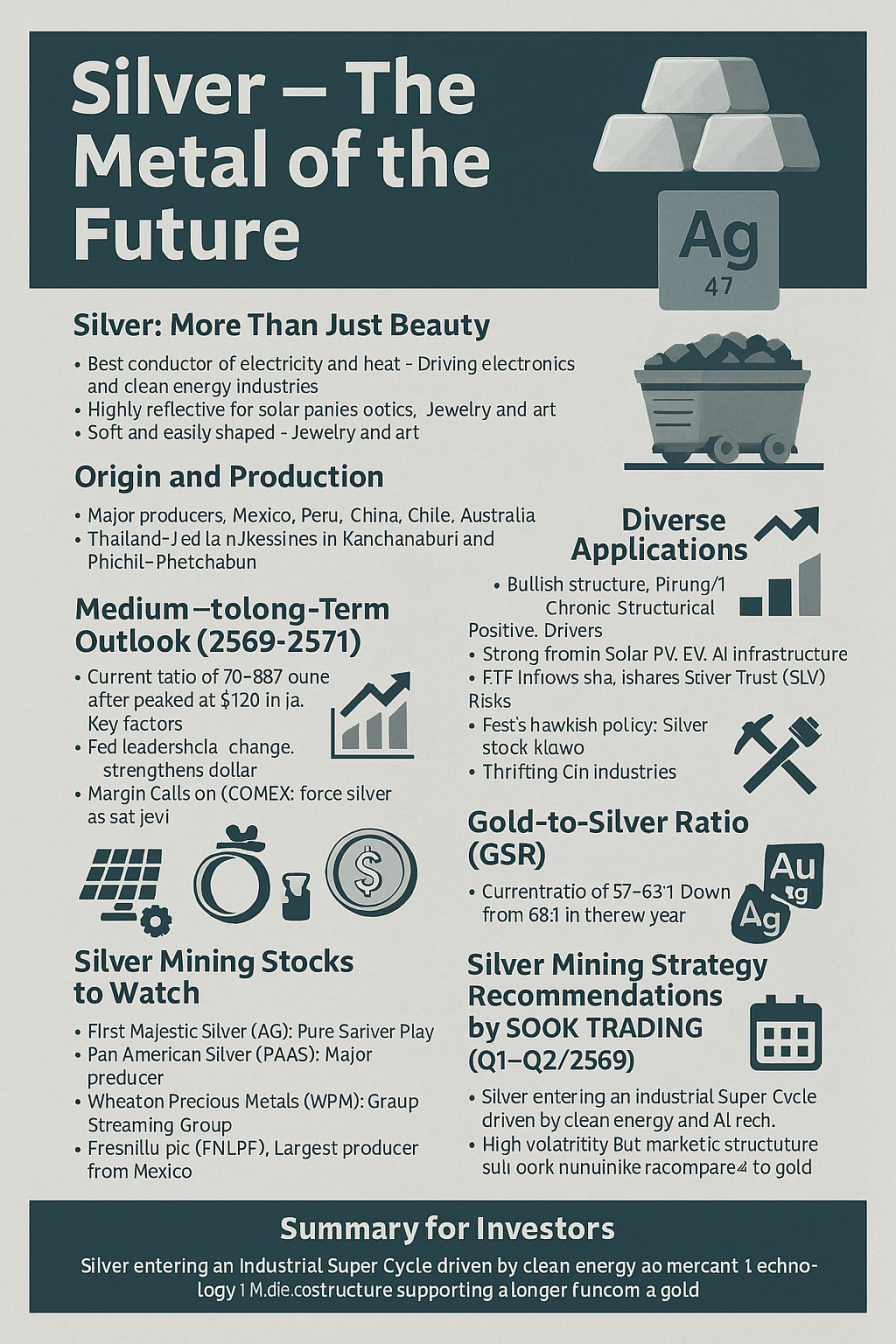
“Silver – The Metal of the Future”

Silver: More Than Just Beauty

Silver (Ag, atomic number 47) is not merely a shiny white precious metal used for jewelry — it has become a core element of the modern economy. Among all metals, silver stands out with unique properties:

Best electrical and thermal conductivity → Driving electronics and clean energy industries
High reflectivity → Essential for solar panels and optical devices
Soft and malleable → Perfect for jewelry and artistic creations
 

Occurrence and Major Sources

Found in compounds such as Argentite, often as a byproduct of lead, copper, and gold mining
Major producers: Mexico, Peru, China, Chile, Australia, Poland, Russia
In Thailand: Found mixed in lead mines (Kanchanaburi) and gold deposits (Phichit–Phetchabun)
 

Diverse Applications

Technology industries: Solar panels, electric vehicles, electronics, medical devices
Jewelry: 925 Sterling Silver (92.5% pure silver + 7.5% other metals)
Investment: Silver bullion, coins (e.g., American Silver Eagle)
Photography & chemistry: Used in film and developing solutions
 

Market Overview and Price (Feb 2026)

Silver prices fluctuated sharply between $70–85/oz, after peaking at $120 in January
Key factors:
Change of Fed Chair → Stronger US dollar
Strong US economic data → Lower expectations of rate cuts
Margin calls on COMEX → Forced investor sell-offs
Geopolitical tensions → Silver seen as a safe haven
Physical shortage → COMEX inventories below 100 million oz
 

Medium–Long Term Outlook (2026–2031)

Structural Bullish Trend: New price base at $65–70/oz
Positive Drivers:
Six consecutive years of structural deficit
Rising demand from Solar PV, EV, AI infrastructure
ETF inflows (e.g., iShares Silver Trust)
Risks:
Hawkish Fed policy → Stronger dollar
Industrial thrifting → Reduced silver usage
 

Gold-to-Silver Ratio (GSR)

Currently 57–63:1, down from over 85:1 last year
If it returns to historical levels of 40–50:1, silver could outperform gold
 

Silver Mining Stocks to Watch

First Majestic Silver (AG) – Pure silver play
Pan American Silver (PAAS) – Major global producer
Wheaton Precious Metals (WPM) – Streaming model company
Fresnillo plc (FNLPF) – Largest silver producer in Mexico
 

SOOK TRADING’s Investment Strategy (Q1–Q2 2026)

Short term (Q1): Watch for corrections after $121 peak → Support at $75–80
Medium term (Q2): Recovery driven by real demand in Solar PV and AI
Recommendation: February’s pullback is a buying opportunity, according to Goldman Sachs and Wells Fargo
 

Investor Summary

Silver is entering an Industrial Super-Cycle fueled by clean energy and AI technologies. Despite higher volatility compared to gold, the market structure supports a long-term upward trajectory.


About SOOK TRADING

For those seeking a trusted partner in exporting metals and clean energy from Thailand to the global market, SOOK TRADING is ready to collaborate.
We are not only exporters but also reliable suppliers, delivering high-quality raw materials from trusted sources to support your business growth.


Related Content
Supercycle 2026: The Day the World Buys Precious Metals: From Dollar Weakness to USA–IRAN Conflict: A Turning Point for the Global Commodity Market Analysis by SO OK TRADING
On January 29, 2026, the global metals and commodities market witnessed a historic moment. Gold, silver, copper, and aluminium all surged to new All-Time Highs, marking the onset of a powerful Supercycle. The rally was driven by multiple forces: the U.S. dollar falling to its lowest level in four years, escalating geopolitical tensions between the United States and Iran, China’s restrictive export policies, and booming demand from the EV and AI industries. SO OK TRADING identifies this extraordinary surge as a critical turning point for the global commodity market, offering insights into price movements and strategies for February 2026. While the bullish trend remains intact, overheating signals and correction risks are rising, requiring investors to stay vigilant and manage risk carefully. Despite at the night Gold went down from 5,600 USD/ONZ to 5,000 USD/ONZ LEVEL and Silver at went down from 122USD/ONZ to 115 USD/ONZ Level
30 Jan 2026
HNY 2026 with a First Analysis on Thai Baht Value
he Thai baht in Q1 2026 is expected to strengthen against the US dollar, driven primarily by a weaker dollar globally, a seasonal tourism boost, and expectations of US Federal Reserve rate cuts. This strength is occurring despite a weak domestic economic outlook and the Bank of Thailand's (BoT) likely continued easing of its policy rate. Exchange Rate Drivers and Forecast External Factors: The primary driver for the strengthening baht is external, mainly the broad weakness of the US dollar as global markets price in expected Fed rate cuts. The baht is also correlated with global gold prices, which have been climbing. Tourism High Season: The period extending into Q1 2026 is the high season for tourism, which typically brings in foreign currency and supports the baht's value. Policy Divergence: The BoT is expected to continue its easing cycle, potentially cutting the policy rate further to 1.00% by Q1 2026 to stimulate the sluggish domestic economy. This divergence from a potentially less aggressive US Fed in Q1 could support the baht in the short term, though some analysts warn the currency could weaken later in 2026. Forecasts: Projections for 2026 generally place the baht in a range of 30.80–33.00 per US dollar. Some models estimate it could trade around 31.06 by the end of Q1. A persistently strong baht below 31 per US$ is seen as a significant risk to the Thai export and tourism sectors. Key Economic Context Weak Growth: Thailand's economy is expected to slow down to a 5-year low growth rate of around 1.6-1.8% in 2026, pressured by US tariffs, global trade tensions, and high household debt. The central bank chief expects an improvement in Q1 2026 after a weak second half of 2025. Political Uncertainty: A general election expected in February 2026 could also introduce volatility, though some historical trends suggest the baht may strengthen following the formation of a new government. Low Inflation: Headline inflation is projected to remain subdued or even negative, providing the central bank with justification for further rate cuts to stimulate demand. In summary, Q1 2026 is characterized by a strong and volatile baht driven by external factors, contrasting sharply with a weak domestic economy and accommodative monetary policy.
1 Jan 2026
This website uses cookies for best user experience, to find out more you can go to our Privacy Policy and Cookies Policy
Powered By MakeWebEasy Logo MakeWebEasy