Share

Breaking Barriers: Gold’s $5,000 Milestone & Global Outlook
Last updated: 12 Feb 2026
1471 Views

Gold Breaks $5,000 – Entering a Major Bullish Cycle

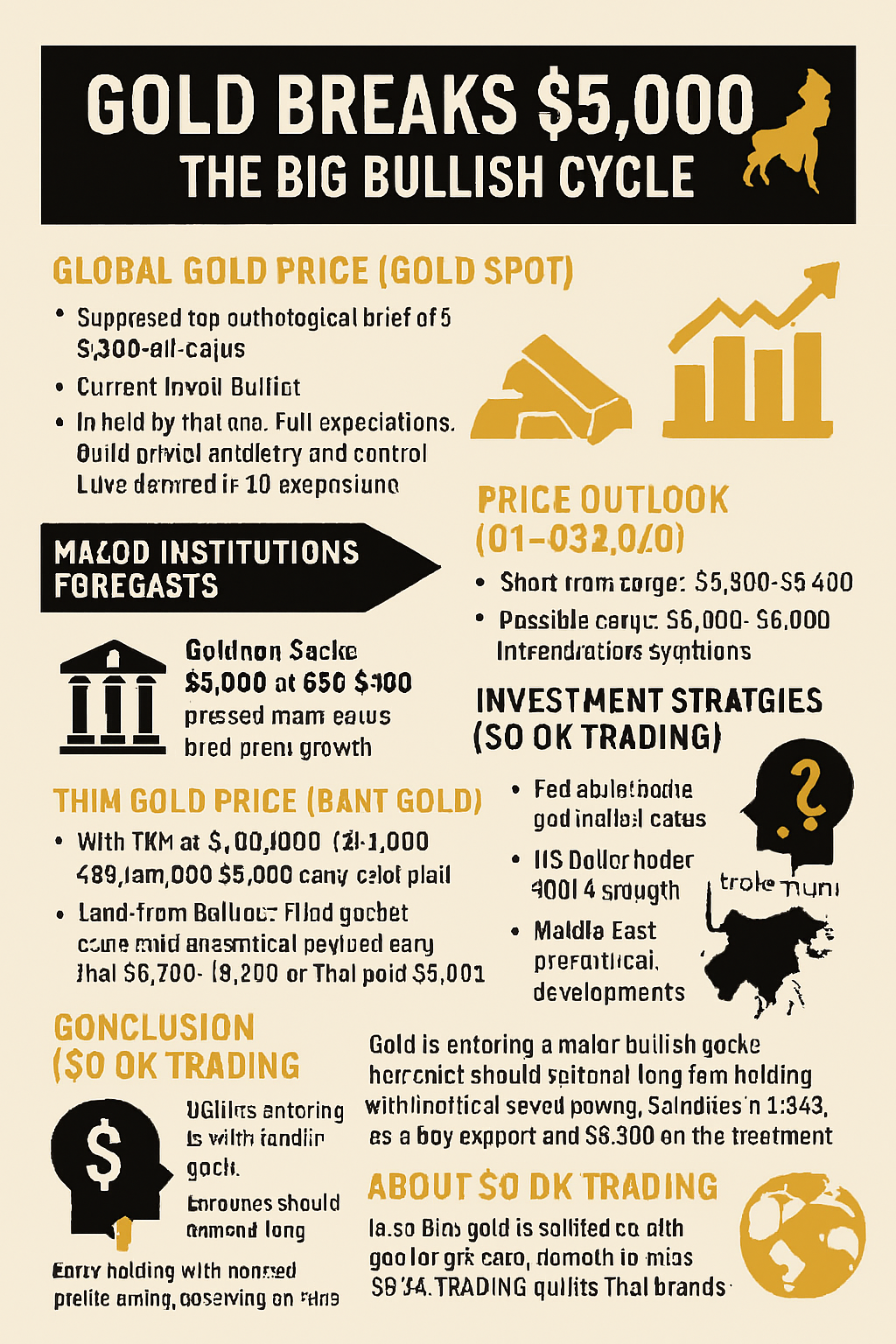
The global gold price (Gold Spot) has shaken financial markets worldwide after surpassing the psychological threshold of $5,000 per ounce. The trend remains firmly bullish, supported by expectations of Federal Reserve rate cuts, ongoing geopolitical tensions, and sustained central bank buying — with China continuing purchases for the 15th consecutive month.


Global Gold Price Outlook (Q1–Q2 2026)

Q1 2026:
Short-term targets are set at $5,300–$5,400. If gold breaks through key resistance levels, it could surge further to $5,500–$6,000.

Q2 2026:
Major financial institutions have raised their forecasts:

Goldman Sachs: $5,500–$5,800, citing strong central bank demand despite high prices.
J.P. Morgan: $6,000–$6,300, driven by persistent inflation and falling interest rates.
UBS: $6,200, viewing gold as “insurance” against stock market volatility.
Citi: $5,300 in the short term, expecting a correction before climbing to $6,000.
Standard Chartered: $5,500, emphasizing political uncertainty in the US and Europe.
 

Thai Gold Price (Baht Gold)

With the exchange rate steady at 31.00 THB/USD, Thai gold bars are expected to trade between ฿74,500–฿80,300 depending on global price levels. If the baht strengthens below 31.00, domestic gold prices may rise more slowly than global prices, making Bank of Thailand policy a critical factor to watch.


Investment Strategies (By SO OK TRADING)

Short-term traders (Trading):
Focus on buying dips near $5,000–$5,050, with a stop-loss set below $4,950.

Long-term investors (Holding):
Continue holding positions as global interest rates remain in a downward cycle. However, partial profit-taking is advised if gold surpasses $5,400–$5,500 or if Thai gold reaches ฿80,000, to hedge against correction risks.


Key Signals to Watch

Fed statements: Delays in rate cuts could trigger sharp corrections.
US Dollar Index (DXY): A stronger dollar would pressure gold prices.
Middle East geopolitics: Temporary ceasefire news could spark short-term profit-taking.
 

SO OK TRADING Insight

Gold has entered a major bullish cycle. Investors should balance long-term holding with tactical profit-taking, keeping $5,000 as a key support level and $5,500 as the next resistance to guide trading strategies effectively.


Related Content
“Recycled Lead Ingot: From Scrap Batteries to Clean Energy — The Pillar of Circular Economy and the Power of a Sustainable Future” Article by SO OK TRADING – March 14, 2026
♻️ Recycled Lead Ingot: The Circular Metal the World Still Relies On Often seen as an “old metal,” recycled lead ingot is in fact becoming the backbone of the circular economy, powering industries from batteries and automobiles to data centers and renewable energy worldwide.
14 Mar 2026
Silver Market After Chinese New Year: Correction Is Not the End — Silver 2026: From Sharp Drop to Base Building and Rebound — From $114 to $73, the Pause Before the Next Rally
Silver Market Overview After Chinese New Year 2026 From the peak of $114/oz to a sharp correction at $73.65/oz (Feb 17) — the market is now building a new base for recovery. SO OK TRADING Analysis: Short-term pressures vs. long-term supports, key support/resistance levels, and investment strategies. - Accumulate on dips - Stop Loss: $71 - Target: $82–85
18 Feb 2026
ALUMINUM PRICE TREND 2026
An analysis of the aluminum market in 2026 indicates a likely continued market deficit and upward price pressure, driven by constrained supply and resilient demand from green energy sectors. However, significant volatility is expected due to policy uncertainties and the potential for new Indonesian supply to eventually balance the market. Key Drivers and Projections for 2026 Supply Side Analysis Capacity Constraints: China's primary aluminum output is approaching its self-imposed 45 million-tonne capacity cap, limiting global supply growth. Power Challenges: Smelters outside of China face intense competition for power from energy-intensive sectors like AI data centers, which are willing to pay higher prices for long-term contracts. This has kept significant capacity offline in Europe and the US. Production Disruptions: Outages and potential shutdowns at existing smelters in Iceland and Mozambique further tighten the market. Scrap Supply Pressure: The EU's planned implementation of the Carbon Border Adjustment Mechanism (CBAM) and potential scrap export tariffs in spring 2026 are expected to impact global scrap flows, creating regional shortages and price volatility. New Capacity: Indonesia is a key source of new supply, with several projects in the pipeline. However, analysts suggest the pace of the ramp-up may be slower than expected due to infrastructure and policy challenges, meaning it is unlikely to fully offset near-term tightness. Demand Side Analysis Green Transition Demand: Demand from "green" sectors such as solar panels, new energy vehicles, and energy transition infrastructure remains strong, providing fundamental support for the market. Substitution Effect: Aluminum's wide price discount relative to copper has encouraged substitution in electrical applications, acting as a tailwind for demand and prices. Construction and Automotive: The construction and automotive industries continue to be major consumers, with growing demand for lightweight, low-carbon aluminum products. Price Forecasts and Volatility The market is expected to remain in a deficit in 2026, with estimates ranging from 200,000 to 600,000 tonnes. This structural tightness is leading most analysts to forecast sustained or rising prices. Bullish Views: Analysts at Bank of America project prices of $3,000/tonne as early as 2026. J.P. Morgan also expects prices to approach $3,000/tonne in Q1 2026. ING forecasts an average price of $2,900/tonne for the year. Bearish/Conservative Views: Goldman Sachs is an outlier, forecasting prices to decline to $2,350/tonne by Q4 2026, anticipating a market surplus later in the year. SMM forecasts a "high first, then lower" pattern, with prices finding equilibrium in the $2,700–$2,800/tonne range by year-end. Premiums: Regional premiums, particularly the US Midwest premium, are expected to remain high and volatile due to tariffs and regional supply dynamics, creating a disconnect from the LME benchmark price. In essence, 2026 is projected to be a year of high volatility where participants need to focus on scenario readiness rather than relying on a single price forecast, as geopolitical and energy policies significantly influence regional supply and costs
31 Dec 2025
This website uses cookies for best user experience, to find out more you can go to our Privacy Policy and Cookies Policy
Powered By MakeWebEasy Logo MakeWebEasy