“Wood Pellets: From Waste to Future Energy — From Husk to Kilowatt, Thai Pellets Turn Residues into Value” Article by SO OK TRADING
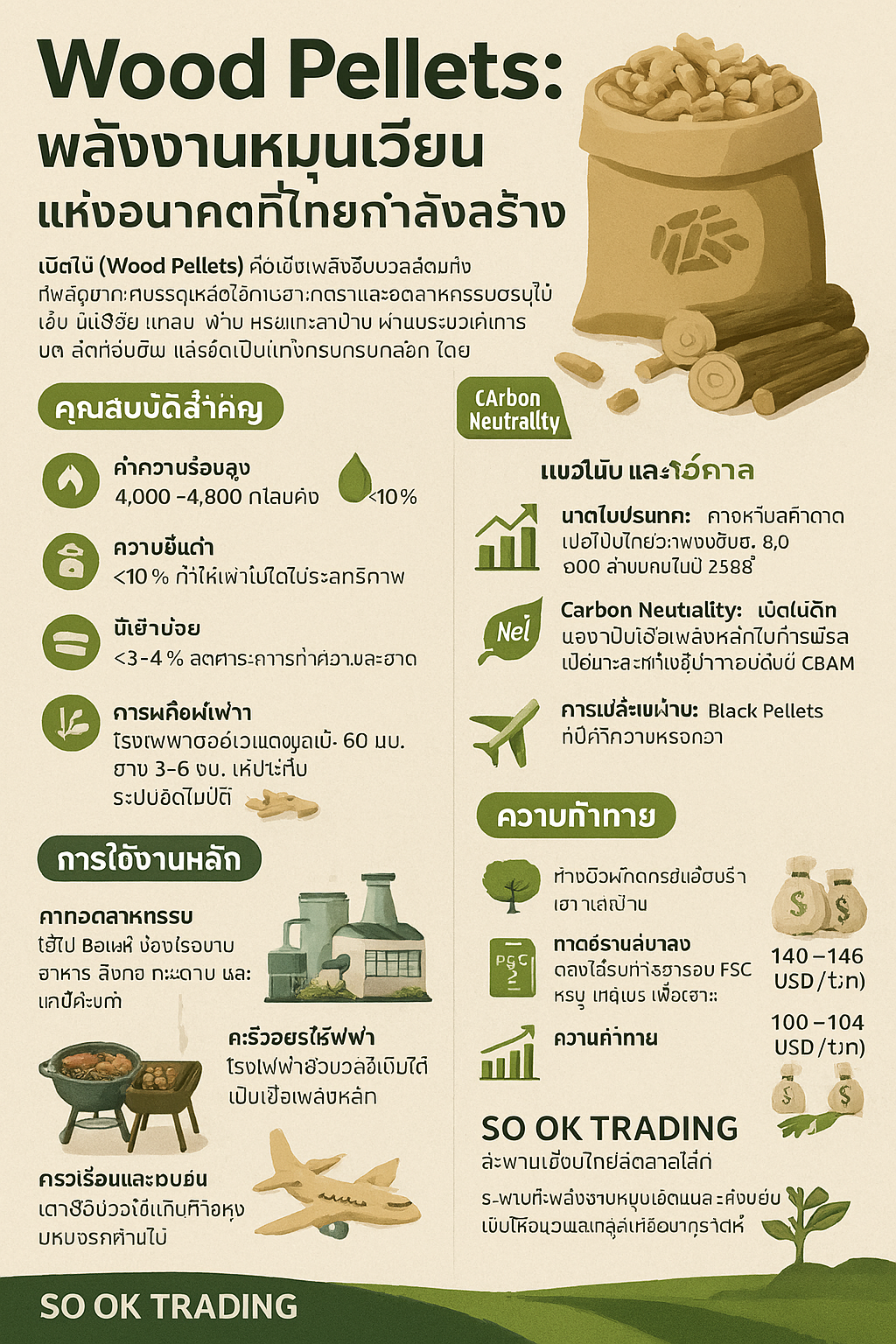
Wood Pellets: The Future of Renewable Energy Thailand is Building
Wood Pellets are biomass fuel made from agricultural and forestry residues such as sawdust, rice husks, straw, or palm shells. These materials are crushed, dried, and compressed into cylindrical pellets, with natural lignin acting as a binder. The result is a fuel with high calorific value, low moisture, low ash content, and consistent size.
This is why wood pellets are seen as the “star” of renewable energy in an era where the world is moving toward Carbon Neutrality and Net Zero.
Key Properties
High calorific value: 4,000–4,300 kcal/kg
Low moisture: <10%, ensuring efficient and stable combustion
Low ash content: <3–4%, reducing cleaning requirements
Standard size: Diameter 6–10 mm, length 3–6 cm, suitable for automated systems
⚙️ Main Applications
Industrial Use: Boilers in food, textile, paper, and chemical industries, replacing fossil fuels like coal and fuel oil
Power Generation: Biomass power plants and co-firing with coal (e.g., Mae Moh power plant in Thailand)
Residential & Community: Biomass stoves, pellet grills for barbecue and smoking, animal bedding
Export: Thailand is a major producer in ASEAN, with Japan and South Korea as key markets
Trends and Opportunities
Domestic Market: Expected to reach 8 billion THB by 2025, up from 1.3 billion THB in 2021
Carbon Neutrality: Considered a key fuel for achieving Net Zero by 2065
Fuel Transition: Large factories shifting from fossil fuels to wood pellets, responding to EU CBAM measures
Innovation: Development of Black Pellets with higher calorific value and moisture resistance, nearly 100% coal replacement
Export Growth: South Korea accounts for 80% of Thai exports, with Japan’s demand steadily increasing
⚠️ Challenges
Raw Material Supply: Ensuring sufficient rubber wood, fast-growing trees, and agricultural residues
International Standards: FSC or ENplus certification required for entry into Japanese and European markets
Competition: Competing with Vietnam, a major exporter with lower production costs
Price Volatility: Japan pays higher (140–146 USD/ton) compared to South Korea (100–104 USD/ton) due to stricter quality standards
SO OK TRADING: The Bridge Connecting Thailand to Global Markets
In an era where renewable energy and sustainability are at the heart of the global economy, SO OK TRADING stands as a trusted exporter of premium Thai products — from high-quality fruits and rice to metals and clean energy such as wood pellets