Thailand’s Economy After the Election: On the Path of Recovery and Risk — SO OK TRADING Insight: A Global Perspective
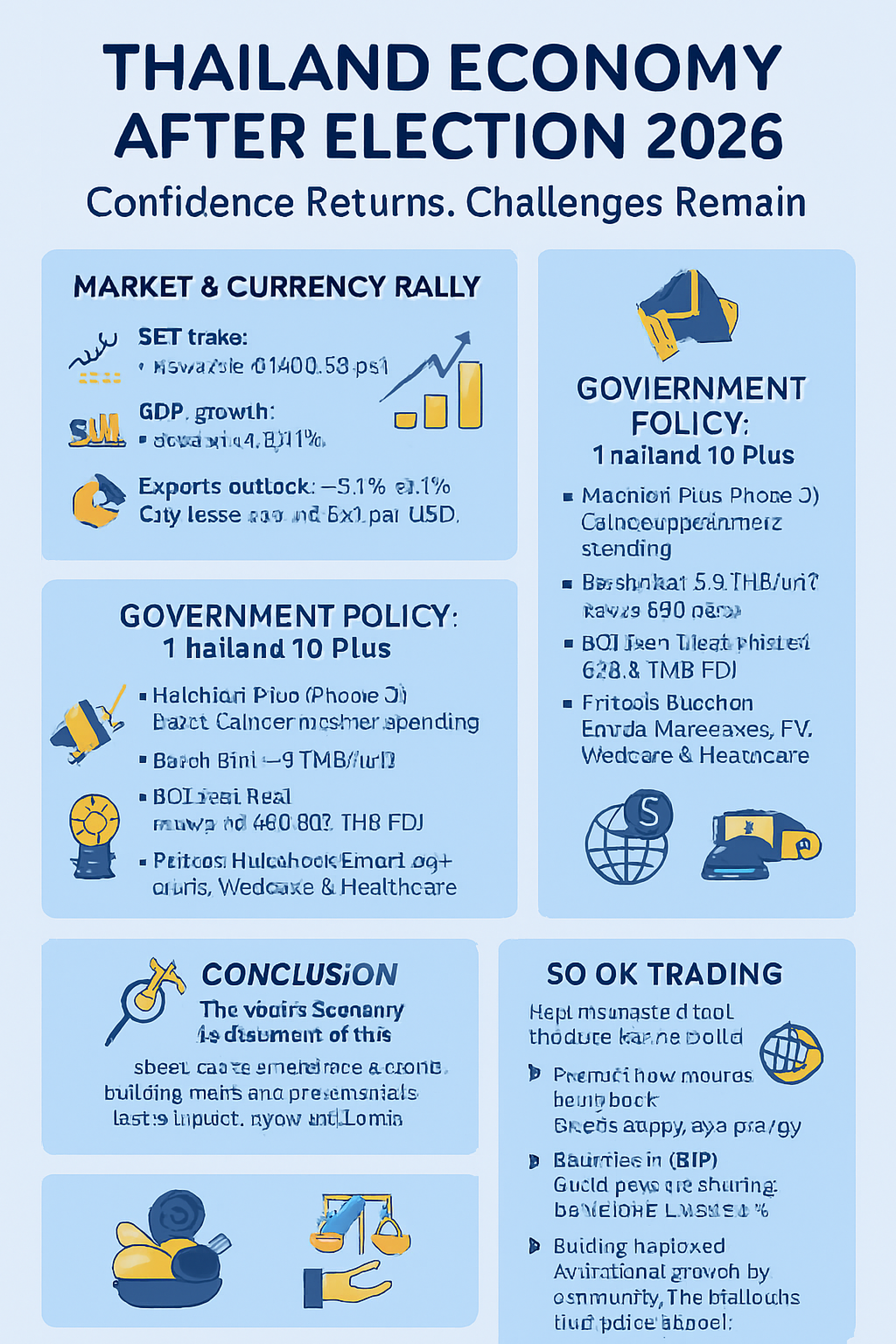
Thailand’s Economy After the 2026 Election: Confidence Returns, Major Challenges Await
The general election in February 2026 was not merely a political event; it became a turning point that instantly boosted confidence in Thailand’s economy, while also exposing deep structural issues that demand urgent reform.
Capital Market & Thai Baht: Post-Election Rally
SET Index surged: On the first trading day after the election, the Thai stock market jumped 46 points (+3.46%), closing at 1,400.89 — higher than the average post-election rally in the past.
Political-linked stocks soared: Infrastructure-related stocks such as STECON rose more than 16%, reflecting expectations of accelerated public investment projects.
Baht appreciation: The currency opened at 31.42 per USD, strengthening immediately due to foreign capital inflows and renewed confidence in political stability.
GDP & Exports: Fragile Recovery
GDP growth forecast: 2026 is expected to grow only 1.2%–2.2%, below potential and slower than 2025.
Exports outlook: The Ministry of Commerce projects a possible contraction of up to -3.1%, pressured by U.S. trade barriers under Trump 2.0 and weakening global demand.
Key challenges: Electronics and automotive industries face heavy impacts from trade wars, while cheap imports from China continue to challenge Thai producers.
️ New Government Policy: Thailand 10 Plus
Grassroots stimulus: “Half-Half Plus, Phase 2” to support SMEs and consumers.
Lower living costs: Electricity capped at 3 THB/unit for the first 200 units.
FDI attraction: BOI Fast Pass aims to draw over 480 billion THB in foreign investment.
Future industries: Smart Agriculture, EV, Wellness & Healthcare as new economic pillars.
Global Perspective: Short-Term Confidence, Long-Term Doubts
Financial institutions: Citi and UBS see stronger stability, predicting fund inflows.
Credit ratings: S&P maintains BBB+ “Stable,” while Moody’s and Fitch remain cautious about fiscal discipline.
Foreign media: Financial Times still labels Thailand the “Sick Man of Asia,” citing high household debt (nearly 90% of GDP), aging society, and declining competitiveness compared to Vietnam.
Diplomacy: The new government is expected to balance relations between the U.S. and China, while playing a role in the Myanmar crisis.
Conclusion: Recovery on Risk
Thailand’s post-election economy is buoyed by political confidence and stimulus measures, yet faces external pressures and internal structural challenges. If short-term momentum can be transformed into reform-driven energy, Thailand has the potential to reclaim its position as a strong economic hub in the region.
SO OK TRADING: Thailand’s Gateway to the World
In an era filled with challenges and opportunities, SO OK TRADING stands as a pioneer in exporting premium Thai products — from high-quality fruits and Thai rice to metals and clean energy.